- Construction recovery could trigger selective restocking in coming weeks
- Uncertainty emerges over continuation of UAE scrap export restrictions
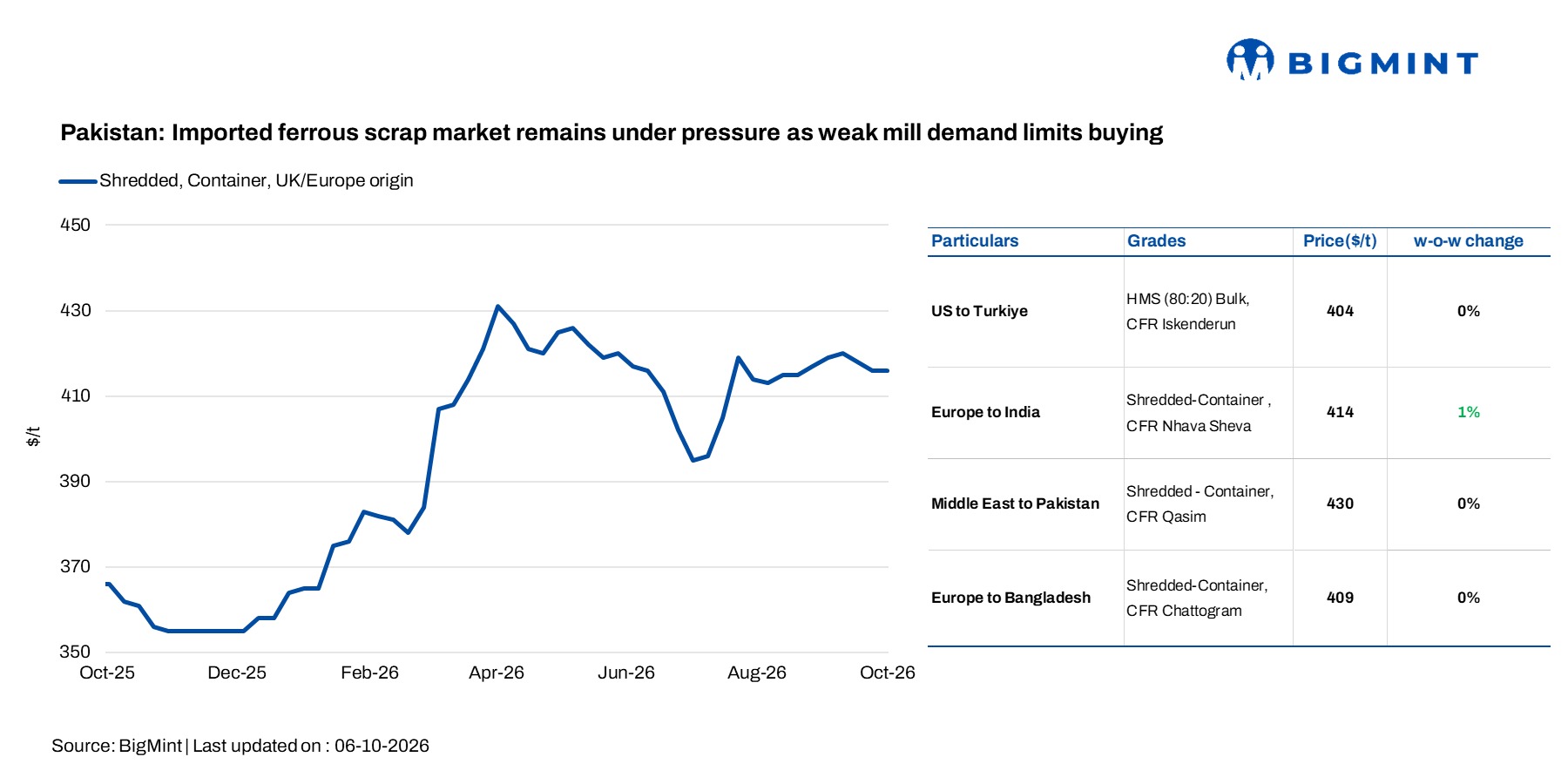
Pakistan’s imported ferrous scrap market remained subdued during the week ending on 6 October, with weak finished steel demand, low mill utilisation and cautious procurement limiting import activity. Buyers continued to resist higher offers, keeping the market under pressure despite firm international prices and elevated freight costs from Europe.
European shredded scrap offers were heard at around $418-422/t CFR Qasim, while buyers were targeting around $415/t. Middle Eastern HMS sheared was heard at $410-412/t CFR Qasim, while offers were around $415/t.
BigMint assessed Europe-origin shredded scrap at $416/t CFR Qasim, stable w-o-w. Market participants said, “Demand remained slow and stagnant, with mills reluctant to build inventories amid weak finished steel sales.”
Recent trades
- 4,000 t UK-origin shredded scrap booked at $422-427/t CFR Qasim.
- 1,000-1,500 t UK-origin premium-yard shredded scrap sold at $427/t CFR Qasim.
- 1,000 t Brazilian sheared HMS sold at $392/t CFR Qasim.
- 2000 t UK-origin shredded scrap booked at $412-415/t CFR Qasim.
- 1000 t US-origin shredded scrap booked at $405 CFR Qasim.
A Karachi-based steelmaker said, “The court has temporarily halted the recovery of the new tax, so the situation remains uncertain. The stay could continue for another 10-12 months, or the court could lift it within the next couple of months. The scrap market is weak, with only limited inquiries and bookings. Shredded is offered around $420/t CFR Qasim and HMS around $390/t CFR, but we are not booking at these levels. Mill operations remain dull at around 35%.”
A European scrap trader said, “The imported scrap market remained slow, with prices trending down to stable levels. Buying activity was largely limited to approved yards, while non-approved yards were unable to participate actively in the market.”
A Peshawar-based steel mill said, “I think the UAE will remove the export restrictions after 8 October, as yards there are carrying excessive scrap inventories while domestic consumption remains limited. We have not booked any cargoes due to high import prices. There is some movement in the local market, but mill-side activity remains dull.”
A UAE-based international trader said, “Freight and logistics remain key considerations. Tight container availability in the UK and Europe has led to some bookings being cancelled or delayed. Freight from the UK to Qasim was heard at around $1,900-2,100, raising delivered costs and limiting sellers’ flexibility. Premium-yard material continued to command higher prices, although buyers remained reluctant to chase elevated offers.”
Domestic market
Pakistan’s domestic steel market remained weak, with mills operating at around 30-35% utilisation. Domestic scrap prices were at PKR 133,000-135,000/t ($480-488/t), while billet was assessed at PKR 213,000-215,000/t ($769-776/t) and rebar at PKR 232,000-235,000/t ($838-849/t).
Weak finished-steel demand and subdued construction activity continued to limit mills’ incentive to build large scrap inventories. The market is also facing uncertainty over the sales tax on electricity bills.

As per a Karachi-based steel mill source, steel units have challenged the tax, which remains adjustable against final tax liability. Courts in Islamabad and Peshawar have issued stay orders; the Peshawar case is under consideration, and the Islamabad High Court hearing is scheduled for 20 October 2026. The outcome could influence mills’ operating costs and scrap procurement decisions.
Outlook
Pakistan’s scrap market is likely to remain subdued and buyer-driven in the coming days. Weak finished-steel demand and low mill utilisation will limit restocking, while high freight and tight container availability will keep imported scrap replacement costs elevated.
The upcoming construction season could improve steel demand and trigger selective restocking. However, a sustained recovery in domestic steel demand and mill operating rates will be needed to support higher scrap prices. Until then, mills are expected to remain price-sensitive and focus on competitively priced cargoes.
Leave a Reply