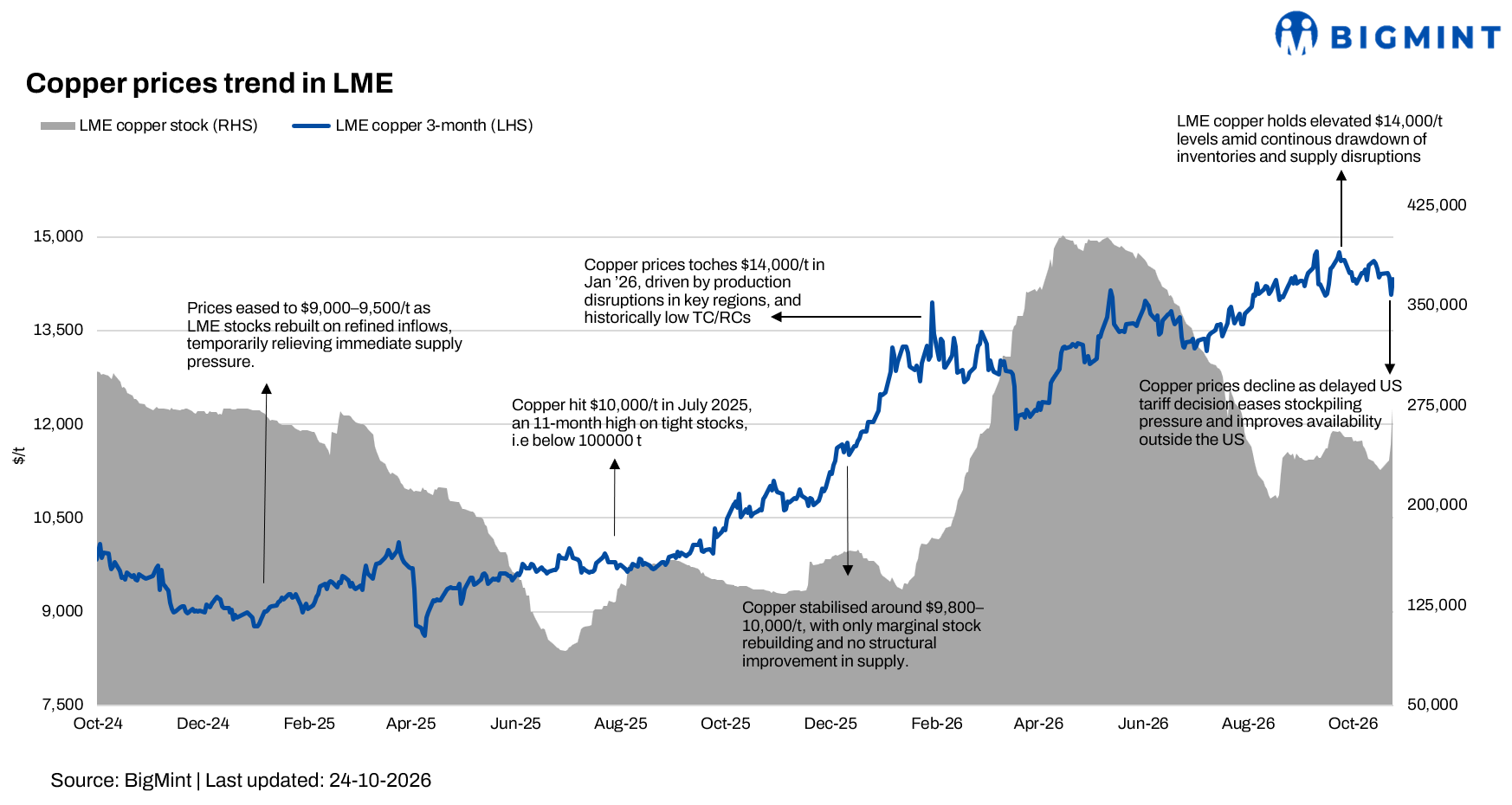
- LME copper inventories climb sharply as US warehouse inflows ease immediate supply concerns
- Indian cathode and brass scrap prices decline amid cautious buying and weaker market sentiment
Global copper markets weakened during the week ended 23 October 2026 as rising exchange inventories and cautious investor sentiment weighed on prices. According to the supplied weekly assessment, LME three-month copper declined 0.6% w-o-w to $14,322/t from $14,407/t. Meanwhile, LME inventories increased 20.4% to 272,950 t from 226,600 t, adding to concerns over near-term market availability. Fresh warehouse inflows, particularly in the US, eased immediate supply concerns despite persistent regional supply constraints.
In India, copper cathode and brass honey scrap prices declined as buyers delayed purchases amid expectations of further corrections. Elevated import premiums continued to restrict sourcing flexibility, while weak demand and wider bid-offer gaps limited scrap transactions. However, record European copper premiums highlighted continued tightness in regional physical supply. Mitsubishi’s investment in the Copper World project in Arizona also reinforced the longer-term push to strengthen US domestic copper supply.
Domestic copper and scrap markets remain under pressure
India’s copper cathode market weakened during the week ended 22 October as lower international benchmarks and cautious spot demand pressured prices. According to BigMint’s assessment, ex-Ahmedabad copper cathode prices declined by INR 32,000/t, or 2.29% w-o-w, to INR 1,368,000/t. Ex-Mumbai prices fell by INR 31,000/t, or 2.22%, to INR 1,366,000/t. Primary copper CC wire rod (CCR) prices, ex-Delhi, decreased by INR 40,000/t, or 2.75%, to INR 1,415,000/t.
MCX copper also weakened, falling to INR 1,378,350/t from INR 1,402,300/t, a decline of approximately 1.71%. Lower futures prices reinforced expectations of further corrections, prompting buyers to delay purchases and prioritise immediate requirements. Meanwhile, sellers remained cautious about reducing offers against inventories purchased at higher prices.
Elevated import premiums further restricted buying flexibility. Japanese Grade A cathode premiums were reported at around $310-320/t CIF Nhava Sheva on 21 October. This kept imported material relatively expensive despite softer international benchmarks. Scheduled maintenance at Japanese facilities in November could also constrain availability as post-monsoon demand improves. Consequently, domestic buyers continued to weigh benchmark movements against premiums and additional landing costs before committing to imports.
India’s brass honey scrap market also weakened during the week ended 23 October. BigMint assessed Jamnagar prices at INR 895,000/t, down from INR 940,000/t in the previous week. Lower copper benchmarks and rising inventories reinforced bearish sentiment, while discounts reached INR 510/kg in Jamnagar and up to INR 15/kg in Delhi and other western markets.
However, sellers remained reluctant to accept lower bids, limiting transactions despite weaker demand. Buyers continued to seek more competitive offers and avoided building inventories amid expectations of further price corrections. Diwali-related restocking could temporarily improve activity, although the extent of any recovery will depend on consumption and price stability.
Global scrap-trade developments added to sourcing uncertainty. China’s copper scrap imports rose 33.4% month on month (m-o-m) to 236,600 t in September, while January-September imports increased 10.3% year on year (y-o-y) to 2.4 million tonnes. Stronger Chinese buying could intensify competition for exportable scrap. Meanwhile, proposed European restrictions on certain metal-scrap exports to non-OECD destinations and Thailand’s proposed scrap-import ban could alter regional trade flows. Their eventual impact on Indian availability will depend on the final regulatory measures and changes in supplier offers.
Rising exchange inventories contrast with regional supply tightness
Global copper markets faced diverging signals as rising exchange stocks eased immediate availability concerns, while supply constraints continued to support physical premiums. LME inventories reached 272,950 t on 22 October, their highest level since July, following substantial inflows into US warehouses. Around 62% of LME stocks were held in the US, with New Orleans accounting for much of the recent increase. The build followed a narrowing COMEX-LME price differential, which reduced the incentive to move additional metal towards the US market.
The International Copper Study Group (ICSG) nevertheless expects the refined copper market to remain in surplus through 2027. Its October forecast projects a surplus of around 104,000 t in 2026, widening to 368,000 t in 2027. Global mine production is expected to grow by 1.3% in 2026 and 3.1% in 2027, while refined production is forecast to rise by 0.4% and 3.4%, respectively. Refined copper usage is expected to increase by 1.5% in 2026 and 2.5% in 2027.
The projected increase in refined output reflects new smelting and refining capacity in Indonesia, India and the European Union, alongside higher secondary production from scrap. However, concentrate availability remains a constraint for smelters, while operational challenges at major mines could limit production growth. The outlook therefore points to a potential refined-metal surplus without eliminating regional shortages or pressure on smelting margins.
Regional supply tightness drives premiums as US copper projects advance
Codelco raised its 2027 European copper cathode premium to a record $350/t from $325/t, while Aurubis increased its offer to $347/t from $315/t. US stockpiling, mine disruptions and limited concentrate availability have tightened regional supply, prompting producers to seek higher premiums despite the International Copper Study Group’s projected refined copper surplus in 2027. The final impact will depend on contract negotiations and regional metal availability.
Meanwhile, Mitsubishi Corporation and Hudbay Minerals approved the development of the $1.023 billion Copper World project in Arizona. Mitsubishi’s total expected investment includes an additional $423 million commitment, while first production is targeted for H2 2029. The project is expected to produce around 100,000 t of copper annually over a 15-year mine life. It will strengthen long-term US domestic supply prospects, although it is unlikely to ease immediate market tightness.
Outlook
Copper markets are likely to remain volatile as rising LME inventories and expectations of higher refined output weigh against regional supply constraints. Further warehouse inflows could keep benchmark prices under pressure, although mine disruptions and elevated physical premiums may limit downside in some markets. The ICSG’s projected surplus for 2027 could temper longer-term price expectations, but its realisation will depend on mine performance, concentrate availability and refinery output.
In India, copper cathode prices may remain under pressure if MCX and LME benchmarks weaken further. However, elevated Japanese premiums and potential maintenance-related supply constraints could limit reductions in import costs. Brass honey scrap trading is also likely to remain subdued amid weak consumption, cautious procurement and persistent bid-offer gaps. Diwali restocking may provide temporary support, while changes in international scrap trade flows could affect availability over the longer term. Market direction will depend on exchange inventories, Chinese demand, regional premiums and domestic buying activity.
Leave a Reply