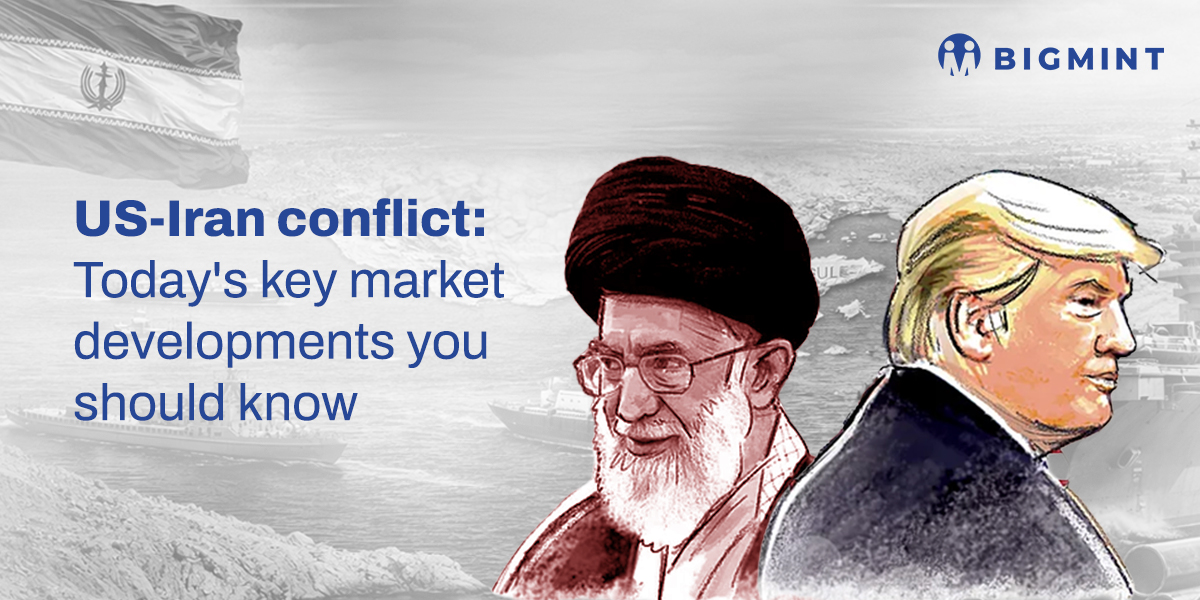
- US strikes on Iran’s main oil export hub escalate shipping risks
- Bunker fuel surge and vessel rerouting push freight and raw material costs higher
How will the ongoing conflict in the Middle East affect the global metals markets? As the US-Israel and Iran war escalates, BigMint presents a lowdown of the impact of this geopolitical conflict on the Indian metals, raw materials and energy markets:
Oil prices and tanker risks surged after US air strikes targeted military installations on Iran’s Kharg Island, the hub for the vast majority of Iran’s crude exports. The strikes hit military facilities on the island but stopped short of damaging oil infrastructure, and Washington warned that energy facilities could be targeted if Iran interferes with shipping through the Strait of Hormuz.
Kharg Island handles more than 90% of Iran’s crude exports, making it one of the most strategically sensitive oil hubs in the Gulf. Any disruption there could immediately affect regional oil flows and tanker traffic.
Iran warned that attacks on its energy infrastructure could trigger retaliatory strikes on US-linked oil facilities across the region, raising the risk of broader disruptions to Gulf oil supply and maritime trade routes.
The Strait of Hormuz, a narrow maritime corridor linking the Persian Gulf to global markets, carries roughly one-fifth of the world’s oil and LNG shipments and remains the most critical energy chokepoint in global trade.
Brent crude futures jumped 2.7% to about $103/bbl after the attack as markets try to price in the risk of further supply disruptions. Traders warned that further escalation around Iranian export infrastructure could tighten global energy balances significantly.
Tanker disruptions and heightened security risks have already forced refiners and commodity traders to reassess supply chains. The International Energy Agency announced a coordinated release of 400 million barrels from strategic reserves, though the measure has had limited impact on easing market volatility.
War-risk insurance premiums for vessels transiting the Gulf have surged, while several shipowners have begun rerouting cargoes away from conflict-sensitive corridors. These changes are extending voyage times and pushing freight costs higher across global commodity supply chains.
India has moved quickly to reduce exposure to potential disruptions through the Strait of Hormuz. The country is expanding liquefied petroleum gas import sources to include the United States, Norway, Canada and Russia alongside traditional Gulf suppliers to manage tightening global supply conditions.
India consumes roughly 33.15 million tonnes of LPG annually, with imports historically accounting for nearly 60% of demand from Gulf countries. To safeguard domestic supply, the government has instructed refiners to maximise LPG production and restrict industrial sales while prioritising supply for around 333 million household connections.
At the same time, India has accelerated diversification of crude procurement. Nearly 70% of the country’s crude imports now come from routes that bypass the Strait of Hormuz, helping limit exposure to potential shipping disruptions in the Gulf.
Steel
Rising energy prices and shipping costs are reinforcing a cost-driven cycle across global steel markets. Much of the pressure is emerging through maritime trade routes, as tanker attacks and the risk of further escalation near Iranian export infrastructure have pushed insurance costs higher for vessels operating in the region, increasing freight rates for bulk commodities including steel.
Europe remains particularly vulnerable because of its heavy reliance on imported LNG supplies, while rising energy costs continue to weigh on industrial demand across automotive and manufacturing sectors.
China exports between 25-30 million tonnes of steel annually to the Middle East. Shipping disruptions could force Chinese mills to redirect shipments to Southeast Asia or domestic markets, potentially increasing supply pressure in alternative export destinations.
Indian steel exports have also slowed as freight volatility and shipping risks disrupt trade flows. Some vessels are being rerouted via the Cape of Good Hope to avoid high-risk corridors, extending transit times by roughly 10-20 days and increasing logistics costs.
In domestic markets, steel prices remain supported by elevated raw material costs despite cautious buying. IF-route rebar prices have firmed across several markets in recent weeks, supported by higher billet and sponge iron costs.
Ferrous scrap
The conflict has pushed imported scrap markets across South Asia into a phase of tightening supply and rising replacement costs. Recent bulk cargoes to Bangladesh were reported around $372/t CFR Chattogram for HMS (80:20) and $377/t for shredded scrap, reflecting higher freight and energy costs along major trade routes.
Freight from Europe to South Asia has climbed to roughly $65-70/t as war-risk premiums and bunker fuel costs rise. Domestic scrap prices in India have remained relatively stable, with cautious restocking by secondary steel mills supporting market sentiment.
Supply pressures are also emerging within the domestic scrap processing chain. LPG shortages in parts of southern India have disrupted scrap cutting and processing activities, with gas cylinder prices reportedly doubling amid tightening supply.
Non-ferrous metals
Aluminium
Aluminium markets have reacted more directly to geopolitical tensions because of their strong exposure to energy and logistics costs. As of 13 March, LME aluminium traded around $3,480/t after briefly breaching the $3,500/t mark earlier in the week.
Shipping constraints have also tightened aluminium scrap flows into India. Vessel availability remains limited while shipping lines have introduced additional war-risk surcharges. Container freight rates have climbed to roughly $2,000 for 20-foot containers and $4,000 for 40-foot containers, with some carriers imposing emergency surcharges linked to the conflict.
Copper
Copper markets have remained relatively insulated from the direct supply impact of the conflict. LME copper traded near $12,900/t as investors adopted a cautious stance amid rising geopolitical risks.
However, higher freight rates, insurance costs and potential delays in scrap shipments could gradually tighten supply flows to Asian markets.
Zinc and stainless steel
Energy supply constraints are beginning to affect downstream metal industries. Stainless steel production in India has come under pressure as the sector relies heavily on externally supplied fuels such as LPG, propane and natural gas.
Industry sources indicate that shortages of LPG and rising prices of low sulphur heavy stock (LSHS), a key industrial fuel used by stainless producers, have begun affecting operations. Some plants have already reduced production rates by 20-30%, and further curtailments remain possible if fuel availability does not improve.
Coal and energy
Energy markets remain the primary transmission channel through which the Middle East conflict is affecting metals supply chains. Brent crude futures for May delivery jumped by about 2.7% after the attacks to about $103/bbl amid persistent concerns over disruptions to Gulf shipping routes.
Higher energy costs are already feeding into raw material markets. Premium hard coking coal prices delivered to India rose by roughly $9/t week on week, supported by higher vessel freight rates. Domestic thermal coal prices have also firmed amid rising import costs, while delivered prices of high-sulphur petcoke are now widely quoted around $150–155/t CNF India.
Freight and logistics
Freight markets have become one of the most immediate pressure points across global commodity supply chains. Very low sulphur fuel oil (VLSFO) prices in Singapore, a key benchmark for marine bunker fuel, surged from around $515/t at the end of February to $1,085.50/t on 12 March and further to $1,120.50/t on 13 March as maritime risk premiums escalated.
Because bunker fuel typically accounts for up to 60% of vessel operating expenses, the surge in marine fuel prices is pushing freight rates higher across bulk commodity shipments including iron ore, coal and steel products.
Shipping companies are increasingly rerouting vessels away from conflict-sensitive areas near the Strait of Hormuz and parts of the Red Sea. Longer voyage distances and tighter vessel availability are pushing logistics costs higher across global commodity trade routes.
These developments are raising landed raw material costs and increasing supply uncertainty across multiple commodities. If tensions escalate further, particularly around Iranian oil infrastructure or tanker traffic through the Strait of Hormuz, freight volatility, energy price swings and tighter fuel supplies could continue shaping metals markets in the coming weeks.
Leave a Reply