- Turkish market firm, freight surge lifts deep-sea scrap prices
- Japanese scrap prices rise, Tokyo Steel raises scrap prices
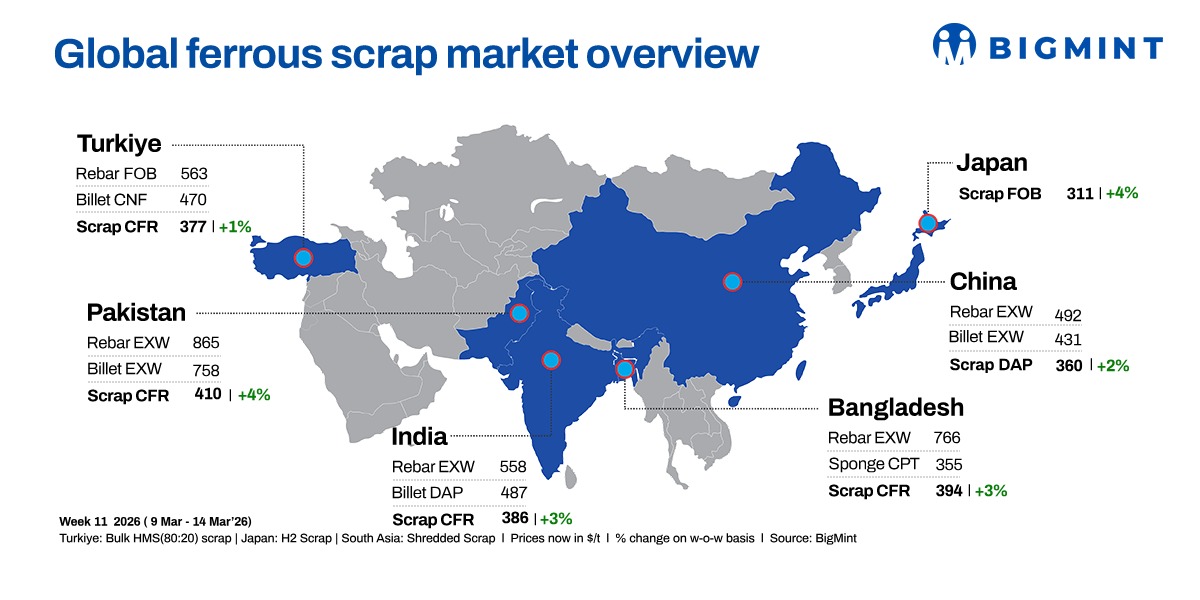
Global ferrous scrap markets remained firm in the week ending 14 March, supported by rising freight costs and Middle East tensions. Turkiye and Japan saw price increases, while the India and Bangladesh markets stayed stable, while China saw an increase in domestic scrap prices and the UAE witnessed a correction.
Turkiye: Deep-sea imported scrap prices in Turkiye remained saw some postivness stable early in the week, with US-origin HMS 80:20 workable around $375-378/t CFR as mills were cautious amid Middle East tensions and weak rebar demand. Prices later edged higher as dry bulk freight rates surged to about $55-58/t, supporting tradable levels at $375-380/t CFR, while domestic rebar prices rose by $10-15/t Exw. Meanwhile, the scrap-to-rebar spread remained at $180-182/t, with rebar export offers at $558/t FOB.
India: Imported scrap sentiment in India remained firm this week as Middle East tensions disrupted trade flows and raised logistics risks. UK/EU-origin HMS 80:20 was indicated around $360-365/t CFR, while HMS 1 was heard near $370-375/t. Shredded scrap offers were reported at $385-390/t and PNS at $390-395/t CFR, although no trades were concluded as buyer bids remained lower.
Freight rates surged sharply during the week, increasing from around $40/t earlier to nearly $60-65/t, significantly raising landed scrap costs. Market participants also noted stronger buying interest from Pakistani mills, which limited scrap availability for Indian buyers. Meanwhile, rising oil prices and concerns over potential gas supply disruptions in India added pressure on mills, prompting many to adopt a wait-and-watch approach amid volatile global conditions.
Pakistan: The firm sentiment was mainly driven by supply shifts and rising freight costs linked to the ongoing Middle East conflict. Market participants noted that shipping lines remained cautious, pushing freight rates higher and tightening supply flows. In addition, strong operating rates at major mills supported consistent scrap demand with with UK-origin shredded heard around $405-415/t CFR Qasim.
In the last seven days, Pakistan booked around 14,500 t of UK/EU-origin shredded scrap, with deals concluded in the range of $400-415/t CFR Qasim, indicating steady buying interest despite fluctuating market sentiment.
Bangladesh: Imported scrap sentiment in Bangladesh remained firm during the week, supported by steady domestic steel demand and stable operating rates at major mills. HMS (80:20) was heard around $370/t CFR, with USWC bulk trades at $373-375/t and fresh offers above $380/t, while shredded scrap was indicated at $390-395/t and PNS near $400/t. Japanese H2 scrap following the Kanto tender was also heard higher at $385-390/t CFR, while busheling offers were discussed near $425-430/t. Rising freight costs and Middle East tensions continuing to support prices .
Japan: Japan’s FOB H2 export prices also increased by JPY 2,000/t to around JPY 49,500/t. Kanto region raised scrap tender purchase prices by about JPY 2,000/t ($13/t), with H2 heard around JPY 47,500-49,000/t ($298-307/t), the highest level in nearly one year and seven months. Tokyo Steel led the increase from 12 March, setting H2 prices at about JPY 48,000/t across its plants and around JPY 48,500/t at the Tokyo Bay Satellite Yard.
China: Shagang Steel raised scrap procurement prices by RMB 50/t ($7/t) effective 10 March, with HMS (6-10 mm) increasing to RMB 2,480/t ($360/t) from RMB 2,430/t, including 13% VAT.
UAE: Domestic ferrous scrap index dropped by AED 82/t w-o-w to AED 1,164/t ($317/t) on 11 March due to price correction after heavy mill purchases. Processed HMS was heard around AED 1,160-1,180/t delivered, while rising Hormuz tensions increased logistics risks and freight costs.
Leave a Reply