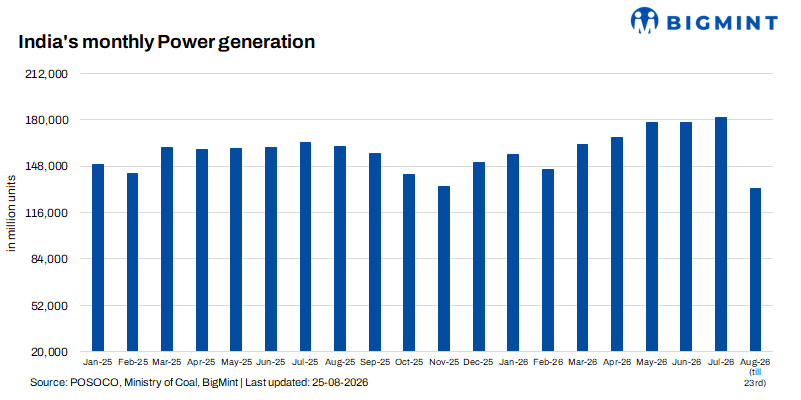
- Power generation rises 9.5%; hydro output falls 17%
- Coal stocks drop 6 mnt during first 23 days of August
India’s power system is showing the consequences of the weak 2026 monsoon with unusual clarity. During 1-23 August, electricity generation rose 9.5% year-on-year and average daily peak demand increased more than 11%. Renewable output surged, but hydropower fell sharply, leaving coal-fired generation to provide much of the additional dispatchable electricity required.
That response is drawing heavily on fuel inventories. Coal stocks at monitored thermal power plants fell from 38.01 mnt at end-July to 31.95 mnt by 23 August, a decline of 6.06 mnt, or almost 16%, in just over three weeks. Plants with critical stocks simultaneously increased from 31 to 38.
The concern extends beyond August. India is approaching the end of its main reservoir-refilling season with water storage materially below last year. If September rainfall disappoints, weaker hydro availability could persist into the 2027 pre-monsoon period, placing greater reliability responsibility on coal-fired generation.

Demand growth overwhelms hydro weakness
The strength in demand has been broad rather than confined to isolated peak days. Even the lowest daily peak during 1-23 August 2026 was around 227.5 GW, nearly 13% above the comparable 2025 minimum.
Late-August demand also frequently peaked during daylight hours. Peak demand reached 247 GW on 19 August, 253 GW on 20 August and a period-high 258 GW on 21 August.
The generation response reveals the underlying challenge.
Renewable energy output increased 38.4% to 25.4 BU, producing 7.05 BU more electricity than during the corresponding period last year. Yet hydro generation fell 17.2%, or 3.34 BU, to 16.04 BU.
Coal generation consequently still increased 9.2% to 84.32 BU, supplying 63.5% of total generation.
In effect, much of the extraordinary increase in renewable generation was required to satisfy higher demand and compensate for missing hydro rather than displace coal.
This is increasingly India’s power-system challenge: rapidly growing renewable energy is adding substantial electricity, but when demand rises while dispatchable hydro weakens, coal must continue carrying much of the balancing and reliability burden.
IEX prices confirm a tighter market
The Indian Energy Exchange (IEX) Day-Ahead Market provides another indication of tightening conditions.

Purchase bids increased 54%, while sell bids rose only 2.5%. The resulting tightening pushed the average Day-Ahead Market price 17% higher to INR 4.22/kWh.
There were six days above INR 5/kWh during the first 23 days of August 2026, compared with none during the corresponding 2025 period. The daily average price reached INR 6.12/kWh on 21 August.
The exchange market therefore reinforces the generation data: electricity demand is increasing much faster than readily available flexible supply.
Coal inventories absorb the pressure
Higher coal generation is translating directly into declining power-plant inventories.

Stocks fell by more than 6 mnt in 23 days. On 23 August alone, plants consumed around 2.63 mnt while receiving only 2.13 mnt, producing another substantial daily drawdown.
A seasonal stock draw is not unusual. What matters is the speed of depletion and the possibility that hydro may provide less relief during the coming dry season.
Weak monsoon creates long-term hydro problem
India’s southwest monsoon was around 13% below normal by 24 August, with El Niño contributing to weaker monsoon circulation. June rainfall was particularly poor, July brought some recovery, but rainfall weakened again during August. Reservoirs have recovered from their early-season lows, but remain well behind last year.
As of 20 August, 166 monitored reservoirs held around 117.8 billion cubic metres (BCM), or 64.2% of live capacity. Storage was approximately 17% below the 142.3 BCM recorded a year earlier and slightly below the ten-year average.
The regional deficits are particularly significant. Northern reservoirs were at around 57% of capacity compared with 84% last year, while southern reservoirs were at 56% compared with 82%.
Hydro generation’s 17% August decline is therefore not an isolated monthly event. Weak reservoir replenishment during the monsoon potentially reduces the amount of water available for generation through winter and, importantly, the high-demand pre-monsoon months of 2027.
Coal’s responsibility could extend into next summer
This creates a fundamentally different challenge from a temporary August demand spike.
Reservoirs accumulate much of their usable water during the June-September monsoon and are progressively drawn down thereafter. If India enters October with materially lower storage, that deficit cannot easily be repaired during the dry season.
Renewable capacity will continue expanding and should provide growing quantities of daytime energy. But solar and wind cannot fully replace the dispatchability provided by hydro during evening peaks, low-wind periods or unexpected demand surges.
Coal consequently becomes the principal controllable source capable of filling the gap.
The immediate priority is therefore not simply maintaining sufficient coal dispatches to meet current consumption. Power-plant inventories need to begin rebuilding before the high-demand winter-to-summer period.
BigMint assessment
The first 23 days of August demonstrate how quickly a weak monsoon can reshape India’s electricity balance.
Power generation increased 9.5%, average peak demand rose 11.3% and renewables surged 38.4%. Yet coal generation still increased 9.2% because hydro output fell 17%.
That additional coal burn has already reduced thermal power-plant inventories by almost 16% since end-July.
If the monsoon finishes materially below normal, India could enter the coming dry season with higher structural electricity demand, substantially greater renewable generation, weaker hydro reserves and depleted coal inventories.
This makes September and October critical for coal logistics. The system must simultaneously satisfy elevated generation requirements and rebuild power-plant stocks.
The strategic risk is that the weak 2026 monsoon evolves from a seasonal hydropower problem into a power-system adequacy challenge extending into 2027.
Until reservoirs recover materially, coal remains India’s largest source of controllable electricity and its principal insurance against high demand, weak hydro and renewable variability.
The challenge is therefore no longer simply producing enough coal-fired power today, but rebuilding sufficient coal inventories to carry a potentially heavier reliability burden through to the next monsoon.
Leave a Reply