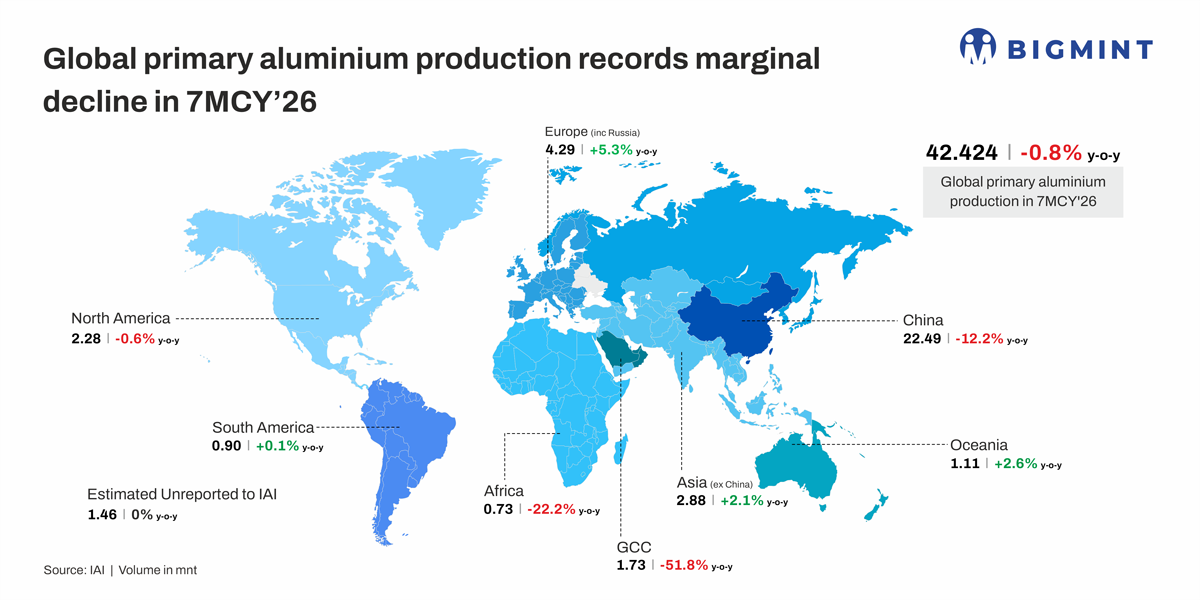
- GCC output falls 51.8%, while China sees 12.2% drop
- Tight stocks underpin global aluminium prices
Global primary aluminium production stood at 42.424 mnt in 7MCY’26, down 0.8% y-o-y from 42.758 mnt in the corresponding period last year, according to International Aluminium Institute (IAI) data.
Production trends remained mixed across regions, reflecting geopolitical disruptions, operational challenges and changing supply conditions across key producing hubs. Steep declines in the GCC, China and Africa primarily drove the overall contraction, while higher production in Europe, Asia ex-China and Oceania limited the overall fall.
Regional drivers shaping global output in 7MCY’26
The decline in global primary aluminium production was largely driven by a sharp contraction in GCC output, which fell 51.8% y-o-y to 1.726 mnt in 7MCY’26 from 3.580 mnt a year earlier. Production in the region was impacted by the escalation of conflict in the Middle East, which disrupted smelter operations and logistics around the Strait of Hormuz. EGA has been gradually restarting affected capacity at its Al Taweelah smelter, while Alba had earlier shut three reduction lines amid supply and transit disruptions. However, the recovery is expected to remain gradual, keeping regional output below normal operating levels.
China’s aluminium production declined 12.2% y-o-y to 22.494 mnt from 25.614 mnt. Despite lower domestic output, higher exports of aluminium alloy and semi-finished products helped redirect Chinese material towards overseas markets facing supply shortages, partly easing tightness in the global market.
African production declined 22.2% y-o-y to 0.728 mnt, partly reflecting the shutdown of Mozambique’s Mozal aluminium smelter due to power-supply constraints. Meanwhile, North American production edged down 0.6% y-o-y to 2.282 mnt from 2.295 mnt, although the region continued to face elevated trade uncertainty and market-access risks.
In contrast, Europe, including Russia, recorded a 5.3% y-o-y increase in production to 4.291 mnt, while Asia ex-China rose 2.1% to 2.876 mnt. Oceania’s output increased 2.6% to 1.109 mnt, supported by relatively stable operations, while South American production remained broadly stable at 0.898 mnt. However, these gains were insufficient to fully offset the sharp production losses in the GCC, China and Africa, resulting in a 0.8% y-o-y decline in global output.
Prices remain firm as stocks decline
The average LME aluminium price stood at $3,330/t in 7MCY’26, up 30% y-o-y from $2,555/t. The sharp increase was mainly driven by supply concerns following disruptions to aluminium production and shipments from the Middle East amid the ongoing conflict and logistical constraints around the Strait of Hormuz. Tightening physical availability, along with supply concerns in other producing regions, further supported prices, while resilient demand from key consuming sectors added to the market’s strength.
Meanwhile, average aluminium inventories declined 15% y-o-y to 394,362 tonnes from 466,307 t, reflecting persistent withdrawals and tighter exchange availability. More recently, LME aluminium stocks have fallen further to multi-year lows, with the drawdown linked to disrupted Gulf supply and limited availability of deliverable metal. Although expectations of recovering production at UAE smelters and higher Chinese exports have provided some relief, low inventories continue to underpin aluminium prices and leave the market vulnerable to further supply disruptions.
Outlook
The global aluminium market is likely to remain supply-sensitive through the rest of 2026.
A gradual recovery in Gulf production should provide additional supply, but the pace of restarts remains uncertain. At the same time, lower Chinese output and weaker African production limit the availability of replacement metal.
With prices already 30% higher y-o-y and stocks down 15%, the market remains vulnerable to fresh geopolitical or logistics disruptions. Until Gulf capacity normalises, aluminium prices are likely to retain a firm underlying bias, keeping input costs elevated for downstream consumers.
Leave a Reply