- Bell Bay Aluminium power deal faces uncertainty
- Rusal rail derailment in Guinea halts alumina exports
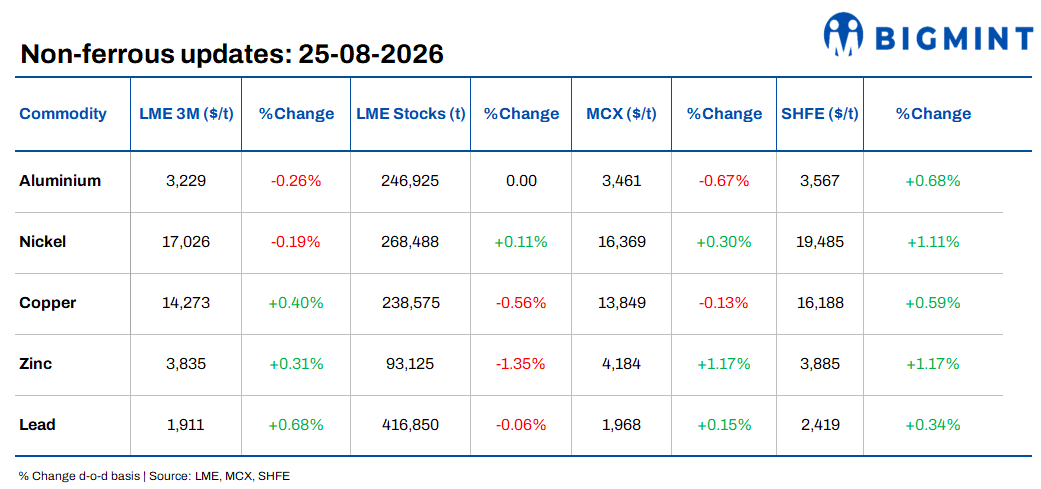
LME base metals traded mixed on 24 August. Lead recorded the strongest gain, rising 0.68% d-o-d to $1,911/t, followed by copper, up 0.40% to $14,273/t, and zinc, which advanced 0.31% to $3,835/t. Meanwhile, aluminium slipped 0.26% to $3,229/t, while nickel eased 0.19% to $17,026/t.
LME inventories recorded mixed trends. Zinc stocks posted the steepest decline, falling 1.35% d-o-d to 93,125 t, followed by copper, down 0.56% to 238,575 t, while lead stocks eased 0.06% to 416,850 t. Nickel inventories rose 0.11% to 268,488 t, whereas aluminium stocks were unchanged at 246,925 t.
Domestic market overview
India’s non-ferrous scrap market witnessed higher prices across the reported aluminium and copper grades on 24 August. Aluminium tense scrap (loose), ex-Delhi, rose INR 1,000/t (0.4%) d-o-d to INR 251,000/t. Meanwhile, ex-Chennai prices gained INR 1,000/t (0.4%) to INR 247,000/t.
Meanwhile, copper armature scrap (Cu 99%), ex-Delhi, increased by INR 3,000/t (0.2%) to INR 1,305,000/t from INR 1,302,000/t. The move came alongside a 0.40% rise in LME copper prices, indicating firmer international copper values were reflected in the domestic market.

Other updates
Oil prices extend decline after US sanctions on Iran
Oil prices fell more than 2% on 24 August as investors largely shrugged off the latest US sanctions on Iran. Brent settled at $91.28/bbl, while WTI closed at $85.01/bbl, before prices stabilised around $92/bbl on 25 August. Lower crude prices could reduce energy and logistics costs for aluminium producers, although the metal’s electricity-intensive production limits the direct impact. Meanwhile, risks around the Strait of Hormuz continue to keep energy markets sensitive to geopolitical developments.
Zijin copper target under pressure after Congo mine flood
Zijin Mining Group said flooding at its Kamoa-Kakula copper mine in the Democratic Republic of Congo has put its 2026 copper production target under pressure. The company had targeted around 1.2 mnt of mined copper for this year. The disruption comes as copper prices remain near record levels, with demand supported by electrification, renewable energy and data-centre infrastructure. Consequently, prolonged production losses could tighten global copper supply expectations and support prices.
Rusal derailment in Guinea halts alumina exports
A train operated by Rusal derailed in Guinea, cutting rail access to its Friguia alumina refinery and halting alumina exports. The disruption has also slowed production, according to sources cited by Reuters. Alumina is the primary feedstock for aluminium smelting, so a prolonged rail outage could raise refinery inventories while tightening overseas availability. Therefore, the disruption could provide support to alumina prices and potentially aluminium if alternative logistics are not arranged.
Bell Bay Aluminium power deal faces uncertainty
Rio Tinto’s Bell Bay Aluminium smelter in Tasmania faces uncertainty over a new electricity agreement, with a reported $60 million annual gap between the price required by the smelter and Hydro Tasmania’s commercial offer. The facility produces around 190,000 t of aluminium annually and supports more than 550 jobs. A failure to secure competitive power could threaten its continued operation. However, any global supply impact would remain limited compared with the wider aluminium market.
Leave a Reply