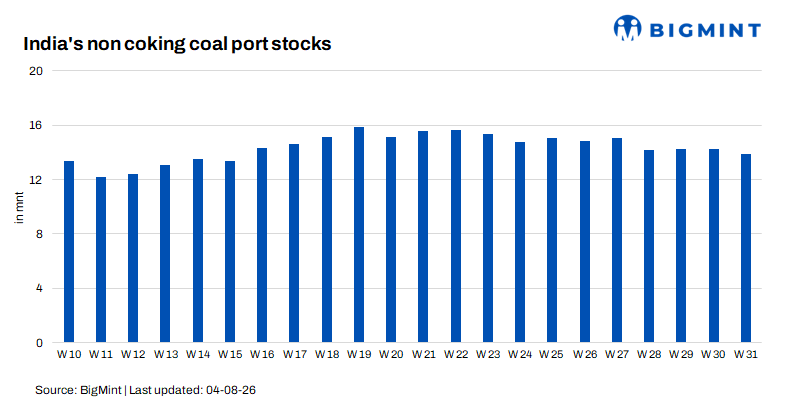
- Domestic dispatches replace imports as utilities meet rising coal demand
- Weak monsoon may revive seaborne coal imports if inventories continue to decline
Coal inventories across India’s power sector and pitheads declined sharply during July as sustained thermal generation exceeded fresh domestic coal receipts despite robust production. Weak southwest monsoon conditions curtailed hydroelectric generation while persistently warm and humid weather kept electricity demand above seasonal norms.
Producers and power utilities met the increase in coal demand by releasing inventories accumulated during the previous two years rather than increasing imports, shifting the market balance from production growth to stock drawdowns.
Thermal generation remains elevated
India’s thermal power sector has borne a larger share of electricity generation this monsoon as below-normal rainfall reduced hydroelectric output while sustained heat and humidity kept electricity demand elevated.
Coal consumption at thermal power stations monitored by the Central Electricity Authority (CEA) accelerated through the summer, reaching around 79 million tonnes (mnt) during both June and July, well above the corresponding months last year. Rather than easing after the onset of the monsoon, thermal generation remained elevated as reservoir inflows failed to recover sufficiently to support hydroelectric generation.

In a typical monsoon season, lower temperatures and stronger hydroelectric generation reduce dependence on coal-fired power. This year, below-normal rainfall limited reservoir inflows while persistent humidity prolonged cooling demand across much of the country, increasing the role of thermal power in meeting electricity requirements.
Inventory drawdowns replace production growth
Thermal power stations consumed more coal than they received during July.
Plants received 73.3 mnt of coal while consuming 79.1 mnt, resulting in an inventory drawdown of around 6 mnt during the month. Coal stocks at power stations declined from 44.1 mnt at the end of June to 38 mnt by the end of July, falling below the Central Electricity Authority’s normative inventory requirement.
The drawdown extended beyond generating stations into the wider domestic coal supply chain. Provisional Ministry of Coal data show domestic coal production reached 69.75 mnt during July, while dispatches increased to 86.33 mnt, exceeding production by more than 16 mnt. Producers met the additional demand by releasing inventories accumulated during the previous financial year rather than further increasing output.
Pithead inventories consequently declined from around 116.4 mnt at the end of June to 99.8 mnt by the end of July, while power plant stocks fell by another 6.1 mnt over the same period. Combined inventory drawdowns across the domestic coal supply chain therefore reached around 22.7 mnt during July.
Coal India accounted for much of the reduction. After ending FY2025-26 with a record 129.96 mnt of raw coal inventories, the company prioritised dispatches over production growth. Between April and July, Coal India is estimated to have reduced pithead inventories by 42.4 mnt, equivalent to nearly one-third of its opening stock.
Captive and commercial miners followed a similar pattern. Their reconstructed inventories declined from 16.93 mnt at the end of March to around 9.81 mnt by the end of July as dispatches consistently exceeded production.
Imports remain subdued despite stronger demand
Higher thermal coal consumption has yet to translate into higher imports.
Power utility coal imports remained below year-ago levels throughout April–June 2026 despite stronger thermal power generation. Imports declined by 25% y-o-y to 3.51 mnt in April, 26% to 4.08 mnt in May, and 8% to 4.69 mnt in June, reflecting the sector’s continued reliance on higher domestic coal dispatches and inventory drawdowns instead of increased imports.
During April-June, power utilities imported 12.28 mnt of coal, compared with 15.26 mnt during the corresponding period of 2025, representing a decline of around 20% despite significantly higher coal burn.
Utilities have met higher demand through three domestic sources: higher coal production, stronger dispatches supported by pithead inventories and inventory drawdowns at generating stations. Together, these enabled thermal generators to sustain higher coal consumption without increasing purchases from the seaborne market.
Logistics become the next constraint
Coal production remained robust while dispatches reached record levels, indicating mine output has kept pace with demand.
Moving coal through the domestic supply chain is becoming increasingly important as thermal generation remains elevated. Industry participants indicate railway capacity is increasingly being prioritised for power-sector movements, allowing thermal utilities to sustain generation while leaving industrial consumers with tighter rake availability. Although this has not been reflected in formal policy announcements, it is consistent with elevated dispatches during July and the simultaneous reduction in inventories across the domestic coal supply chain.
Outlook
India entered FY2026-27 with historically high coal inventories after two years of production growth aimed at strengthening energy security and reducing import dependence. Those inventories are now supporting higher thermal generation as weak monsoon conditions limit hydroelectric generation.
Current inventory levels continue to provide a buffer, but the cushion will erode if thermal coal consumption continues to exceed fresh domestic receipts through August and September. Under those conditions, inventory replenishment is likely to become a higher priority for producers and power utilities.
India may then increasingly supplement domestic supply with imported coal—not because domestic production has failed, but because inventories and logistics may no longer be sufficient to absorb sustained growth in coal-fired electricity generation.
After more than a year in which improving domestic availability restrained import demand, India’s power sector could once again emerge as a significant source of incremental seaborne thermal coal demand if inventory replenishment becomes a priority during the second half of FY2026-27.

Leave a Reply