- Company returns to profitabiliy, posts Q1 net profit of JPY 145.5 billion
- Lower shipments and weaker spreads weigh on Japan business as overseas operations drive earnings
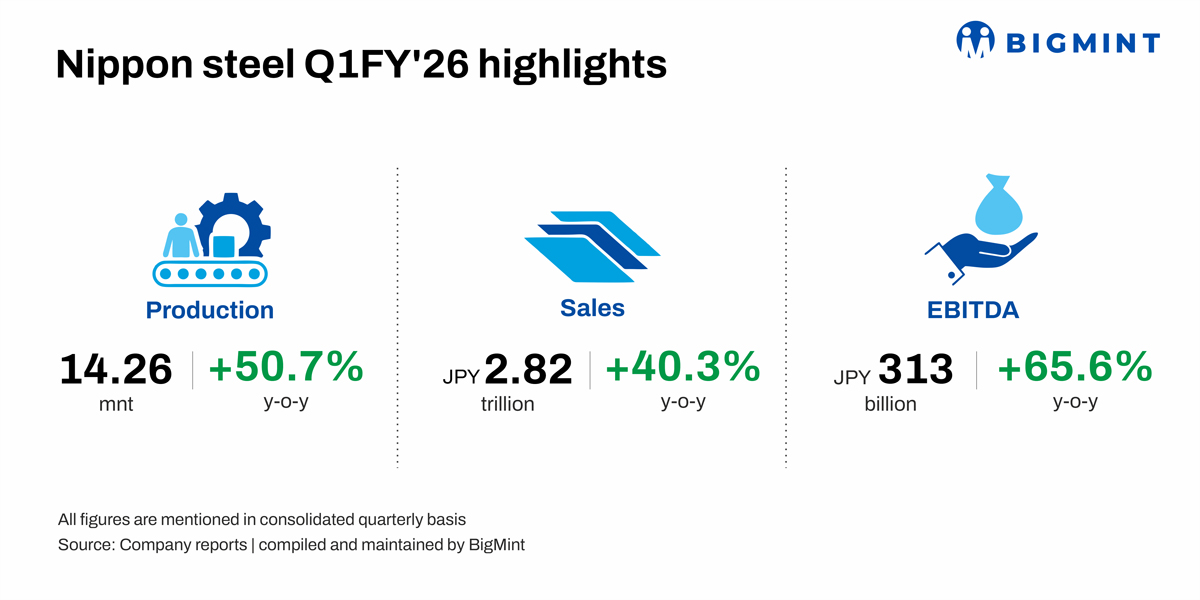
Nippon Steel’s consolidated crude steel production increased 50.7% year on year to 14.26 million tonnes (mnt) in the April-June quarter, driven primarily by the consolidation of U.S. Steel into its operating base. The increase masked a largely unchanged domestic business, with non-consolidated crude steel production in Japan rising 3% to 8.51 mnt, while steel products shipments declined 1.4% to 7.53 mnt on subdued domestic demand.
Higher realised steel prices and a weaker yen provided some support, with average steel prices increasing to JPY 141,800/t from JPY 139,700/t and the exchange rate weakening to JPY 160/USD from JPY 145/USD.
Overseas operations become the group’s earnings engine
Nippon Steel returned to operating profitability in the April-June quarter as the consolidation of U.S. Steel strengthened overseas earnings and the prior year’s reorganisation losses did not recur. Consolidated revenue increased 40.4% year on year to JPY 2.82 trillion, while operating profit recovered to JPY 145.5 billion from an operating loss of JPY 139.6 billion a year earlier.

Net profit attributable to shareholders reached JPY 75.3 billion, compared with a loss of JPY 195.8 billion in the corresponding quarter of FY2025, while basic earnings per share improved to JPY 14.40 from a loss per share of JPY 37.47. The prior-year quarter included JPY 231.5 billion of reorganisation losses related to the transfer of the company’s equity interest in AM/NS Calvert LLC.
The group’s earnings mix shifted decisively towards overseas operations. Overseas business profit increased JPY 29 billion during the quarter, with U.S. Steel contributing JPY 32 billion, more than offsetting a JPY 94 billion decline in domestic underlying business profit.
While the domestic business remained under pressure from weaker steel spreads, lower steel products shipments and higher raw material and fuel costs, higher inventory valuation also supported reported earnings, adding JPY 112 billion to business profit despite a JPY 65 billion decline in underlying business profit.
FY2026 guidance reflects overseas strength
Reflecting the stronger contribution from overseas operations, Nippon Steel raised its FY2026 overseas underlying business profit forecast by JPY 90 billion to JPY 320 billion, including a JPY 80 billion increase in expected earnings from U.S. Steel to JPY 180 billion.
In contrast, it lowered its domestic underlying business profit forecast by JPY 90 billion to JPY 380 billion, citing higher raw material and fuel costs together with a weaker operating environment in Japan.
Regional growth strategy gathers pace
Nippon Steel said global steel markets continue to face pressure from China’s excess production capacity, persistent exports of low-priced steel and expanding steelmaking capacity in emerging economies. The company expects trade measures and the formation of regional economic blocs to widen performance differences across markets, reinforcing its strategy of building regional production hubs in North America, Europe, India and ASEAN.
As part of that strategy, the company plans to begin construction of the first phase of its 7 mnt integrated steelworks at Rajayyapeta in India while commissioning new downstream facilities at AM/NS India’s Hazira complex in the second half of FY2026. Management expects overseas expansion, led by U.S. Steel, to underpin its medium-term target of achieving annual underlying business profit of JPY 1 trillion.
Outlook
Nippon Steel’s earnings outlook is becoming increasingly tied to the performance of its overseas operations rather than a recovery in Japan. While the company expects U.S. Steel to remain its primary earnings driver through higher steel prices, blast furnace restarts and operational synergies, its domestic business is likely to remain under pressure from higher raw material and fuel costs, weaker steel spreads and sluggish demand.
Against a backdrop of persistent Chinese overcapacity and expanding trade barriers, the company’s earnings are therefore becoming increasingly dependent on the performance of regional steel markets rather than a recovery in Japan, reinforcing its shift towards a geographically diversified production base.
Leave a Reply