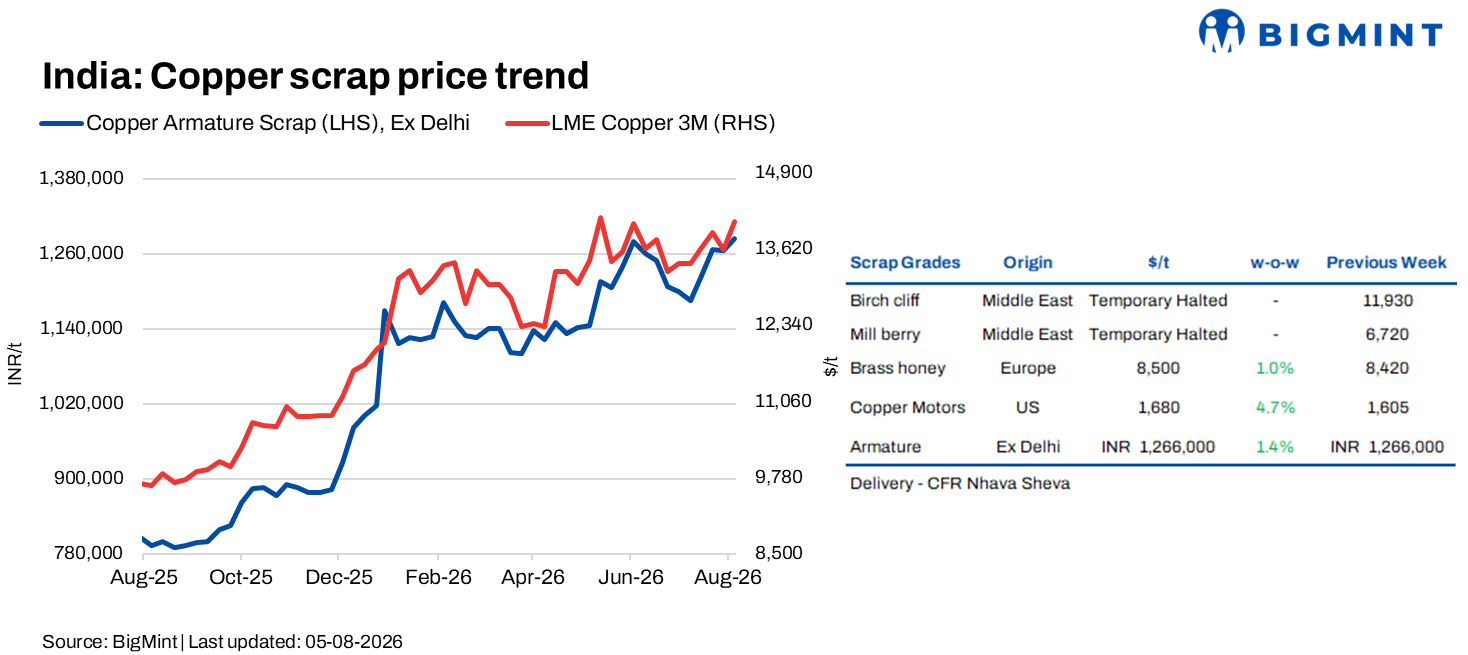
- LME copper inventories fall 9.7% w-o-w to a 5-month low
- Pakistan and Far East markets attract imported scrap cargoes
Domestic copper scrap prices in India strengthened during the week ended 6 August 2026, supported by a strong rally in LME copper prices, tightening availability of imported scrap and increasing competition for physical material across Asian markets.
As per BigMint’s assessment, copper armature scrap, ex-Delhi, increased by around 1.4% w-o-w to INR 1,284,000/t from INR 1,266,000/t in the previous week. The domestic rally tracked a 3.4% w-o-w increase in LME copper prices, which climbed to $14,070/t, its highest level in nearly three months. The gains were primarily driven by tightening physical copper availability, declining global exchange inventories and continued movement of refined copper into the US market, reducing the availability of material in other regions.
Market updates
The Indian copper scrap market remained well supported during the week as a sharp rally in LME copper prices and continued drawdown in global exchange inventories reinforced bullish sentiment. LME inventories declined by 9.7% w-o-w to 249,850 t, extending the ongoing reduction in readily available metal. Although some cancelled warrants returned to LME warehouses during the week, prompt-delivery copper outside the US remained scarce, keeping the physical market tight and supporting global copper prices.
Against this backdrop, the availability of imported high-grade copper scrap in India remained constrained. Elevated international prices encouraged overseas recyclers and traders to replenish inventories in anticipation of further gains, reducing spot offers in the export market.
Global supply disruptions tighten imported scrap availability
Beyond firm copper prices, several global supply-side developments continued to tighten the availability of imported copper scrap. Copper and other non-ferrous scrap generation across key European markets, particularly Germany and the Netherlands, remained subdued, limiting the volume of export cargoes available to international buyers.
At the same time, production at several European scrap processing facilities was disrupted following recent fire incidents, reducing processing capacity and further restricting scrap availability.
Logistical challenges also intensified during the week. Container freight rates increased by around $450/container, raising the landed cost of imported scrap for Indian buyers.
Meanwhile, the sinking of an India-flagged cargo vessel in the Red Sea, following a reported projectile strike, renewed concerns over shipping security along a key trade route, adding further uncertainty to global scrap supply chains.
At the same time, imported scrap cargoes continued to be diverted towards Far East Asian markets and Pakistan, where buyers were offering better realizations than India. The diversion reduced the availability of imported feedstock in the domestic market, keeping replacement costs elevated and limiting procurement options for Indian recyclers.
Higher raw material costs pressure secondary producers
The price spread between primary CCR wire rod and secondary CCR wire rod widened sharply to around INR 45,000/t from nearly INR 21,000/t in the previous week, improving the cost competitiveness of secondary copper rod. The wider differential encouraged continued interest from price-sensitive downstream consumers, particularly in the wire and cable segment, where manufacturers increasingly preferred secondary material to manage higher input costs.
However, stronger demand for secondary rod translated into increased procurement requirements for copper scrap at a time when imported scrap availability remained constrained. The resulting supply tightness kept scrap replacement costs and premiums elevated, limiting the ability of secondary producers to significantly ramp up production despite healthy downstream demand.
Beyond the immediate supply tightness, the long-term demand outlook for copper remains increasingly constructive. Rising investments in AI-driven data centres, power transmission infrastructure, renewable energy and grid expansion, particularly across the Gulf Cooperation Council (GCC) and other developing regions, are expected to drive sustained copper consumption over the coming years.
The increasing requirement for transformers, cables, switchgear and transmission equipment is likely to strengthen demand for both primary and recycled copper, reinforcing the strategic importance of copper scrap as an alternative source of raw material amid tightening global mine supply.
Meanwhile, domestic trading activity remained seasonally subdued due to the ongoing monsoon, which continued to weigh on construction-related demand across several regions.
Deals heard
- USA-origin Cu motor mix at $1,650/t CFR Mundra
- USA-origin Cu motor mix at $1,660-1680/t CFR Mundra
- USA-origin Cu motor (large) at $1,500-1530/t CFR Mundra
Outlook
The Indian copper scrap market is expected to remain firm in the near term, supported by tightening global supply conditions and limited availability of imported scrap. Continued diversion of cargoes towards markets offering better realizations is likely to keep replacement costs and scrap premiums elevated.
Meanwhile, robust long-term demand from power infrastructure, renewable energy, AI-driven data centres and electrification projects is expected to support global copper prices. In India, procurement is likely to remain requirement-based during the monsoon season, while constrained scrap availability should continue to underpin domestic scrap prices.

Leave a Reply