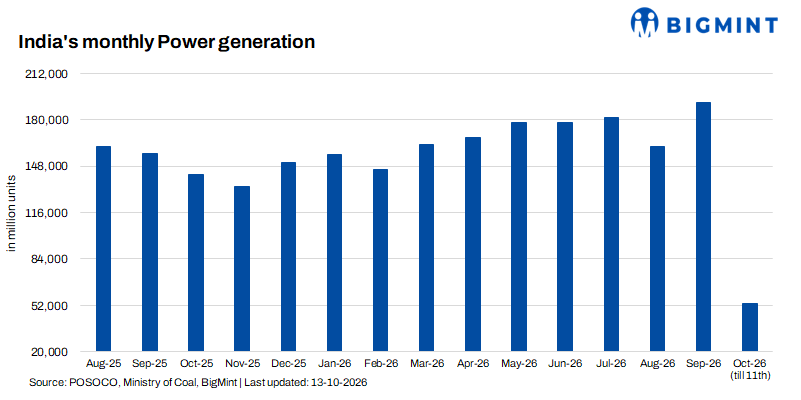
- Coal supplies nearly 79% of additional electricity generation
- Exchange prices almost triple; coal inventories begin stabilising
India’s electricity system remained under considerable pressure during 1-11 October 2026 compared with the corresponding period last year. Higher demand required a strong generation response, led by coal, while weaker hydro output increased dependence on thermal plants.
Coal supplies improved sufficiently to slow inventory depletion and support a modest recovery towards the end of the period. However, recurring evening shortages and high electricity exchange prices show that the system has yet to regain a comfortable supply buffer.
Demand remains substantially above last year
The average of India’s daily maximum demand met increased by 24% to 251.93 GW during 1-11 October, from 203.19 GW a year earlier.
The highest demand met reached 260.73 GW on 5 October, compared with 208.70 GW during the corresponding 2025 period-an increase of approximately 25%.
Demand met exceeded 250 GW on seven of the 11 days. Although below September’s 269 GW record, October’s requirement remained substantially higher than last year.
A change in timing is also evident. During 2025, the national daily maximum generally occurred in the evening. In 2026, it occurred around 3-4 pm on the first 10 days, when solar generation was available.
This creates two distinct operating challenges: meeting a much larger daytime load and maintaining sufficient supply after solar output declines.
Maximum demand met measures the load actually served; it excludes unmet demand.
Coal carries most of the generation response
Gross electricity generation increased by 22.7% to 63,917 MU during 1-11 October, from 52,090 MU a year earlier.

Coal generation increased by 9,313 MU, supplying nearly 79% of the net increase in electricity output. Its average daily generation reached 3,960 MU, approximately 5.3% above September’s daily average.
Renewables added 3,205 MU, but hydro generation fell by 1,926 MU. Consequently, much of the additional renewable output was offset by weaker hydro support.
Hydro generation also declined within October, from approximately 571 MU on 1 October to 444 MU on 11 October. The system therefore continued to require substantial thermal generation despite strong renewable growth.
Gas, naphtha and diesel generation almost tripled, adding 1,078 MU. Although their contribution remained relatively small, the increase shows that the supply response extended beyond coal.
Shortages concentrated in non-solar hours
NLDC reported approximately 236 MU of unmet energy during the eleven days, with shortages recorded every day.
The western region accounted for approximately 110 MU, or 46% of the total, followed by the northern region at 71 MU and the eastern region at 40 MU. Southern and north-eastern shortages were smaller at approximately 12 MU and 3.5 MU, respectively.
Non-solar-hour peak shortages reached 5,812 MW on 3 October and 5,562 MW on 5 October. Shortages remained above 4,000 MW on each day from 6-9 October.
The regional pattern was uneven. On 8 October, the western region reported a 3,442 MW shortage at 7 pm, while the southern region reported none. On 9 October, southern shortages reappeared, including 4.71 MU of unmet energy in Telangana.
These figures establish recurring supply gaps, although they do not identify coal availability as the sole cause. Generation outages, plant availability and network constraints also influence the outcome.
IEX prices reveal much tighter market
The simple average of daily IEX day-ahead market clearing prices increased to INR 7,428/MWh, or INR 7.43/kWh, from INR 2,486/MWh during 1-11 October 2025 – almost three times last year’s level.
Purchase bids increased more than sixfold to 12.95 million MWh, while sell bids halved to 2.58 million MWh. Final scheduled volumes nevertheless declined by approximately 4.9% to 1.71 million MWh.
The combination is significant: buying interest increased sharply, but fewer offers were available and traded volumes did not expand accordingly. Bid volumes represent exchange orders, rather than a direct measure of national unmet electricity demand.
Daily average prices peaked at INR 8.01/kWh on 5 October and remained above INR 7.75/kWh through 9 October.
Sunday, 11 October, brought relief. Maximum demand met fell to 233.77 GW, reported energy shortages dropped to 1.27 MU and the daily average exchange price eased to INR 5.93/kWh. However, even that price remained twice the corresponding 2025 level.
Coal stocks stabilising, not rebuilding
Across monitored power plants, coal receipts totalled approximately 29.18 mnt during 1-11 October against consumption of 29.77 mnt-a deficit of 0.60 mnt.
The balance improved considerably within the period. During 1-6 October, receipts fell short of consumption by approximately 0.80 mnt. During 7-11 October, receipts exceeded consumption by approximately 0.20 mnt.
Total plant stocks recovered from 20.44 mnt on 6 October to 20.87 mnt on 11 October, but remained below the 21.06 mnt reported on 1 October.
Domestic-coal-based plants showed a weaker recovery. Their receipts during 7-11 October only marginally exceeded consumption, while imported-coal-based plants accounted for most of the combined receipt surplus.
By 11 October, 87 plants remained critical, including 81 domestic-coal-based plants. Some individual inventories improved-Kota and Kalisindh, for example-but both still held only 12-14% of normative stocks.
BigMint assessment
October’s supply response is slowing the loss of coal inventories, but the underlying electricity market remains tight.
Demand is substantially above last year, hydro support is weaker and coal continues to carry most of the additional generation. Sustained deliveries above consumption are needed to rebuild buffers, particularly at domestic-coal-based plants.
The improvement on 11 October is encouraging, but a Sunday reduction in demand does not establish lasting relief. The next test is whether stronger coal receipts and generation availability can maintain that improvement when weekday demand returns.
Leave a Reply