- Shipping risks, freight uncertainty continue to weigh on exports
- Persistent uncertainty clouds near-term export outlook
Indian hot-rolled coil (HRC) export activity remained subdued during 24-31 March 2026 across key overseas markets, as escalating geopolitical tensions continued to disrupt major shipping corridors. Heightened security risks along critical routes such as the Red Sea-Suez Canal and the Strait of Hormuz have led to widespread vessel diversions, longer transit times, and a notable surge in freight and war-risk insurance costs.
Market participants have adopted a cautious stance, with no firm offers reported during the week. Elevated freight-related uncertainty, coupled with limited near-term visibility and persistent logistical challenges, weighed on overall market sentiment, keeping export activity largely muted.
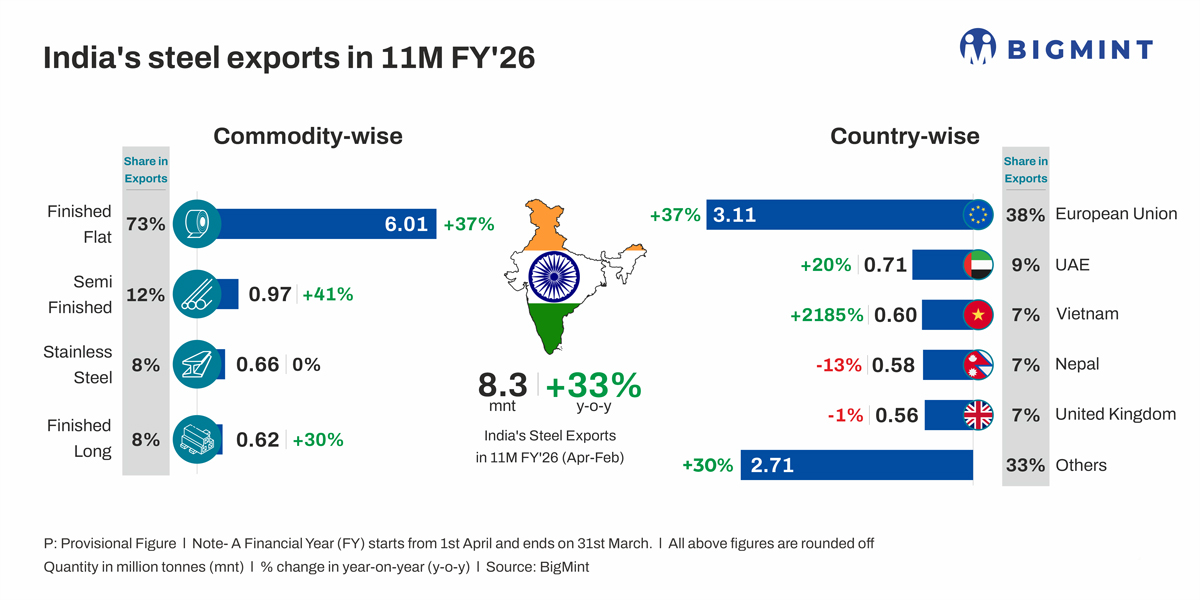
HRC exports to Europe: Indian HRC exports to Europe remained muted, with no firm offers reported, as escalating security risks across key maritime routes continued to disrupt trade flows. An increasing number of vessels are bypassing the Red Sea-Suez Canal corridor and rerouting via the Cape of Good Hope, extending transit times to Europe by approximately 15-20 days. This has disrupted delivery schedules and sharply increased freight and war-risk insurance costs, undermining export competitiveness.
European buyers maintained a cautious approach, preferring domestic material amid ongoing uncertainty. Import volumes into the EU remained constrained, with elevated freight costs, logistical challenges, and regulatory pressures continuing to weigh on overseas procurement.
HRC exports to Middle East: Indian HRC export activity to the Middle East remained largely subdued w-o-w, as escalating geopolitical tensions and persistent security risks in key shipping corridors continued to disrupt trade flows. The Strait of Hormuz, which accounts for around 20% of global oil and LNG trade, has emerged as a key flashpoint. Escalating missile and drone threats, along with attacks on merchant vessels, have significantly disrupted shipping operations, triggering a sharp rise in freight rates and war-risk insurance premiums, thereby eroding export viability.
Shipping lines and insurers have adopted a cautious approach, with several vessels rerouting to avoid the corridor and some carriers suspending operations in high-risk areas altogether. Consequently, trade flows have been materially affected, as heightened freight-related uncertainty and limited near-term visibility continue to weigh on overall market sentiment.
A Middle East-based source indicated that, “ongoing disruptions around the Strait of Hormuz have significantly impacted cargo movements, particularly to and from the UAE, with no improvement in the situation so far. The corridor remains effectively inaccessible, preventing both inbound and outbound shipments and severely constraining regional trade flows. As a result, market activity has largely come to a standstill, with even Chinese suppliers refraining from issuing fresh offers amid persistent logistical uncertainties and elevated shipping risks, leading to a suspension of all offers to the Middle East.”
Meanwhile, May 2026 HRC contracts on the Shanghai Futures Exchange (SHFE) edged down by RMB 20/t ($3/t) w-o-w to around RMB 3,301/t ($478/t) on 31 March, compared with RMB 3,321/t ($481/t) on 24 March.

Outlook
Indian HRC export activity is likely to remain limited as escalating geopolitical tensions continue to disrupt key shipping routes. Longer transit times, elevated freight rates, and higher insurance costs are expected to keep export activity subdued. Exporters are likely to remain cautious until shipping conditions normalise and geopolitical uncertainties ease.
Leave a Reply