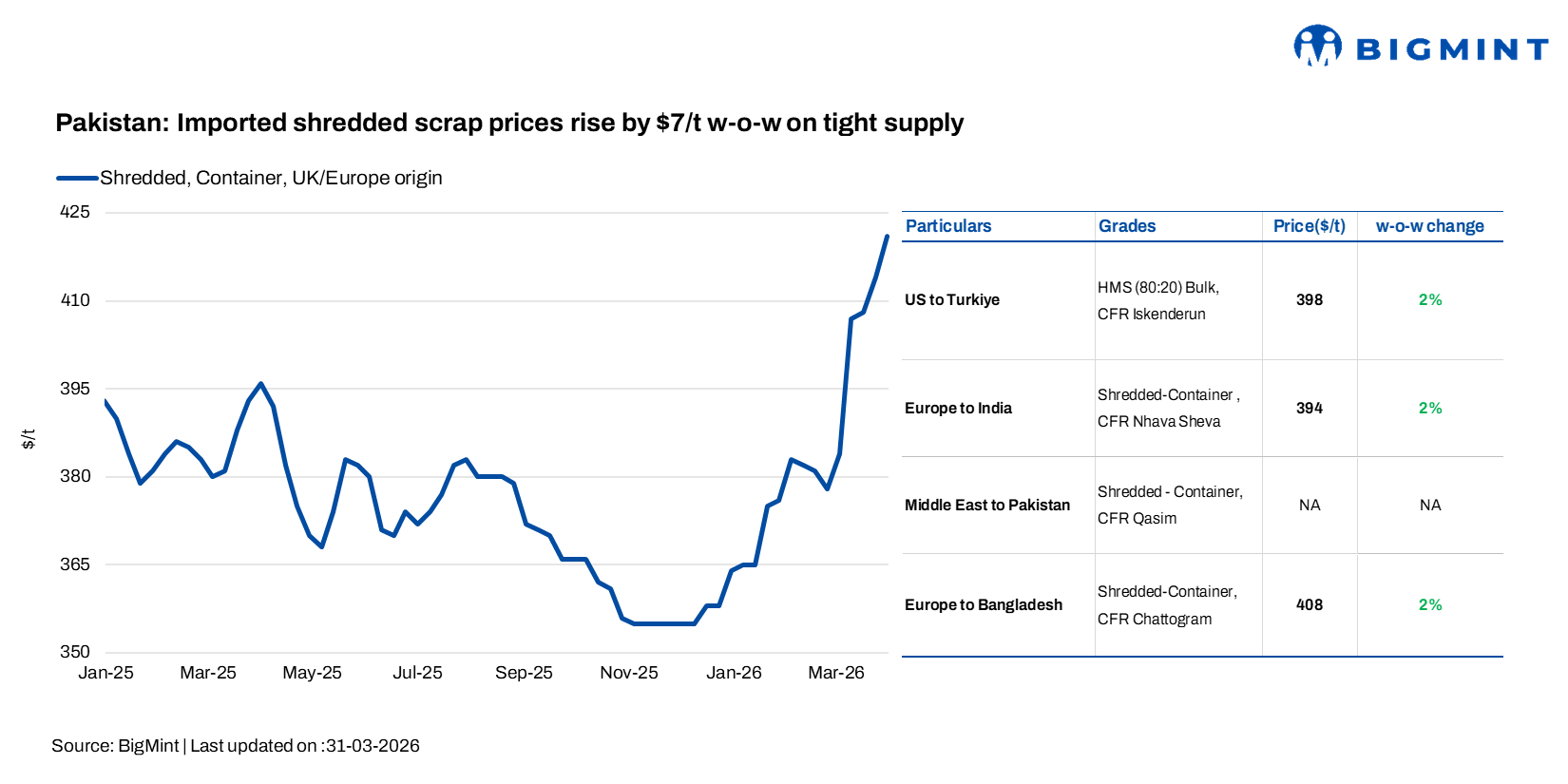
- Shredded prices rise on higher freights, supply constraints
- Producers cautious despite bullish supply-side signals
Pakistan’s ferrous scrap market has remained firm since early to mid-March 2026, with imported shredded scrap prices increasing amid persistent global supply tightness, although actual trading activity slowed due to holidays and cautious downstream demand.
European-origin shredded scrap assessment stood at $421/t, rising by $7/t w-o-w, and offers were heard at $420-423/t for UK-specific yards and at $415-420/t for other European regions on a CFR Qasim basis, with some deals concluded at $413-418/t CFR compared to $405-415/t earlier. Market indications also suggest offers climbing toward $420-430/t amid ongoing container shortages.

A UK-based scrap supplier noted that tighter scrap flows from the Middle East and limited global availability continue to support supplier sentiment. “With shredded scrap in India at around $390-395/t CFR, Pakistani buyers are effectively paying a premium to secure material in the current tight supply environment,” he added.
Despite firm underlying demand, market activity remained subdued. Mills had already restocked in bulk before the holiday period.
Domestic market
Domestic scrap prices were reported at PKR 148,000-152,000/t ($530-545/t). Finished steel prices remained firm, with rebar at PKR 250,000-252,000/t ($896-903/t) and billets at PKR 210,000-215,000/t ($752-771/t).
 Despite the upward trend, producers remained cautious about a potential correction, although most market participants believe any sharp decline is unlikely given the tight supply fundamentals. Notably, sentiment in the commercial trading segment appeared more nervous compared to the relatively stable outlook among formally graded scrap buyers.
Pakistan’s proposed Time-of-Use (ToU) tariff structure could reshape production economics. While higher fixed charges may increase baseline costs, variable tariff optimisation during off-peak hours may offer partial relief, particularly for flexible operations. However, smaller mills may face challenges in adapting to the new system.
Ship recycling activity at Gadani improved slightly this week, supported by available yard space and proximity to Gulf vessels. However, fundamentals remain weak as falling domestic steel plate prices have compressed recycler margins. While a stable rupee offered limited support, cautious sentiment persists. The addition of a few HKC-compliant yards has marginally improved Gadani’s positioning as a competitive option in the regional recycling market.
Outlook
Scrap prices are expected to remain firm in the coming days, supported by tight global supply. However, sluggish finished steel demand, post-holiday slowdown, and cautious buyer sentiment may keep trading activity selective.

Leave a Reply