- South African coal freight faces pressure
- High freights curb fresh bookings on Indonesian routes
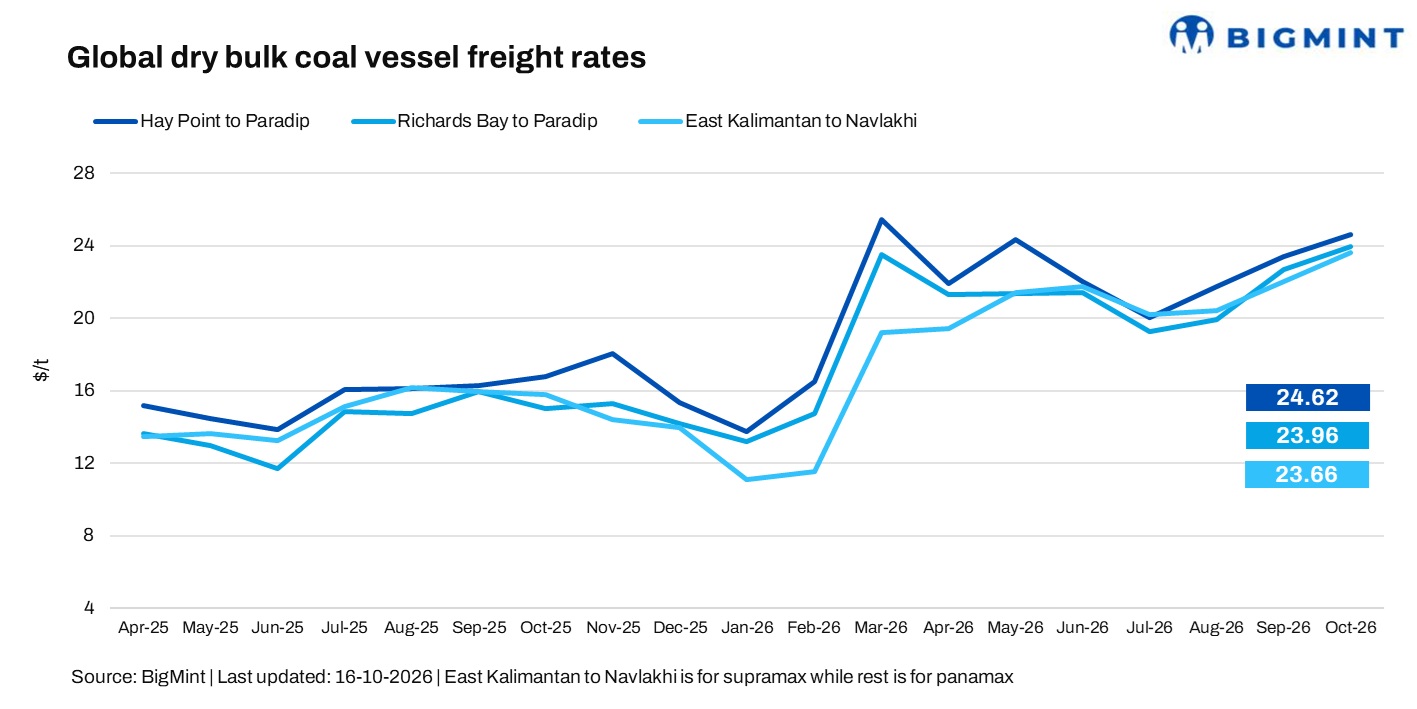
India-bound coal freight markets showed mixed trends in the week ended 16 October 2026, with Australian Panamax routes drawing support from firm Pacific demand, while South African and Indonesian routes faced pressure from limited fresh fixtures and cautious chartering. Rising bunker costs added to vessel operating expenses, but high freight offers continued to deter some charterers, keeping overall market sentiment sideways.
Route-wise update

Panamax holds firm on Australian demand
Australian coal freight remained supported by steady Pacific demand, while weaker Atlantic sentiment and cautious chartering limited gains elsewhere.
A shipbroker said, “Market sentiment remains sideways, with rising bunker prices influencing freight rates. Supramax demand is relatively firm, while Panamax activity is gaining support; however, Capesize demand remains subdued.”
Pacific demand continues to support Panamax activity, despite weakness in the broader dry bulk market.
Supramax faces pressure on high Indonesian freight costs
High freight offers and limited fresh bookings weighed on Indonesian Supramax routes. Some cargoes are shifting to Panamax vessels as charterers seek more economical options.
A shipbroker said, “No fresh fixtures have been reported on Indonesia routes over the past two weeks as high freight rates deter charterers. Some Supramax cargoes are shifting to Panamax vessels, with charterers seeking more economical freight options.”
Indonesia remains a leading coal supplier, supported by strong consumption in August. However, stronger Indian domestic coal production could curb import demand and intensify pressure on smaller importers and trading houses.
Another shipbroker said, “Indonesia continues to lead coal supply, supported by strong consumption in August. However, any improvement in Indian domestic coal production could reduce import demand, putting smaller importers and trading houses under pressure, while established players may remain cautious.”
Dry bulk indicators signal mixed market conditions
- Baltic Dry Index (BDI) declines w-o-w: The BDI fell 14.4% (428 points) to 2,545 as of 15 October, from 2,973 on 8 October, amid weaker Capesize market performance and subdued cargo activity. The Panamax index declined 2.3% (55 points) to 2,356, while the Supramax index rose 2.7% (49 points) to 1,856, supported by relatively steady demand for smaller vessels.
- Bunker prices rise further w-o-w: Singapore Very Low Sulfur Fuel Oil (VLSFO) increased by $13.5/tonne (t), or 1.5% w-o-w, to $910/t on 16 October from $896.5/t on 9 October. The continued rise reflects persistent crude-price volatility and Middle East supply concerns, adding to fuel-cost pressures for vessel operators and potentially supporting higher freight rates.
- Brent crude futures rise w-o-w: December Brent crude futures climbed 2.1% ($2.20/barrel (bbl)) to $106.48/bbl as of 16 October, from $104.28/bbl on 9 October, supported by persistent geopolitical tensions and concerns over potential supply disruptions in the Middle East. Rising crude prices could push marine fuel costs higher, adding to vessel operating expenses and keeping dry bulk freight rates exposed to further volatility.
- DCE coke futures decline w-o-w: January 2027 Dalian Commodity Exchange (DCE) coke futures fell 2.4% (RMB 47.50/t; $6.60/t) to RMB 1,972.50/t ($294.79/t) as of 16 October, from RMB 2,020/t ($301.39/t) on 8 October, amid cautious market sentiment and concerns over steel demand.

Outlook
BigMint expects Australian Panamax freight to remain supported by Pacific cargo demand, although weaker Atlantic conditions could limit broader market gains. Indonesian Supramax routes may remain under pressure if high freight offers continue to deter charterers and cargoes shift to larger vessels.
Rising bunker costs will remain a key factor shaping owners’ offers, while developments in Indian domestic coal production could influence import requirements. Overall, the market is likely to remain sideways and route-specific, with fresh cargo enquiries, vessel availability and charterers’ acceptance of prevailing freight levels determining the next move.
Leave a Reply