- Weak demand and ample availability are keeping prices under pressure
- Tight power stocks and post-Diwali restocking could support prices
Indian portside prices of Indonesian thermal coal softened marginally week-on-week (w-o-w) during the week ended 16 October, as subdued industrial consumption, comfortable spot availability and cautious procurement continued to weigh on market sentiment.
Buyers remained largely defensive, with several market participants indicating that prevailing Indonesian coal prices have stabilised at current levels, while procurement interest remains limited as consumers increasingly favour domestically sourced coal where available.
Portside prices slip marginally as spot availability builds
Against this demand backdrop, Indonesian thermal coal prices at key Indian ports recorded modest declines. Prices of 5,000 GAR coal decreased by around INR 100/t w-o-w to approximately INR 11,700/t at Kandla and INR 11,600/t at Vizag.
Similarly, 4,200 GAR coal prices declined by around INR 50/t to approximately INR 9,800/t at Kandla and INR 9,700/t at Vizag. Meanwhile, 3,400 GAR coal at Navlakhi eased by around INR 100/t to approximately INR 7,750/t.
The relatively modest price correction suggests that sellers are currently facing pressure from weak spot demand rather than a significant deterioration in the broader supply-demand balance. With replacement requirements still present among power and industrial consumers, downside potential appears limited unless buying activity weakens further.
Muted industrial demand keeps buyers on the sidelines
Demand for imported thermal coal remained subdued during the week, particularly from industrial consumers, amid cautious purchasing and adequate availability of spot cargoes.
Market participants reported that buyers are currently reluctant to build inventories aggressively, preferring to adopt a wait-and-watch approach before committing to fresh purchases. The availability of domestic coal at relatively competitive levels has further reduced the urgency for imported coal procurement, particularly among price-sensitive industrial consumers.
As a result, Indonesian coal prices have remained largely stable, with sellers facing limited room to push offers higher despite firmer international benchmarks. One market participant noted that cargo availability in the market is currently ample, while buying activity remains weak, resulting in a gradual build-up of inventories. Market activity is therefore expected to remain subdued in the near term, with a potential improvement in demand anticipated after the Diwali period as industrial operations normalise.
Tight power-plant stocks provide a crucial price floor
Despite weak spot-market activity, declining inventories at domestic thermal power plants continue to provide underlying support to imported coal prices. Coal stocks at Indian thermal power plants declined by around 1% w-o-w to 20.44 million tonnes (mnt) as of 15 October, equivalent to roughly seven days of consumption. In addition, nearly 91 power plants were reportedly operating with critically low coal inventories.
The relatively tight stock position remains an important bullish factor for the thermal coal market, particularly ahead of any seasonal or weather-driven increase in electricity demand. Although adequate port availability and subdued industrial buying are currently preventing a meaningful price recovery, sustained depletion of power-sector inventories could encourage utilities to return to the seaborne market for replenishment, thereby limiting further downside.
Rising port inventories reflect weak offtake
The build-up in port inventories further highlights the current imbalance between cargo availability and immediate consumption. Coal inventories at Indian ports covered under BigMint’s Week 41 assessment increased by 0.24 mnt, or 1.3%, to 18.68 mnt during 4-10 October 2026. Within this, non-coking coal inventories rose by 0.32 mnt, or 2.4%, to 13.39 mnt, while coking coal inventories declined by 0.08 mnt, or 1.6%, to 5.28 mnt.
The rise in non-coking coal stocks indicates that imported thermal coal inflows are currently outpacing immediate offtake, particularly as buyers remain cautious about accumulating high-cost inventories. Unless demand improves, elevated stocks could continue to act as a ceiling on portside price recovery in the short term.
Firm Indonesian benchmarks signal limited downside from the supply side
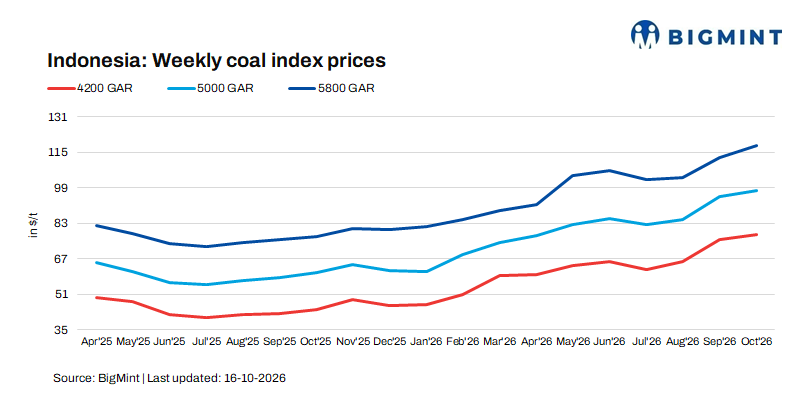
In contrast to the softer Indian portside market, Indonesian FOB benchmarks showed a broadly positive trend during the week. 4,200 GAR coal prices increased marginally by around $0.1-0.2/t, while 5,800 GAR coal prices strengthened more significantly by approximately $7-8/t. Meanwhile, 3,400 GAR coal prices increased by around $4-5/t.
The firmness in Indonesian FOB benchmarks suggests that the current weakness in Indian delivered prices is being driven primarily by domestic market factors — namely subdued buying, rising inventories and competition from domestic coal — rather than a broad-based decline in Indonesian coal fundamentals. This divergence could eventually constrain the extent of further price reductions at Indian ports if Indonesian sellers maintain firm offers.
Outlook
Indonesian thermal coal prices are expected to remain stable-to-soft in the near term, weighed down by ample availability, elevated port inventories and cautious buying. However, downside may remain limited by tight power-plant stocks and potential replenishment demand. Post-Diwali industrial activity and power-sector restocking will be key to market direction, with stronger demand likely to support prices, while comfortable domestic coal availability could cap any recovery.
Leave a Reply