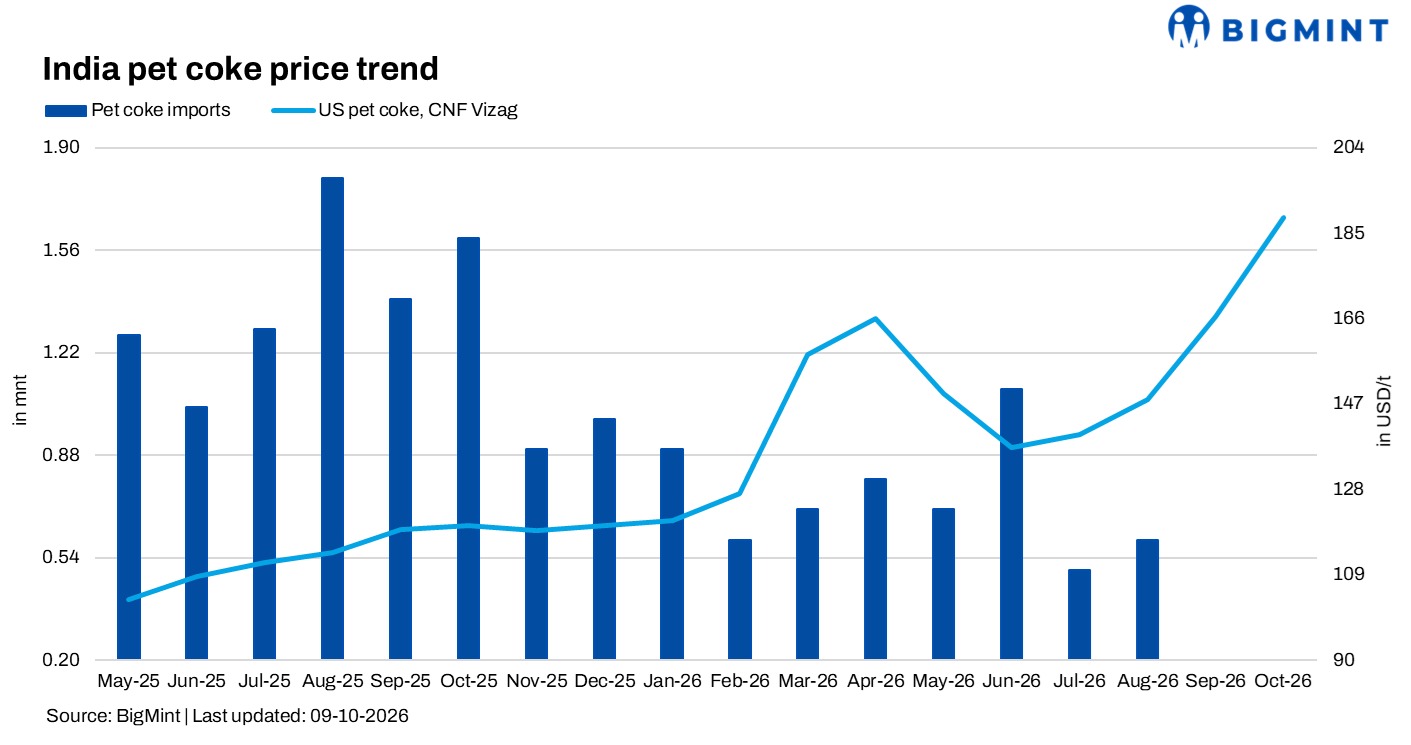
- Expensive petcoke and NAPP coal encourage domestic coal blending
- October arrivals could ease India’s NAPP retail supply pressure
Indian cement producers face an expensive fuel market. Imported petcoke and US high-calorific-value coal prices have risen, limiting the savings available from switching between these two fuels.
Buyers are increasingly examining domestic coal and alternative imported grades, including higher-sulphur South African material. Their objective is to reduce the cost of the overall blend while retaining sufficient heat value and controlling ash. Low-ash imported coal therefore remains important, even where companies increase domestic coal use. The market is firm, but resistance to higher offers is encouraging selective purchases, consumption of existing stocks and changes in fuel mix.
Global petcoke: Higher offers meet buying resistance
Early-October checks place offers for US high-sulphur petcoke for October-November loading in the mid-to-high $180s/t CFR west coast India. Some east-coast offers have reached approximately $190/t.
Buying interest remains below these levels. Checks indicate some buyers considering prices in the $170s/t, while others have stepped back. These are bids and offers, rather than evidence of widespread transactions.
Indicative US Gulf netbacks associated with the higher destination offers exceed $110/t FOB, although fixed-price business remains thin. Freight stabilisation has supported sellers’ netbacks, but expensive delivered petcoke is narrowing its advantage over competing coals.
Petcoke supply also responds differently from mined coal. As a refinery by-product, its availability depends on refinery operations, crude feedstock and processing decisions. Higher oil prices alone do not establish whether petcoke production is increasing or declining.
The clearest current signal is higher replacement costs combined with growing buyer resistance. The available checks do not establish a global production shortfall.

Petcoke and NAPP cannot be compared on dollar-per-tonne prices alone. Buyers must account for heat value, ash, moisture, sulphur, handling and inland transport to determine the cost of usable fuel.
Indian cement: Rising costs change procurement
As construction activity improves after the monsoon, cement fuel requirements could strengthen. However, buyers remain reluctant to accept expensive replacement cargoes.
BigMint’s early-October checks show some producers consuming existing petcoke inventories and increasing domestic coal use. Others are examining alternative imported grades.
One producer reported approximately 70% domestic coal use, illustrating the extent of substitution possible at individual plants. This should not be treated as an industry-wide ratio.
Recent cement price increases may help recover higher costs, but their benefit depends on acceptance by customers. Until then, producers have an incentive to limit fuel spending through selective buying and changes in their blends.
Import demand can therefore soften even while cement production remains healthy: companies may burn existing stocks or replace part of their imported fuel requirement.
Domestic coal gains attention; low ash retains value
Domestic coal offers potential savings, but its higher ash content can complicate kiln operations and the raw-material balance.
Low-ash imported fuel helps offset that limitation. Buyers may consequently reduce purchases of expensive imported grades without eliminating their need for a low-ash blending component.
Discounted high-sulphur or otherwise off-spec South African coal provides another option where its quality suits the plant. The discount must compensate for any additional operating, blending or handling costs.
Higher sulphur is acceptable only within a plant’s operating and environmental limits. Such material is therefore suitable for particular consumers, rather than a universal substitute. Domestic availability also matters. Greater enquiries do not guarantee sufficient supply, particularly when power-sector requirements compete for coal.
US NAPP: Valuable blending fuel, expensive replacement
Northern Appalachian coal competes with petcoke through its high heat value and relatively low ash. Indicative offers around $185/t CFR India, however, make it an expensive alternative. Late-September checks indicated that one major supplier had committed availability through January. This suggests limited prompt flexibility at that supplier, rather than the absence of all US supply.
The long voyage adds another cost hurdle. An early-October US East Coast–India freight indication of approximately $51.75/t illustrates the substantial transport component.
NAPP retains blending value, but cement buyers increasingly weigh that benefit against cheaper domestic and alternative imported coals.
ILB: Thin trade limits market visibility
Illinois Basin coal remains a smaller part of the visible Indian trade. The vessel list identifies one 60,370-tonne ILB cargo, compared with numerous NAPP shipments.
That supports the description of thin visible trade, but does not establish a national market share. ILB is not a popular coal with cement companies for its chlorine content.
NAPP retail: Firm prices, cargoes approaching
NAPP has an additional outlet through Indian port-based stock-and-sale trading, allowing consumers to purchase quantities below full-cargo size. This is distinct from the predominantly cement-focused petcoke channel.
Early-October spot indications of INR 18,500–19,500/t show firm replacement costs, alongside reports of need-based buying.
The 5 October check records approximately 99,533 tonnes of retail stock at Kandla and Tuna, with 36,895 tonnes lifted during the reported week. Earlier sheets have differing totals and seller coverage, preventing a clean inventory comparison.
Incoming supply is substantial. The lineup lists approximately 0.84 Mnt across ten October arrivals classified as retail or mixed retail/industry, plus approximately 0.56 Mnt across seven industry-listed NAPP arrivals.
These are expected shipments, not completed receipts. Mixed-use cargoes will not all become freely available retail stock. Nevertheless, timely arrivals and discharge could ease spot pressure.
BigMint assessment
The market combines expensive replacement supply with increasing buyer resistance. Cement demand supports fuel consumption, but cost pressures favour cheaper blends and selective imports. Petcoke and NAPP remain valuable for their heat and ash characteristics. Higher prices are encouraging substitution rather than eliminating their role.
For NAPP retail, October deliveries are the main potential source of relief. For cement producers, the decisive measure remains the delivered cost of a technically workable fuel blend.
Leave a Reply