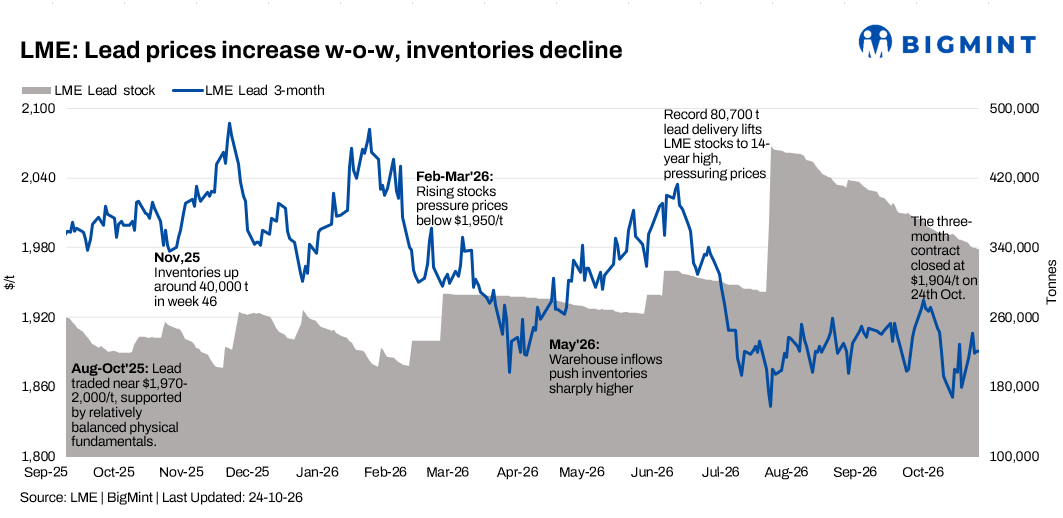
- LME inventories fall 15,300 t during the week
- Tight concentrate supply offsets rising secondary output
Lead prices strengthened during the week ended 23 October as falling London Metal Exchange (LME) inventories and tight concentrate availability supported the market. However, prices struggled to sustain levels above $1,900/t as cautious downstream procurement, expectations of higher Chinese secondary lead production and a widening global refined-lead surplus in 2027 limited buying momentum.
LME cash lead settled at $1,872/t on 22 October, up 1% from $1,854/t on 16 October. The three-month contract rose 0.3% to $1,897/t. Meanwhile, exchange inventories declined by 15,300 t to 323,975 t, and the cash-to-three-month contango narrowed by $12/t to $25/t.
The combination of falling stocks and a narrowing contango indicates firmer nearby availability. However, the continued contango suggests that the market has yet to reflect an outright shortage.
Concentrate shortages pressure primary production
Lead concentrate availability remained tight, with domestic Chinese treatment charges at CNY 0/t for Pb50 material and imported Pb60 treatment charges at -$190/dmt. These levels indicate strong competition for feedstock and pressure on primary smelter economics.
China’s primary lead smelter operating rate across three provinces fell by 4.14 percentage points week-on-week to 64.03% during 16-22 October. Maintenance at major Henan smelters contributed to the decline, potentially limiting refined-metal availability if concentrate constraints persist.
However, the impact on total supply remains uncertain. China’s secondary lead smelter operating rate across four provinces increased by 2.4 percentage points to 33.2% over the same period as facilities resumed production. Further restarts could offset some of the decline in primary output.
Battery demand provides limited support
China’s lead-acid battery manufacturers recorded an operating rate of 74.16% during 16-22 October, up 0.79 percentage points week-on-week. Automotive battery producers gradually increased output ahead of the fourth-quarter peak season, supporting lead consumption.
However, demand remained uneven. Seasonal e-bike battery demand weakened, while manufacturers continued to procure lead ingots mainly against immediate requirements and gaps in long-term supply contracts. This limited the scope for a stronger demand-led price increase.
Secondary lead supply also remained sensitive to battery-scrap availability. Although scrap quotations declined by CNY 50-100/t during the week, suppliers continued to hold offers firm amid relatively tight spot availability. Any improvement in secondary smelter output will therefore depend on feedstock collection and procurement economics.
Global surplus limits price upside
The International Lead and Zinc Study Group’s October forecast projects a refined-lead surplus of 90,000 t in 2026, widening to 163,000 t in 2027. Global refined output is forecast to rise by 1% to 13.88 mnt in 2026 and by a further 1.5% to 14.08 mnt in 2027.
Demand is expected to increase by 0.9% to 13.79 mnt in 2026 and by 1% to 13.92 mnt in 2027. The projected surplus indicates that additional refined production could outpace consumption growth, limiting the sustainability of price rallies.
Outlook
Lead prices are likely to remain sensitive to inventory movements and Chinese production trends through November. Continued declines in LME stocks and further restrictions on primary output could support prices, particularly if concentrate availability deteriorates during seasonal mine production slowdowns.
However, secondary smelter restarts and cautious battery-sector procurement may cap gains. The market’s ability to sustain prices above $1,900/t will depend on whether tightening prompt availability outweighs the prospect of additional recycled supply. The projected 163,000 t surplus in 2027 remains a key constraint on the broader price outlook.
Leave a Reply