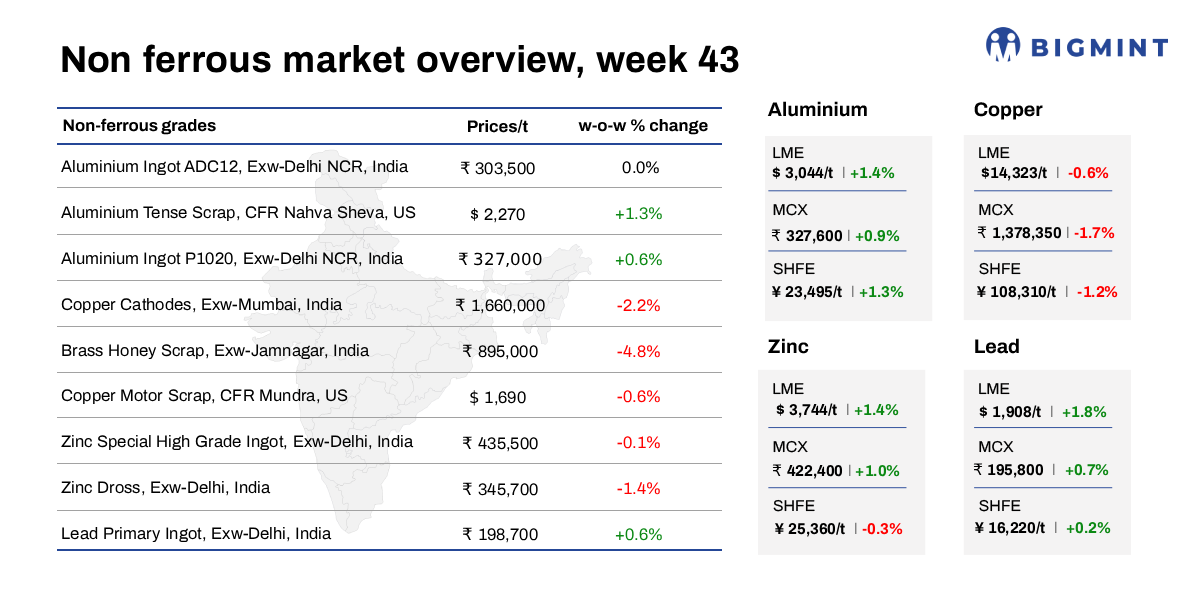
- Stronger dollar, record Chinese aluminium output weigh on LME prices despite supply risks
- Copper cathode prices fall as LME inventory builds and Indian buyers delay purchases
LME base metals faced pressure from a stronger US dollar, elevated US Treasury yields and uneven demand expectations. Aluminium weakened amid rising Chinese production and expectations of additional global supply, while copper declined as inventories increased. Zinc also came under pressure from a sharp build-up in exchange stocks, although continued tightness in nearby supply offered some support. Lead remained comparatively resilient.
Indian non-ferrous markets showed mixed price movements as international benchmarks, domestic procurement and primary metal pricing diverged. Aluminium ingot prices edged higher despite weaker global sentiment, while imported Zorba scrap offers declined marginally. Copper cathode and armature scrap prices fell as buyers awaited further corrections. Zinc dross and oxide prices also weakened, whereas HZL raised its primary zinc and lead benchmarks, highlighting the contrasting dynamics between primary metal pricing and secondary-market demand.
Aluminium
India’s aluminium market showed mixed price movements, with primary metal prices recovering slightly while imported scrap offers softened. According to BigMint’s assessment, P1020 aluminium ingot prices in Delhi NCR rose by INR 2,000/t (0.62%) w-o-w to INR 327,000/t. Meanwhile, UK-origin Zorba 95-5 scrap prices fell by $10/t (0.38%) to $2,610/t.
Globally, three-month LME aluminium prices declined by 3% w-o-w to $3,024/t from $3,104/t, despite a 0.4% decrease in inventories to 238,325 t. A stronger US dollar, elevated US Treasury yields and subdued Chinese demand weighed on prices. Meanwhile, expectations of higher Chinese output, expanding Indonesian capacity and Middle Eastern smelter restarts reinforced concerns over future supply. However, ongoing Gulf disruptions and low exchange inventories continue to limit downside pressure.
Domestic aluminium prices may remain sensitive to global benchmarks and downstream demand. Although primary ingot prices recovered marginally, subdued consumption and weaker scrap offers suggest that buying interest remains selective. Further price movements will depend on the pace of demand recovery and changes in global supply expectations.
Copper
India’s copper market weakened as lower global benchmarks and cautious buying weighed on domestic prices. According to BigMint, copper cathode prices ex-Mumbai fell by INR 31,000/t (2.2%) w-o-w to INR 1,366,000/t. Copper armature scrap prices ex-Delhi declined by INR 35,000/t (2.6%) to INR 1,305,000/t.
LME copper fell 0.93% w-o-w to $14,356/t in the week ended 22 October. Inventories rose 1.81% to 233,800 t, encouraging buyers to delay purchases. However, Japanese cathode premiums remained high at $310–320/t CIF Nhava Sheva. PSIC-related port delays also restricted copper scrap availability for mid-sized traders. Supply concerns extended to Europe. Codelco offered a record premium of $350/t for 2027 cathode deliveries, up from $325/t in 2026. Aurubis also raised its offer to $347/t from $315/t.
Indian copper prices may remain under pressure amid cautious buying and weaker LME benchmarks. However, tight cathode supplies and scrap-clearance delays could support physical premiums.
Zinc & lead
India’s secondary zinc market weakened during the week as softer international sentiment and rising exchange inventories weighed on prices. BigMint assessed zinc dross prices ex-Delhi at INR 345,700/t, down INR 5,000/t (1.43%) w-o-w, while zinc oxide (99% Zn) prices fell by INR 4,200/t (1.26%) to INR 330,000/t. In contrast, HZL raised its SHG zinc benchmark by INR 2,000/t to INR 400,300/t on 22 October and its lead ingot benchmark by INR 400/t to INR 211,600/t.
Globally, LME zinc inventories climbed to 167,075 t from 151,050 t a week earlier, a 10.6% increase. The build-up reflects continued deliveries into LME warehouses, alongside increased Chinese refined zinc exports and expectations of recovering mine output as operations resumed following safety-related disruptions. China’s refined zinc exports reached 70,400 t in September, up 73.2% m-o-m, adding to international supply availability.
However, lead showed firmer underlying supply conditions: secondary lead smelter operating rates rose by 2.4 percentage points to 33.2% during 16–22 October, while spot supply remained tight. A large smelter’s production resumption in Inner Mongolia is expected to support further operating-rate gains.
Zinc dross and oxide prices may remain under pressure if higher exchange inventories and improved export availability continue to weigh on sentiment. However, constrained concentrate supply and elevated production costs could limit the downside. Lead prices may find support from tight spot availability, although improving secondary smelter operations could gradually ease supply constraints.
Leave a Reply