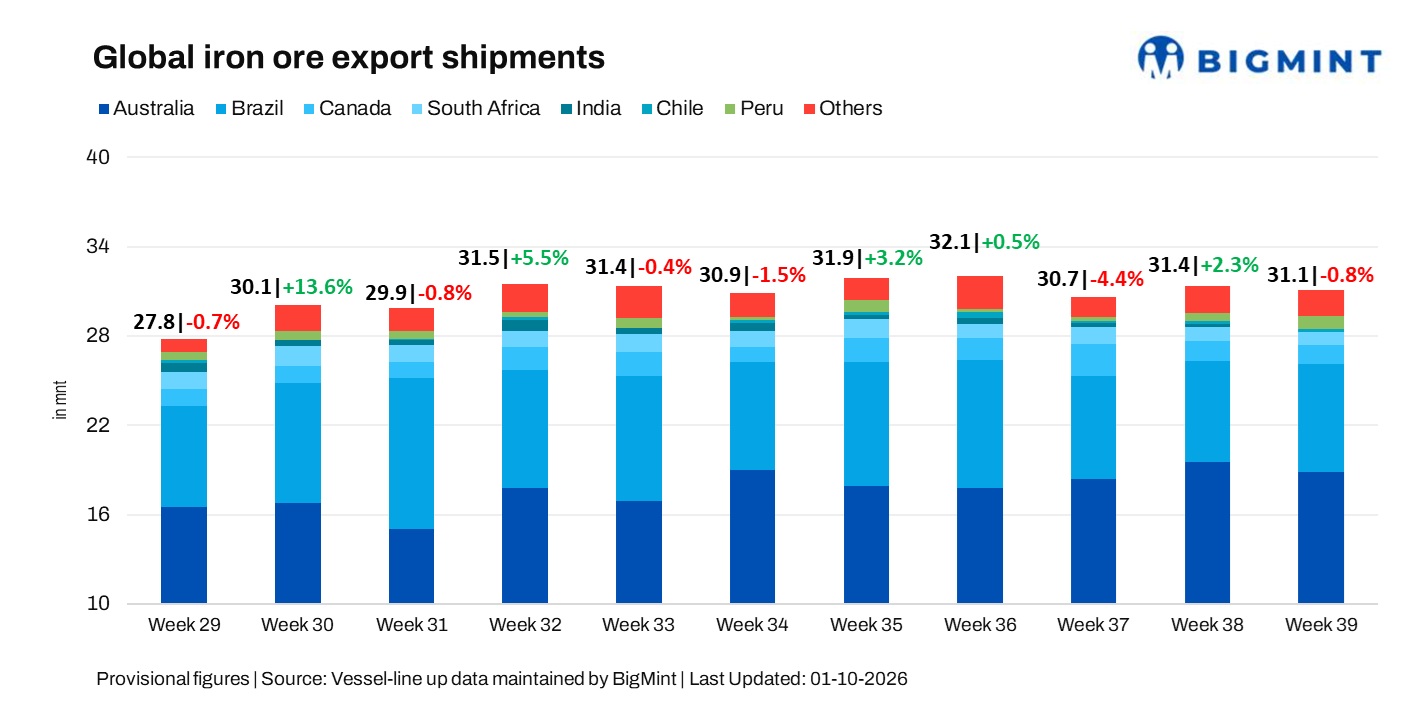
- Brazil, Peru shipments strengthen, offsetting weaker flows from Australia
- Atlantic Capesize freights firm on tighter tonnage; Pacific sentiment subdued
Global seaborne iron ore shipments remained largely stable w-o-w (down 0.8%) at 31.1 million tonnes (mnt) in the week ended 25 September, from 31.4 mnt a week earlier. Firmer shipments from Brazil, Peru, Chile, Guinea and Sweden were offset by softer flows from Australia, Canada, South Africa, India, Liberia and Mauritania, while Sierra Leone and Norway remained broadly stable.
The weekly market remained mixed, with stronger Atlantic-side cargo activity contrasting with softer Pacific sentiment. Pre-holiday Chinese buying provided some support to cargo enquiries, although cautious steel-market sentiment and weak mill margins continued to cap demand momentum.
Country-wise exports

Port & shipper-wise trends
- Australia: Hedland led shipments at 11.6 mnt, followed by Walcott at 4.1 mnt and Dampier at 2.7 mnt. Rio Tinto was the largest shipper at 6.8 mnt, followed by BHP at 5.4 mnt and FMG at 4.8 mnt. China remained the key destination at 16.4 mnt, followed by Japan at 0.8 mnt.
- Brazil: Ponta da Madeira led at 2.7 mnt, followed by Tubarao at 1.6 mnt and Itaguai at 1.3 mnt. Vale accounted for 3.5 mnt, while CSN and Vale together shipped 2.9 mnt. China received 4.8 mnt.
- Canada: Sept-Iles led at 0.8 mnt, followed by Milne Inlet at 0.3 mnt. France received 0.3 mnt, followed by the Netherlands at 0.3 mnt and China at 0.2 mnt. IOC shipped 0.8 mnt, while Baffinland accounted for 0.3 mnt.
- South Africa: Saldanha handled 0.8 mnt, followed by Richards Bay at 0.1 mnt. China received 0.5 mnt.
- Chile: Totoralillo handled 0.2 mnt, with the entire volume destined for South Korea.
- Peru: San Nicolas led at 0.7 mnt, followed by Matarani at 0.1 mnt. China received 0.8 mnt, while Shougang Hierro accounted for 0.7 mnt.
- Guinea: Morebaya handled 0.8 mnt, with China receiving 0.4 mnt.
- Liberia: Buchanan handled 0.1 mnt during the week.
- Sierra Leone: Freetown handled 0.2 mnt during the week.
- Norway: Mo I Rana handled 0.01 mnt, with the entire volume destined for the Netherlands.
- Mauritania: Nouadhibou handled 0.4 mnt during the week.
- Sweden: Narvik handled 0.4 mnt, with Germany receiving 0.1 mnt and India 0.2 mnt.
Capesize Atlantic freights firm; Pacific sentiment subdued
Capesize freight markets remained mixed, with Atlantic rates firming on tighter prompt tonnage and steady cargo enquiries, particularly on Brazil-China and South Africa-China routes. In contrast, Australia-China rates softened amid ample vessel availability and subdued fresh enquiries. Firmer bunker costs also lent support to freight rates.
Overall, the freight market remained supported by tighter Atlantic tonnage and steady cargo activity, while ample Pacific vessel availability and cautious buying sentiment limited upside.
Outlook
Global shipments are likely to remain mixed, with stronger Atlantic cargo activity supporting Brazil and West African flows, while operational and logistics constraints could keep volumes from Canada, South Africa and other smaller exporters volatile.
Freight rates are expected to remain largely stable, with tighter Atlantic tonnage and healthy cargo availability providing support. However, ample Pacific vessel availability, cautious Chinese buying and weak steel margins could limit further upside.
Leave a Reply