- Concentrate market faces 640,000 t deficit in 2026
- Mine output declines amid ageing assets, project delays
Global copper concentrate supply is expected to remain tight through 2026-27 as declining ore grades at ageing mines, delays to new projects, and rising development costs constrain supply growth, according to industry reports from the 2026 China Copper Week in Harbin, Heilongjiang province.
Chinese market research institute Antaike expects the global copper concentrate market to record a supply deficit of 640,000 t in 2026, followed by a 440,000 t deficit in 2027. Market participants have forecast a wider 2026 deficit of 650,000-850,000 t, underscoring persistent tightness in concentrate availability.
Mine supply under pressure
Global copper mine output declined 1.9% y-o-y to 9.38 mnt during January-May, while copper concentrate production fell 3.3% y-o-y to 7.28 mnt.
Production at major mining companies has also weakened amid underinvestment, declining ore grades and operational disruptions. Combined copper output from the world’s 14 largest copper mining companies fell 3.9% y-o-y to 6.35 mnt in H1CY’26.
Declining ore grades are increasing the amount of material miners need to process to maintain output. Average global copper ore grades fell to 0.45% in 2023 from 0.9% in 2000, highlighting the growing capital and operating requirements at existing mines.
India increases reliance on imported concentrate
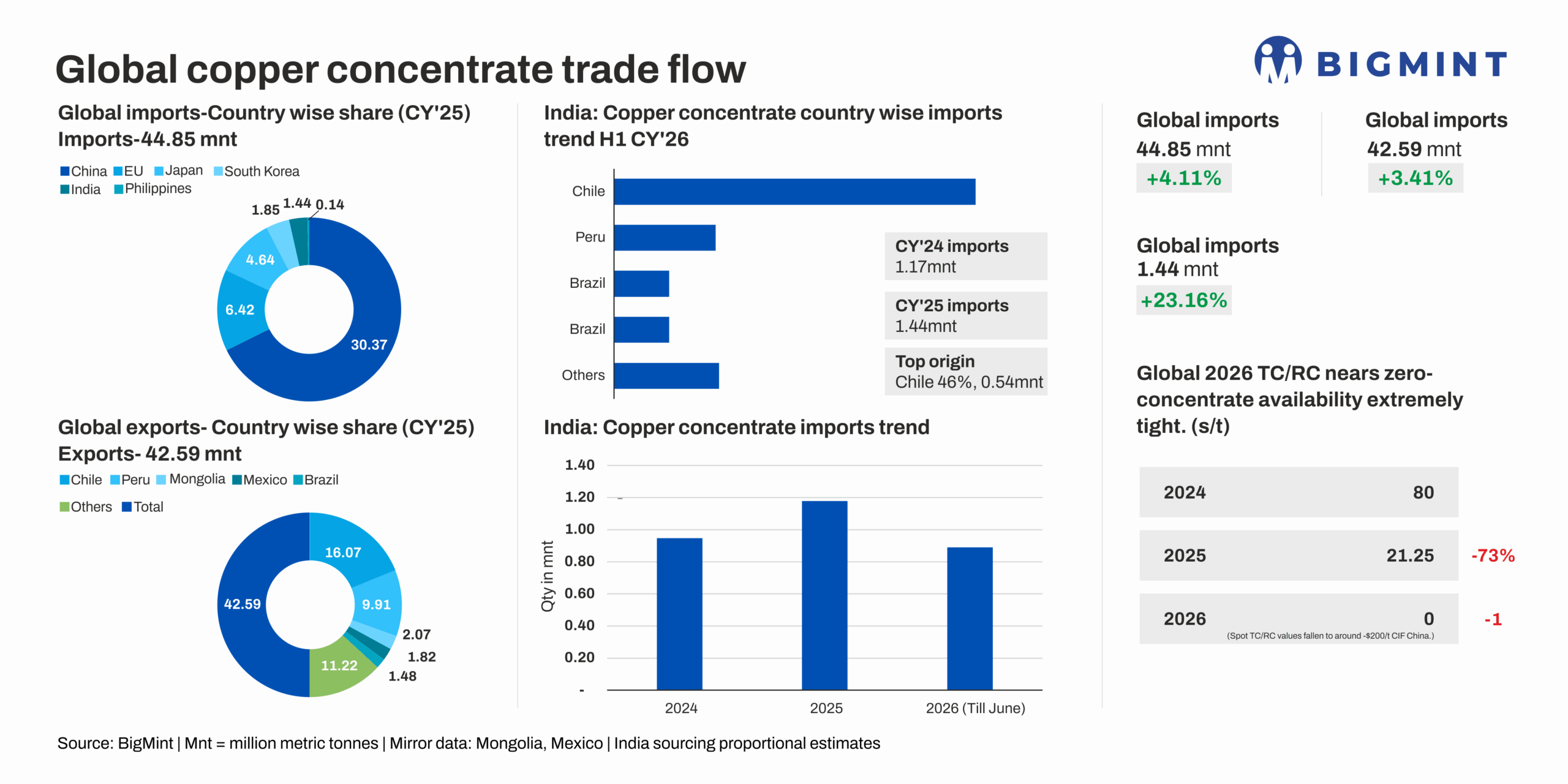
India’s copper concentrate imports increased to 888,723 t in H1CY’26, up 46% y-o-y from 608,858 t in H1CY’25.
The increase reflects higher domestic smelting capacity and stronger concentrate requirements, with Indian smelters increasing their reliance on imported feedstock amid limited domestic concentrate availability.
The rise in Indian concentrate procurement adds another demand centre to an already tight global market. As Indian and Chinese smelters expand capacity, competition for seaborne concentrate is increasing at a time when global mine supply is struggling to keep pace.
India’s dependence on imported concentrate is expected to remain high as domestic mine output remains insufficient to meet the requirements of expanding smelting capacity.
New projects face higher costs
Copper mine supply is also being constrained by rising development costs and delays to new projects. Many undeveloped deposits are located in remote regions, increasing infrastructure, capital, and operating costs.
Persistent inflation has added to development expenses, with industry data indicating that capital expenditure required to develop a mine is now around 45% higher than originally budgeted.
These cost pressures could make it more difficult for new projects to offset declining production from ageing operations, particularly where development timelines are already extended.
Geopolitical risks add uncertainty
Resource nationalism has intensified across major copper-producing regions, particularly in Latin America and Africa. Government intervention through export restrictions, higher royalties, and tax reforms has emerged as an additional source of uncertainty for global copper supply chains.
For smelters, these supply constraints have tightened the concentrate market beyond earlier expectations.
The 2026 annual benchmark treatment and refining charges (TC/RC) settled at $0/t, reflecting severe concentrate shortages. Spot TC/RC values have subsequently fallen to around negative $200/t CIF China.
The negative spot TC/RC level indicates intense competition among smelters for available feedstock and increasingly weak treatment economics for smelters.
Chinese smelter capacity expands
China’s copper smelting capacity continues to expand despite tight concentrate availability. Yingkou Jianfa Shenghai commissioned the first phase of its new copper smelter in Yingkou, Liaoning province, on 12 September, adding 300,000 t/year of refined copper production capacity.
The first phase will process copper concentrate as feedstock. The company has not disclosed a construction or commissioning timeline for the second phase, which is also designed for 300,000 t/year of refined copper production capacity.
The start-up follows the commissioning of the 300,000 t/year second phase of the Jintong copper smelter project in Chifeng, Inner Mongolia, in June.
Yingkou Jianfa Shenghai is a newly established copper smelting company jointly invested by Xiamen C&D and Liaoning Shenghai Industrial.
Market implications for India
India’s 46% y-o-y increase in concentrate imports in H1CY’26 highlights the growing importance of imported feedstock for its expanding copper smelting sector.
With China also adding smelting capacity and global mine supply remaining constrained, Indian smelters could face stronger competition for seaborne concentrate. This could increase exposure to movements in treatment charges, freight and import costs.
The projected global deficits for 2026 and 2027 suggest that concentrate availability will remain a key constraint for smelters. For India, continued expansion of refining capacity without a corresponding increase in domestic concentrate production would keep the industry dependent on international supply.
Unless delayed mining projects advance sufficiently to offset production declines from ageing operations, competition for concentrate is likely to remain elevated through 2027. For Indian smelters, the availability and cost of imported concentrate will therefore remain an important factor in determining operating economics.
Leave a Reply