- MGO and HSFO decline across major hubs
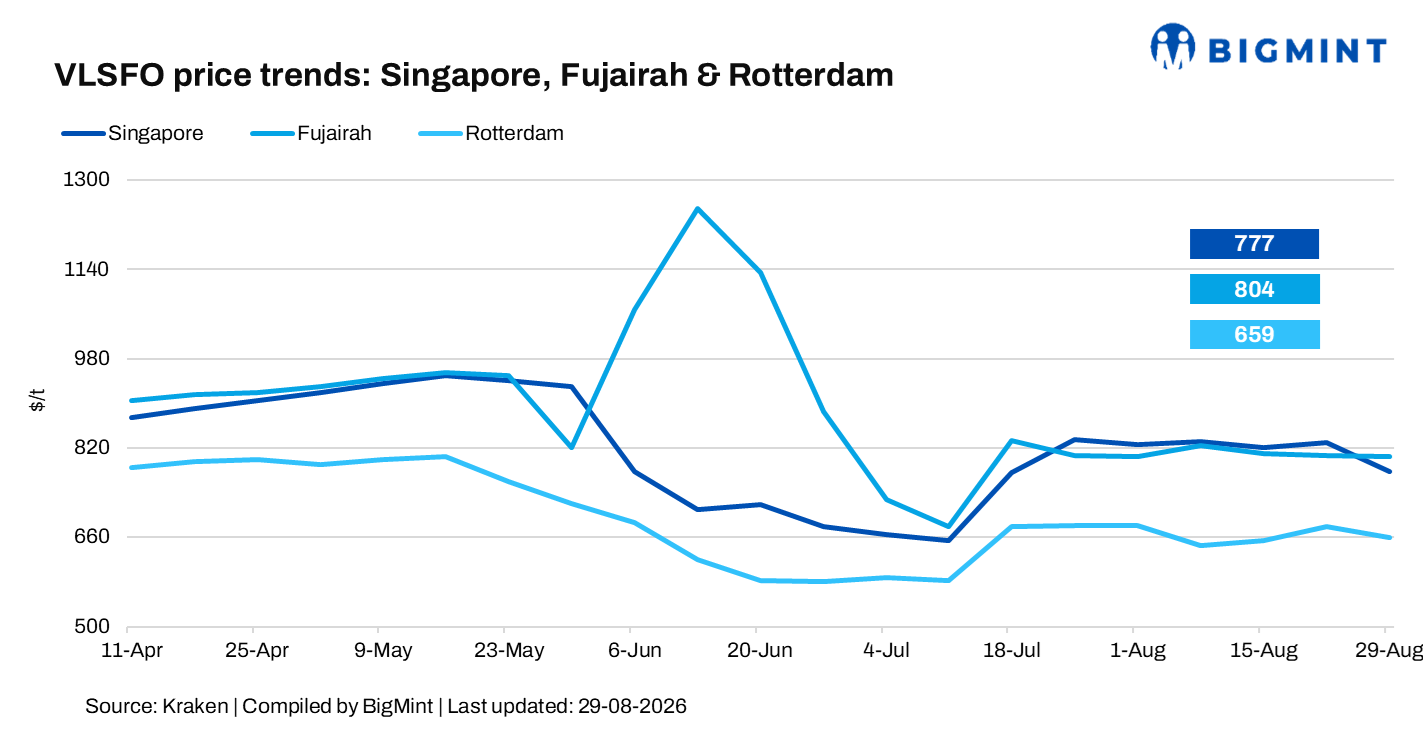
- VLSFO shows mixed movement, Middle East supply risks remain a key factor
Global bunker fuel prices showed a mixed trend across major marine-fuel hubs in the week ended 28 August 2026. VLSFO prices declined in Singapore and Fujairah but edged higher in Rotterdam, while MGO and HSFO prices fell across all three hubs.
The softer crude market eased pressure on bunker replacement costs. However, ongoing uncertainty around Strait of Hormuz disruptions, regional supply flows and refined-product availability continued to keep the market volatile.

Regional bunker markets
- Singapore: Singapore recorded declines across all three fuel grades. VLSFO fell $52/tonne (t) w-o-w to $777/t, while MGO dropped sharply by $107/t to $1,148/t. HSFO declined $53/t to $623/t. The broad-based decline reflects the weaker crude complex and easing immediate supply concerns, although Singapore’s bunker market remains exposed to movements in regional fuel demand and Middle East supply disruptions.
- Rotterdam: Rotterdam was the only major hub to record a rise in VLSFO, increasing $4/t w-o-w to $659/t. In contrast, MGO declined $93/t to $1,220/t, while HSFO fell $50/t to $544/t. The divergence between VLSFO and the middle-distillate and fuel-oil grades points to differing product-market dynamics, while European bunker prices were reported to have moved higher on 28 August amid tighter availability of some products.
- Fujairah: Fujairah VLSFO declined $6/t to $804/t, while MGO fell $34/t to $1,404/t and HSFO decreased $18/t to $637/t. Despite the weekly declines, Fujairah remains particularly sensitive to developments around the Strait of Hormuz. The latest market data show that regional bunker prices have been moving higher in several East of Suez ports, highlighting continued volatility in the Middle East fuel market.
Market factors
- Brent crude futures decline w-o-w: Brent crude futures for the October 2026 contract fell by 5.6% ($5.20/barrel (bbl)) w-o-w to $88.40/bbl on 27 August from $93.60/bbl. Easing geopolitical concerns and improved supply expectations weighed on prices, although Middle East risks continued to provide underlying support.
- WTI crude eases w-o-w: WTI crude futures settled at $83.40/bbl on 28 August, down from $87.06/bbl on 21 August, marking a decline of around 4.2% over the week. The retreat was driven by improving oil flows through the Strait of Hormuz and expectations of a possible agreement to restore shipping, which eased immediate supply concerns.
Outlook
Global bunker prices are likely to remain volatile in the near term. The recent decline in crude prices should provide some relief to bunker costs, particularly for VLSFO and HSFO, but continued uncertainty around the Strait of Hormuz and refined-product availability could quickly reverse the downward trend. MGO remains particularly sensitive to product-market tightness, while VLSFO and HSFO are likely to track crude and fuel-oil movements more closely.
Overall, the current market suggests softer price momentum but elevated downside and upside risks, with developments in Middle East shipping and energy flows remaining the key factor to watch.
Leave a Reply