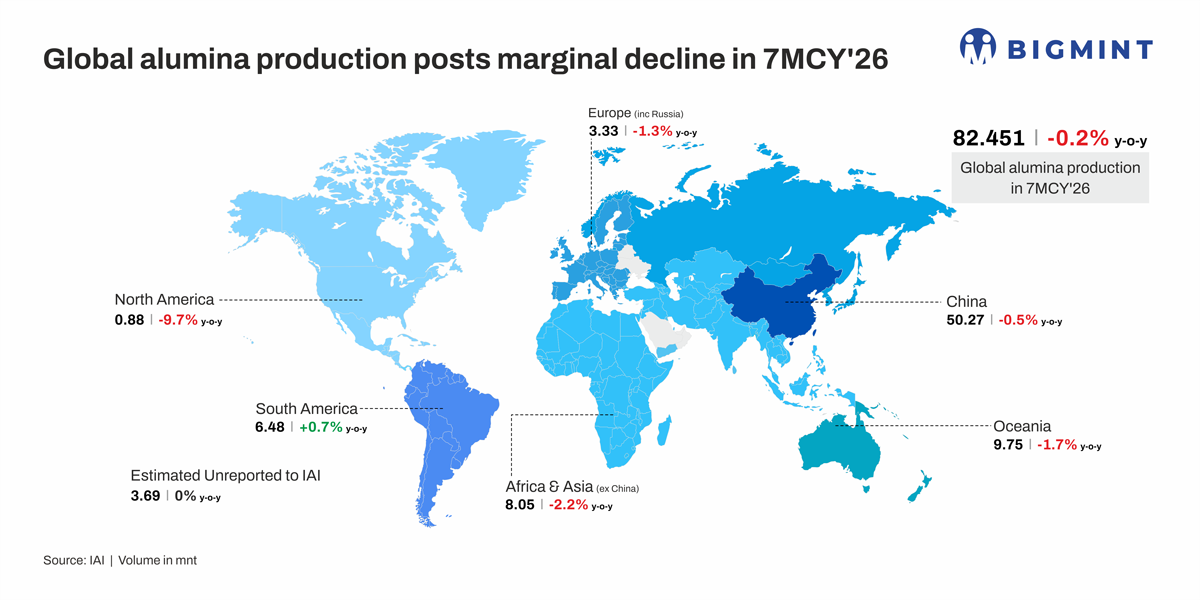
- North America records sharpest 9.7% output decline
- China, South America growth cushions broader regional declines
Global metallurgical-grade alumina production edged down 0.2% y-o-y to 82.45 mnt in 7MCY’26. Production stood at 82.62 mnt in 7MCY’25, according to the International Aluminium Institute (IAI).
The decline remained limited as China and South America increased output. However, lower production in Oceania, Africa and Asia excluding China, Europe, and North America offset these gains.
On a monthly basis, global output rose 3.7% to 12.21 mnt in July from 11.78 mnt in June. The recovery mainly came from China and Oceania after maintenance-related disruptions.
Regional drivers shaping global metallurgical alumina output
China produced an estimated 50.27 mnt of alumina in 7MCY’26, up 0.5% y-o-y. Higher refinery utilisation, steady Guinea bauxite imports and brownfield ramp-ups supported output. However, domestic bauxite shortages and environmental checks limited growth. July production rose 3.3% m-o-m to 7.44 mnt from 7.20 mnt, signalling stronger refinery operations.
Oceania produced 9.75 mnt, down 1.7% y-o-y. The decline mainly reflected Alcoa’s permanent closure of the 2.2 mnt Kwinana refinery and scheduled maintenance elsewhere in Australia. However, July output jumped 12.3% m-o-m to 1.55 mnt as major refineries completed maintenance. Stronger operations helped offset some of the region’s structural capacity loss.
Output fell 2.2% y-o-y in Africa and Asia (excluding China) to 8.05 mnt. Feedstock tightness, higher freight costs and weaker refining margins reduced operating rates in parts of Southeast Asia and the Middle East. Capacity additions in India and Indonesia provided some support. July output increased 1.4% m-o-m to 1.12 mnt as regional operating conditions improved.
South American production rose 0.7% y-o-y to 6.48 mnt. Stable refinery operations in Brazil, particularly at Alunorte and Alumar, supported growth. Reliable bauxite supplies from Paragominas and MRN also helped maintain production. July output edged up to 0.93 mnt from 0.92 mnt in June, indicating stable regional supply conditions.
Europe including Russia saw production decline around 1.3% y-o-y to 3.33 mnt. High electricity and natural gas costs continued to pressure refinery margins, while raw material constraints affected some Russian operations. July output fell 5.8% m-o-m to 0.49 mnt due mainly to planned maintenance. Europe’s decline remained moderate compared with North America.
North America recorded the steepest decline, with output falling 9.7% y-o-y to 0.88 mnt. Lower operating rates at Atlantic Alumina’s Gramercy refinery in Louisiana were the main driver. The refinery remains the only operating alumina refinery in the US. July output nevertheless rose 5.6% m-o-m to 133,000 tonnes, indicating a modest operational recovery.
Outlook
The global alumina market is likely to remain well supplied through the remainder of CY’26, limiting the scope for a sustained price rally. China continues to dominate supply, while its alumina market is already showing signs of surplus, with inventories rising and domestic spot prices weakening. However, the downside should remain limited by higher bauxite and freight costs. Guinea-to-China freight has risen to around $36-37/t, while China’s alumina production costs remain elevated. Therefore, prices are more likely to remain volatile and range-bound, unless weather disruptions, bauxite supply changes or unexpected refinery curtailments tighten the market.
India’s alumina market appears structurally better supplied, with capacity additions and higher refinery utilisation increasing domestic availability. Vedanta has scaled Lanjigarh to 5 MTPA, while NALCO is adding another 1 MTPA refinery stream during 2026. This supply growth is already reflected in trade flows: India’s alumina exports rose 51.3% y-o-y to 2.5 mnt in H1CY’26, while imports fell 34.9% to 0.78 mnt. Consequently, Indian producers are likely to retain a comfortable exportable surplus, keeping domestic prices closely linked to global benchmarks. Strong aluminium production and rising downstream demand should support consumption, but incremental refinery supply is likely to cap sustained price increases.
Leave a Reply