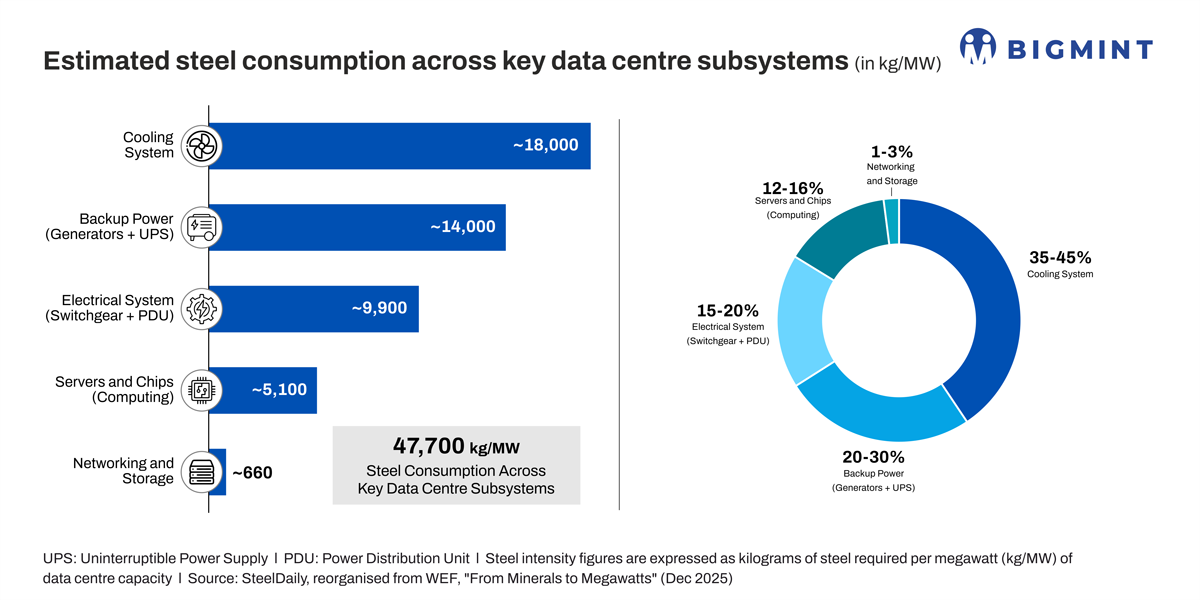
- Around 48 t of steel required per MW of data centre capacity
- Supply of electrical steel emerges as major constraint
The phrase most often attached to AI data centres is “power-hungry”. It is true, but only partly. What builds those facilities and fills them is not electricity, but steel. Data centres run on electricity, but they are built with steel.
In a recent report, the World Economic Forum (WEF) broke data centres down into five subsystems and estimated the metal intensity per megawatt (MW). Of the 60-75 tonnes (t) of metals required for every MW, nearly two-thirds, or around 48 t, is steel. This far exceeds copper (11-12 t) and aluminium (11 t), making steel the single largest material used.
A 100 MW data centre therefore requires around 4,800 t of steel for equipment alone, including approximately 1,000 t of cold rolled steel sheet used in server racks. That is equivalent to the weight of about 1,000 passenger cars contained in the racks alone.
More importantly, where that steel is used matters. Servers and chips responsible for computing account for only around 5 t per MW, while cooling systems and power supply equipment together consume six to seven times more steel.
In other words, steel demand from data centres is determined not by computing capacity itself, but by how effectively the equipment is cooled and how reliably electricity is supplied. As heat generation increases and cooling shifts towards liquid technologies, including direct-to-chip and immersion cooling, steel demand will rise further.
Notably, the 48 t refers only to equipment. Structural steel used in buildings, estimated at 50-100 t per MW, is additional.
From buildings to power grid
The key question is the scale at which these material intensity figures will be applied.
The International Energy Agency (IEA) projects global data centre capacity will expand to 171-219 GW by 2030, roughly double current levels. Building 1 GW requires approximately 100,000 t of equipment and structural steel. New capacity additions over the next five years, amounting to tens or even more than 100 GW, could therefore generate steel demand ranging from a few million tonnes (mnt) to around 10 mnt.
Moreover, demand does not end with the buildings themselves.
Every data centre requires transmission and distribution infrastructure to supply electricity. Most of the 9,000-12,000 kg of metal required for every kilometre of power grid consists of steel, while substations and transformers require grain-oriented electrical steel (GOES).
Steel provides volume, electrical steel is bottleneck
Steel overwhelmingly dominates in terms of tonnage. Yet the real shortage is not ordinary steel.
Commodity-grade steel is widely available and is unlikely to become a supply bottleneck. By contrast, electrical steel used in transformer cores and electric motors, including GOES and non-oriented electrical steel (NOES), is a high-value specialty steel that is already in short supply globally.
Warnings have emerged that shortages of transformers and electrical equipment could delay more than half of new overseas data centre projects in 2026. Transformer lead times now extend beyond two years, prompting some to remark that “the real bottleneck is not GPUs, but transformers.”
The heart of those transformers is electrical steel.
In short, conventional steel accounts for the bulk of volume, while electrical steel captures both the value and the supply bottleneck. This dual structure lies at the heart of the steel story behind data centres.
South Korea: 18.4 GW and KRW 1,000 trillion of future steel demand
This combination of expansion and supply bottlenecks is not confined to overseas markets.
The South Korean government’s “Three Mega Projects”, announced in June 2026, target 8.4 GW of data centre capacity by 2029, comprising 5 GW from SK Telecom, 2.4 GW from GS Group, and 1 GW from Naver. Capacity is planned to reach 18.4 GW by 2035, with cumulative investment expected to exceed KRW 1,000 trillion.
Applying the previously discussed material intensity, 18.4 GW translates into approximately 1.8 mnt of equipment and structural steel demand over the next decade.
However, power infrastructure remains the biggest constraint.
Applications for grid impact assessments in the Seoul metropolitan area totalled 522 projects, representing 33,000 MW of capacity. However, only 10 projects, or 1.9%, received final approval due to transmission network congestion.
With limited capacity available in the capital region, 82% of new projects are shifting to other regions. Those locations will in turn require new transmission infrastructure to deliver electricity.
Ultimately, this means additional demand for transmission lines, substations, structural steel, and electrical steel.
POSCO targets 1 mnt, Hyundai Steel 1.4 mnt
Major domestic steelmakers are already positioning themselves for this opportunity.
POSCO expects steel demand from data centres to increase from 380,000 t in 2024 to 1 mnt by 2030, focusing on transformer steel, electrical steel for power applications, and steel for cooling water tanks.
Hyundai Steel has established a dedicated task force and estimates the related market will exceed 1.4 mnt annually by 2030.
The domestic mega projects alone are expected to generate steel demand measured in hundreds of thousands of tonnes. POSCO’s 1-mnt target and Hyundai Steel’s 1.4-mnt target reflect a much larger opportunity encompassing power infrastructure as well as export demand.
For an industry weighed down by weak domestic demand and trade barriers, this represents one of the few structural growth markets.
However, optimism should be tempered. As demand for electrical steel rises, trade barriers are likely to follow. India has recently launched an anti-dumping investigation into grain-oriented electrical steel imports from countries including South Korea and Japan.
Reading AI through the language of steel
A data centre is not simply a facility that consumes electricity. It is first built and equipped with steel.
The current boom should therefore be viewed not merely as a power sector issue, but as a materials demand story. Demand estimates should distinguish between equipment steel and structural steel, supply capabilities for bottleneck products such as electrical steel should be assessed carefully, and data centres and power grids should be viewed as parts of a single interconnected pipeline.
Forecasts suggesting global data centre capacity could exceed 200 GW by 2030 also imply that a corresponding volume of steel orders has already been effectively reserved.
The AI era may appear to revolve around GPUs. Yet the material that supports those GPUs, cools them, houses them, and delivers power to them remains steel.
It is time to view data centres not only through the language of electricity, but also through the language and numbers of steel.
Note: This article has been published in accordance with a content exchange agreement between SteelDaily and BigMint.
Leave a Reply