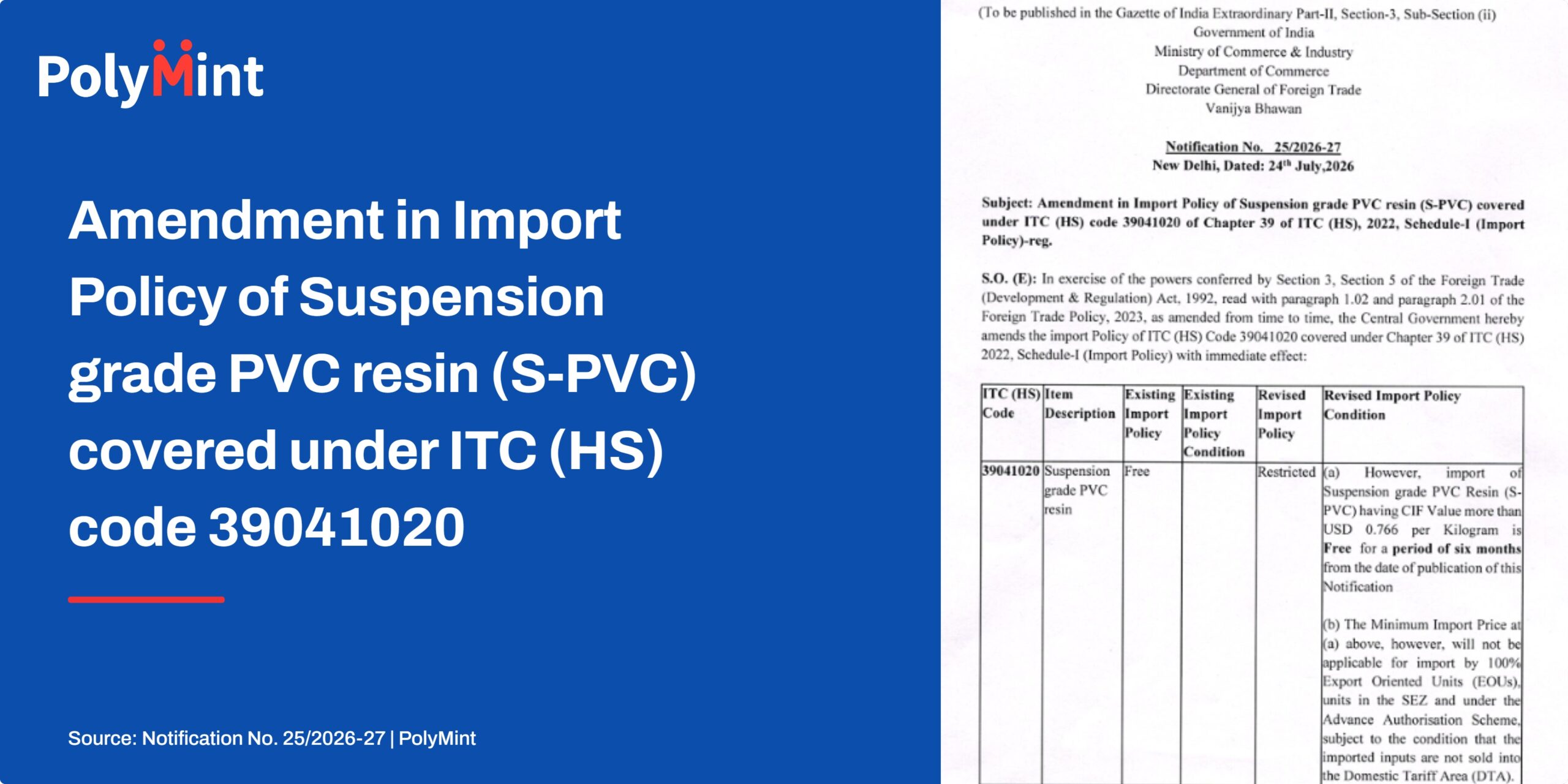
- Imports below $766/t brought under restricted category.
- Higher-value cargoes remain exempt for six months
India has amended the import policy for suspension-grade PVC resin (S-PVC), shifting imports under ITC (HS) Code 39041020 from the “Free” category to “Restricted” with immediate effect. Under the revised policy, imports with a CIF value above $0.766/kg ($766/t) will continue to be permitted freely for six months from the date of notification, while cargoes priced at or below this threshold will require authorisation.
The exemption will not apply to imports by Export Oriented Units (EOUs), units in Special Economic Zones (SEZs), or imports under the Advance Authorisation Scheme, provided the material is not sold into the Domestic Tariff Area (DTA).
The notification marks a significant shift in India’s PVC import framework and appears aimed at regulating the inflow of lower-priced material while allowing continued access to higher-value imports. By introducing a minimum import price threshold rather than imposing a blanket restriction, the government has sought to balance the interests of domestic manufacturers with the raw material requirements of downstream processors.
Sharp decline in import prices prompts move
The policy comes after a sustained correction in imported suspension-grade PVC prices over the past six weeks. CFR India assessments declined from $830-900/t in early June to around $700-750/t by early July, remaining broadly stable at those levels through 21 July.
With prevailing import offers trading below the newly prescribed threshold of $766/t, a sizeable portion of lower-priced cargoes may now fall under the restricted import regime. This could reduce the competitiveness of discounted overseas material in the domestic market while encouraging buyers to reassess procurement strategies.
Market implications
The revised policy is expected to support domestic PVC producers by limiting the unrestricted entry of lower-priced imports. For converters and processors dependent on imported resin, procurement costs could increase if import authorisations delay cargo movement or reduce the availability of competitively priced material.
At the same time, higher-value imports above the notified threshold will continue to enter without restriction for six months, helping ensure supply continuity for premium-grade applications and limiting the risk of immediate supply disruption.
The exemption granted to EOUs, SEZ units, and Advance Authorisation imports also indicates that the government intends to minimise the impact on export-oriented manufacturing while tightening supplies to the domestic market.
Leave a Reply