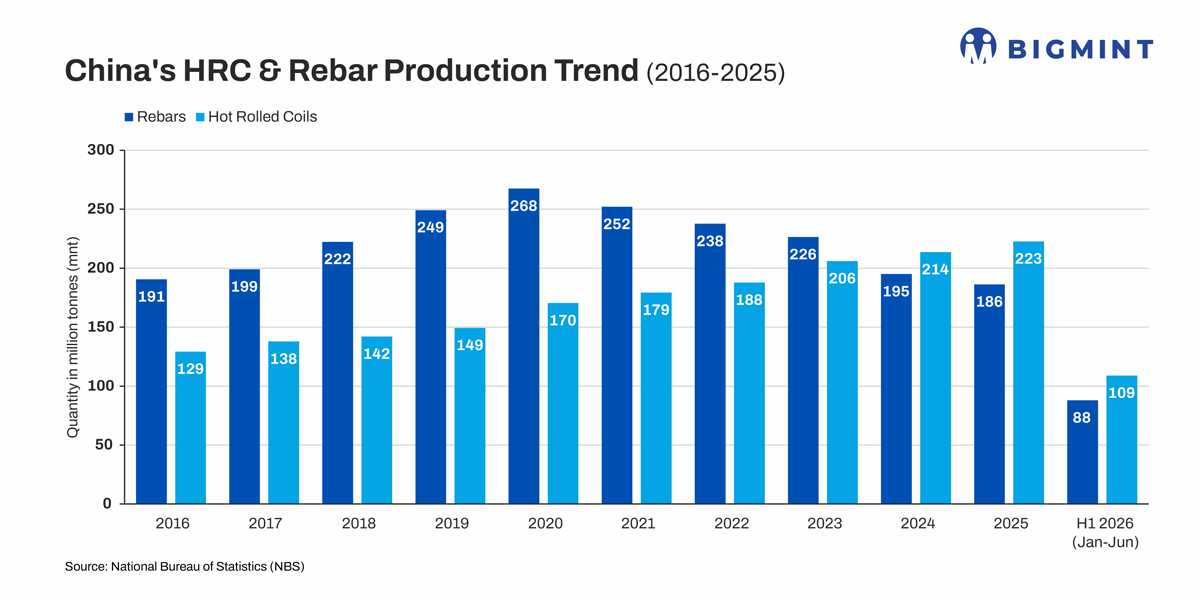
- China’s HRC production falls 4% in H1CY’26, while rebar declines by 11%
- Manufacturing steel consumption to rise to 55% of total demand in CY’26
Data Deep Dive: China’s HRC production has widened its lead over rebar despite declines in both categories, reinforcing the shift in the country’s steel industry from construction-led demand towards manufacturing and downstream flat steel products. HRC output fell 4.4% y-o-y to 109.18 million tonnes (mnt) in January-June 2026, while rebar production dropped 10.7% to 87.82 mnt, according to National Bureau of Statistics (NBS) data.
The difference has become significant. HRC production exceeded rebar by 21.36 mnt in H1CY’26, compared with a gap of around 37 mnt for full-year CY’25, when HRC output reached 223 mnt and rebar output stood at 186 mnt. HRC had already overtaken rebar in CY’24, after HRC output increased 24% from 179 mnt in CY’21, while rebar production fell 26% from 252 mnt over the same period.
The latest figures do not indicate that China’s HRC market is growing outright. Instead, they show that rebar is declining much faster as the property downturn weighs on construction steel, while HRC is becoming increasingly important within a manufacturing-oriented steel system.

Manufacturing overtakes construction as main steel consumer
The shift in China’s steel mix is being driven by a change in its underlying consumption structure, with manufacturing-linked demand expanding as construction continues to contract. Analyst estimates show that manufacturing steel consumption rose to 481 mnt in CY’25, accounting for 53.8% of total domestic steel consumption of 894 mnt, compared with 389 mnt, or 43.5%, for construction.
The gap is expected to widen in CY’26. Manufacturing steel consumption is projected to increase to 494 mnt, lifting its share to 55.3% of total consumption, while construction-related consumption is forecast to fall to 379 mnt, or 42.4%. This would leave manufacturing with a 115 mnt demand advantage over construction, up from 92 mnt in CY’25.
Within manufacturing, machinery remains the largest source of steel demand and is expected to drive much of the growth. Machinery steel consumption rose to 199 mnt in CY’25 from 193 mnt in CY’24 and is projected to reach 213 mnt in CY’26. Shipbuilding steel consumption is forecast to rise from 19 mnt to 22 mnt, as China maintains its global dominance and continues to capture a greater share of orders.
The shift should continue to favour flat and higher-value steel products, while construction-oriented long steel faces further pressure. This helps explain the widening gap between HRC and rebar production as China’s steel demand becomes increasingly tied to manufacturing rather than property and construction. China’s capacity build-out points in the same direction. HRC capacity reached around 410 mnt by end-2025, up nearly 40% from 2020, according to Shanghai Metals Market.
HRC remains base feedstock for wider flat steel chain
HRC can be further processed into higher-value products, while rebar is largely consumed directly in construction. This makes HRC an important feedstock for a broader downstream flat-steel chain.
China’s cold-rolled coil (CRC) production increased 6% y-o-y to 25.02 mnt in H1CY’26. In June alone, CRC output rose 13.5% y-o-y to 4.55 mnt, even as HRC production declined 1.4% to 19.11 mnt. Rising CRC production provides an additional outlet for HRC and indicates that part of flat steel demand is moving further downstream.
The shift towards higher-value flat steel is also consistent with Beijing’s latest steel industry policy. China’s 2025-26 steel industry work plan targets average annual growth of around 4% in value added, while placing greater emphasis on quality, efficiency, technological upgrading, and higher-end materials rather than simply expanding output.
The plan calls for stronger capabilities in high-end materials such as bearing steel, gear steel, and high-temperature alloys, alongside higher standards for steel used in automobiles, machinery, shipbuilding, and household appliances. The policy direction is therefore increasingly focused on extracting more value from each tonne of steel rather than maximising volumes.
The automotive sector provides an example of how this is feeding into steel requirements. The share of high-strength steel used in new-energy vehicles has increased to around 40-50% from about 30% as automakers pursue lightweighting, according to a report by Tianjin Youfa.
At the same time, it should be noted that steel usage in NEVs is estimated to be 15-20% lower than in conventional fuel vehicles. This points to a more nuanced demand shift, where lower steel intensity per vehicle is accompanied by greater demand for higher-strength and higher-value grades.

High-tech manufacturing raises quality requirement
The next stage of China’s industrial transition is likely to be more important for steel quality than for volumes. Beijing is seeking to move the economy towards high-end equipment manufacturing, new energy, digital industries, robotics, and other technology-intensive sectors, which require steel with tighter specifications, higher strength, lighter weight, and more specialised performance.
China’s manufacturing upgrade has continued to accelerate, with value added in high-tech manufacturing rising 9.4% y-o-y in CY’25, compared with 6.4% growth in manufacturing overall, before accelerating to 13.3% in H1CY’26, according to the NBS. Equipment manufacturing also grew 9.2% in CY’25 and 9.5% in H1CY’26.
Although all grades of high-value steel are not directly produced from commodity HRC, the broader direction is clear: the growth of automotive, machinery, electrical equipment, shipbuilding, and other advanced manufacturing sectors is increasing the importance of flat steel.
China’s export model is also moving downstream
The manufacturing shift is occurring alongside a change in the composition of China’s steel exports. Direct HRC exports are increasingly exposed to safeguard duties, quotas, anti-dumping measures, and other trade restrictions in major markets. This makes downstream products relatively more important as China seeks to maintain access to overseas markets.
China’s export mix also points to stronger resilience in downstream flat products, with cold-rolled wide-strip exports rising 21.4% y-o-y in H1CY’26, while coated-sheet exports fell only 6.8%, compared with a 27.9% decline in hot-rolled wide-strip shipments. This reflects China’s broader export strategy, with the industry increasingly seeking to export premium products rather than rely only on commodity steel.
Additionally, rather than exporting steel itself, Chinese manufacturers are shipping more steel-intensive products overseas. China’s total merchandise exports increased 13.4% y-o-y to RMB 14.73 trillion ($2.2 trillion) during the first half of 2026. Exports of mechanical and electrical products rose 20.1% to RMB 9.36 trillion ($1.4 trillion), accounting for 63.5% of total exports, while high-tech product exports jumped 39% to RMB 3.26 trillion ($489 billion).
The trend is particularly evident in capital goods. Vehicle exports climbed more than 65% y-o-y to 5.10 million units, supported by a doubling of new energy vehicle exports to 2.36 million units. Chinese shipbuilders also secured 121.06 million deadweight tonnes of new orders, up 173.1% y-o-y and accounting for 82.3% of global new shipbuilding orders.

Manufacturing cannot absorb all the excess steel
The transition does not mean China’s flat-steel market is insulated from oversupply. Although HRC production itself declined 4.4% in H1CY’26, domestic prices have averaged RMB 3,070/t ($486/t) till 11 August 2026, their lowest in over four years, as per BigMint’s records. Meanwhile, domestic HRC inventories were 29% higher y-o-y at 4.82 mnt in early August, as per Mysteel.
China’s manufacturing PMI slipped to 49.2 in July from 50.3 in June, with new orders falling to 48.5. This shows that even manufacturing demand is facing pressure amid subdued consumer demand and that the sector cannot absorb unlimited volumes of additional flat steel.
Therefore, manufacturing is becoming more important relative to construction, but this does not mean total steel demand is growing strongly. This creates a growing risk that China’s large HRC capacity base will continue to exceed domestic demand, particularly if export access becomes more restricted.
Outlook
BigMint expects China’s HRC and rebar production to decline in H2, but the pace of contraction should differ. Rebar output is expected to fall faster as property investment remains on a downtrend and infrastructure investment has largely plateaued.
Conversely, HRC production should prove more resilient as manufacturing-linked demand continues to grow. The decline in HRC production is already losing pace as the year progresses, with January-June’s 4.4% drop much softer than the 6.7% decline in January-May and 7.2% fall in January-April.
However, manufacturing support is unlikely to prevent an outright decline in HRC output, particularly as HRC exports face tighter trade restrictions. No new hot-coil production lines are expected to be added in H2, according to Mysteel, limiting further supply growth.
Meanwhile, although rebar inventories remain near their lowest level since 2019, they are above 2025 levels, with margins at around -RMB 106/t ($16/t), slightly lower than HRC’s -RMB 96/t ($14/t). With construction demand still contracting, mills are likely to prioritise deeper cuts in rebar and other long products, widening the production gap with HRC.
Rebar inventories at around 6.98 mnt in late July also remain higher than HRC inventories of around 4.44 mnt, providing mills with greater incentive to cut construction steel output.
As such, we believe that China’s HRC production could fall by around 3% y-o-y to about 216-218 mnt in CY’26, while rebar production is likely to decline around 9% to about 169 mnt. The sharper contraction in rebar should widen the HRC-rebar production gap to around 48 mnt from 37 mnt in CY’25.
Leave a Reply