- BF-rebar prices increase w-o-w, project pipeline remains strong
- Mill price revisions infuse momentum into HRC trade market
- HRC export offers stable after EU Oct-Dec’26 quotas get fully exhausted
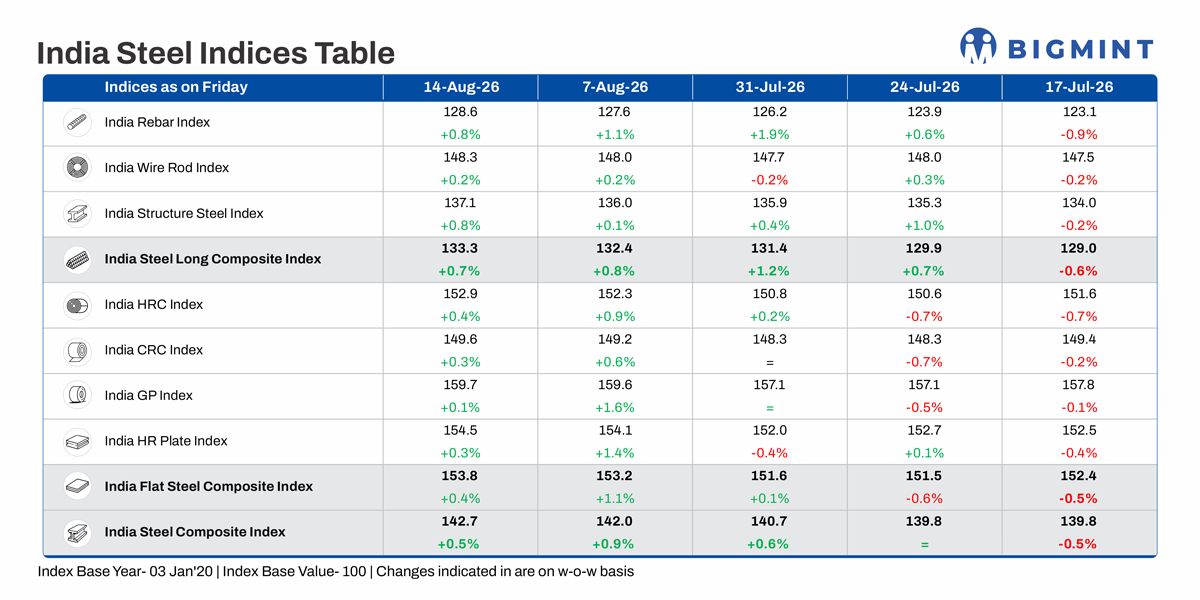
Morning Brief: BigMint’s flagship India steel composite index gained 0.5% w-o-w, assessed on the week ended 14 August 2026, as domestic steel prices continued on an upward trajectory amid tight supply conditions in the long steel market and major mills withdrawing discounts offered earlier, which provided some support to flat steel trade prices. The demand scenario continued to remain moderate-to-stable in mid-monsoon, with no noticeable urgency for restocking.
While the longs composite index increased by 0.7% on the week, the flats index climbed 0.4%. The rebar sub-index edged up by 0.8% w-o-w.

Highlights of price movements
BF rebar trade prices rise: BF-rebar trade prices increased by INR 1,200/t ($12/t) w-o-w to INR 53,200/t ($557/t) ex-Mumbai, as assessed on 14 August, despite moderate demand amid buying activity largely governed by immediate project requirements. However, market sentiment strengthened as several mills scheduled maintenance shutdowns for August, while some producers are expected to divert production to other steel products and limit new bookings.
These developments are likely to tighten rebar availability and reduce distributor inventories, providing near-term support to prices. In the projects segment, buyers continued need-based procurement, while the anticipated tightening in supply supported a positive price outlook.
The infrastructure and construction pipeline remained supportive, with new project awards and announcements exceeding INR 21,000 crore during last week.

IF-route prices edge up: IF-rebar prices moved upward, with TMT prices increasing by INR 100-1,000/t across markets. Buying activity remained moderate, and demand in central India received support from order bookings from neighbouring states. Firm raw material prices and low mill margins continued to limit the scope for price reductions. Mill inventories eased to around 8-10 days, but order-book visibility remained limited at 3-5 days, indicating relatively cautious procurement.
HRC, CRC prices increase marginally w-o-w: BigMint’s bi-weekly assessment for HRC (IS 2062, Gr E250, 2.5–8 mm/CTL) stood at INR 58,100/t on 14 August, up by INR 100/t w-o-w from INR 58,000/t recorded on 7 August. The benchmark assessment for CRC (IS 513, Gr O, 0.9 mm/CTL) increased by INR 200/t w-o-w to INR 65,200/t from INR 65,000/t during the same period. These assessments are ex-Mumbai for the distributor-to-dealer segment and exclude 18% GST.
HRC prices trended up following the withdrawal of mill rebates in the beginning of August, which provided support to domestic prices. The adjustment narrowed earlier distributor losses, bringing trade prices closer to prevailing mill levels and improving trade parity. This improved price alignment is being viewed positively by market participants and, according to sources, could provide support to trading liquidity.
However, purchases remain below normal levels. Industry sources indicated that hot-strip mills (HSMs) were operating at full capacity, while availability remains manageable despite tight supplies in some markets. Buyers continue to remain cautious amid price volatility, with some ageing inventory being liquidated and procurement remaining restricted to immediate requirements.

Domestic trade market unaffected by imports: India’s bulk HRC imports stood at 79,533 t in the first week of August, with a further 224,195 t expected by month-end, led by South Korea, China and Indonesia. However, the sequential rise was largely attributed to Advance Authorisation-linked procurement and captive consumption, particularly by pipe and tube manufacturers producing API/line pipes for overseas oil and gas projects, limiting the impact of these imports on the domestic spot market.
HRC export offers largely stable: Bulk HRC exports by Indian mills stood at 161,539 t during the first week of August, while export offers showed divergent trends across key destinations. EU offers remained stable w-o-w amid strong quota-driven bookings, which came to a standstill after the October-December quotas were fully exhausted. However, offers to the Middle East increased marginally due to strong inquiries from the region. However, demand from Vietnam remained muted.
Coking coal prices remain firm: Steelmaking raw material prices were assessed as broadly stable. BigMint’s Odisha iron ore index (Fe 62% remained stable w-o-w ahead of OMC’s monthly auction, while coking coal prices edged up marginally, remaining strong at little below the $250/t CNF India level. Pellet-based sponge iron prices remained firm in central India while domestic melting scrap prices were largely stable w-o-w.
Outlook
BF-rebar prices are expected to remain firm, with August supply tightening likely to outweigh moderate demand. Planned maintenance shutdowns and production diversion could further reduce supply and draw down distributor inventories. Meanwhile, resilient infrastructure activity and firm raw material costs should provide additional support.
Following recent mill price revisions and infusion of liquidity in the trade channel, domestic HRC prices are likely to remain stable-to-firm in August. Any positive development in the export market could also support prices.
Leave a Reply