- Japanese-origin bulk H2 freight rises to $90-100/t for 15,000-20,000 t cargoes
- Weak steel demand and high landed costs keep scrap bookings selective
Bangladesh’s imported ferrous scrap market remained selective during the week, with firm freight rates and higher landed costs keeping buyers cautious. Active buyers continued to book cargoes at workable levels, while suppliers negotiated to secure deals amid differing price expectations.
Japanese-origin H2 offers stood at $405-410/t CFR Chattogram. A SE Asian trader noted that freight from Japan had risen to $90-100/t for 15,000-20,000 t cargoes, adding to procurement costs. Hong Kong-origin plate and structural scrap (PNS) offers were reported at $415-420/t CFR Chattogram. The Malaysian bundle mix was quoted at $345-350/t, while busheling was offered at $415/t CFR Chattogram.
BigMint’s weekly assessments, CFR Chattogram
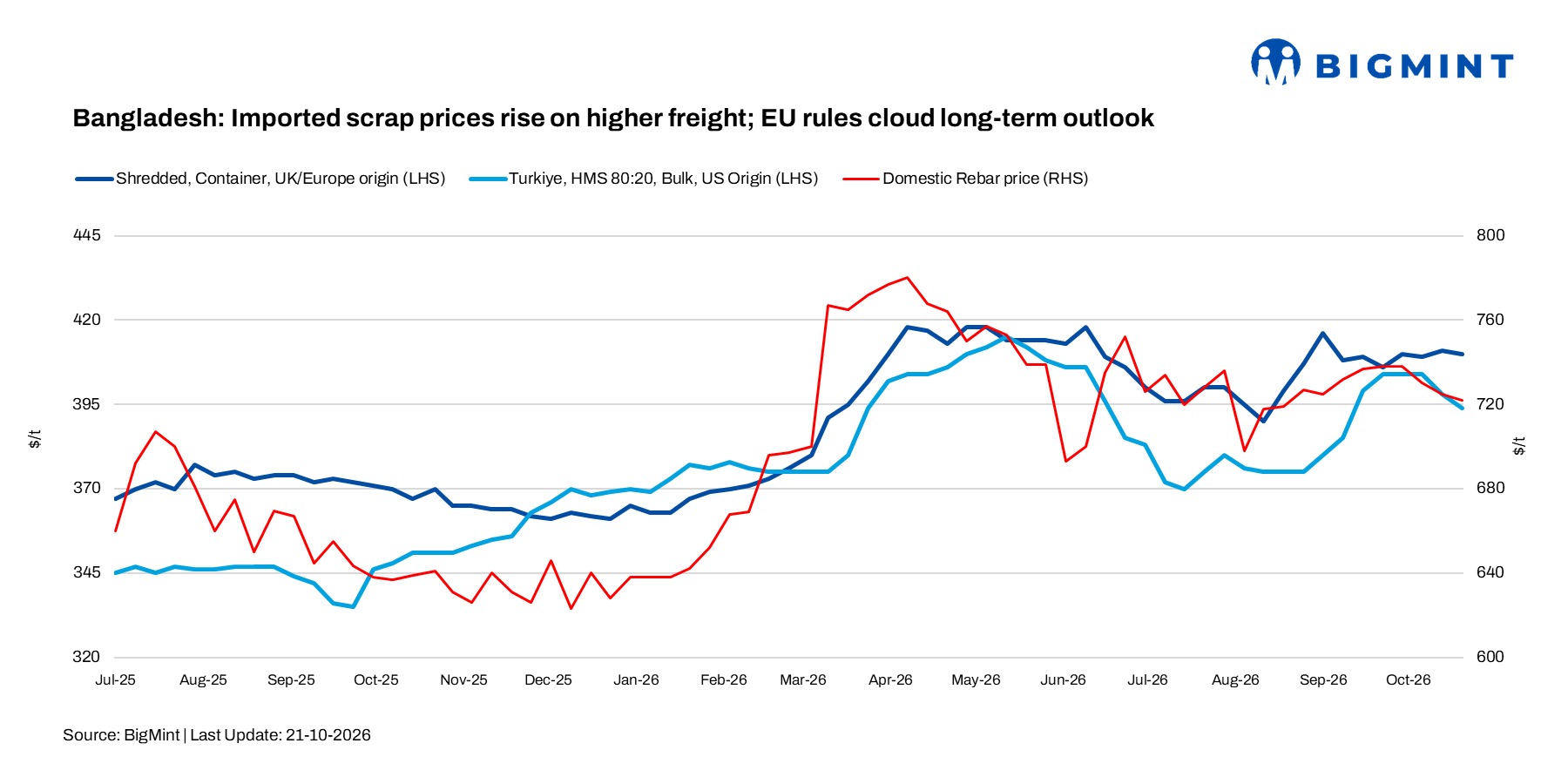
- European-origin containerised HMS 80:20: $378/t, up $2/t w-o-w
- European-origin containerised shredded scrap: $410/t, down $1/t w-o-w
- Japanese-origin bulk H2: $407/t, up $8/t w-o-w
- US-origin bulk HMS 80:20: $409/t, up $2/t w-o-w

EU-27 waste rules raise long-term supply concerns
Beyond immediate freight pressures, the European Commission’s draft authorised-country list under the revised Waste Shipment Regulation (EU) 2024/1157 has introduced uncertainty for Bangladesh’s steel industry. The draft excludes Bangladesh from receiving metal waste, although certain other waste streams, including paper and rubber, are permitted.
Bangladesh imported around 5.3 million tonnes (mnt) of ferrous scrap in 2025, accounting for approximately 85% of total supply, while domestic generation stood at nearly 1 mnt. According to industry insiders, EU countries historically accounted for over 50% of Bangladesh’s scrap imports, although shipments have declined recently amid the Middle East conflict.
If Bangladesh remains excluded from the final list, access to EU-origin metal scrap could be restricted from 21 May 2027. Under the EU-27 framework, non-OECD destinations must be specifically authorised to receive the relevant waste streams. The change could redirect European scrap towards approved destinations and intensify competition for alternative-origin cargoes. The impact will depend on Bangladesh’s eligibility, replacement volumes, and relative delivered costs.
Bangladesh has applied for inclusion, with the government seeking to address the EU’s environmental compliance concerns. The first authorised-country list is expected by the end of 2026, making the outcome important for long-term procurement planning and regional scrap trade flows.
Domestic market
Bangladesh’s domestic steel market remained subdued. Billet prices stood at BDT 70,000-71,000/t ($567-575/t), while local scrap was quoted at BDT 55,000-57,000/t ($445-461/t). Rebar prices were reported at BDT 83,000-85,000/t ($672-688/t) in Dhaka and BDT 89,000-91,000/t ($720-737/t) in Chattogram.
Outlook
Bangladesh’s imported scrap market is likely to remain cautious in the coming week, as firm freight rates and elevated landed costs limit fresh bookings. Buyers may continue to secure selective cargoes where suppliers are willing to negotiate.
Over the longer term, the EU-27’s authorised-country framework could reshape Bangladesh’s sourcing strategy. Failure to secure approval may increase reliance on Japan, Australia, the US, and other suppliers, exposing mills to changing freight economics and competition for available cargoes. Bangladesh’s inclusion in the final list and the availability of competitively priced alternatives will be key factors in determining future scrap procurement costs.
Leave a Reply