- June exports rebound on stronger demand
- South Korea drives first-half export growth
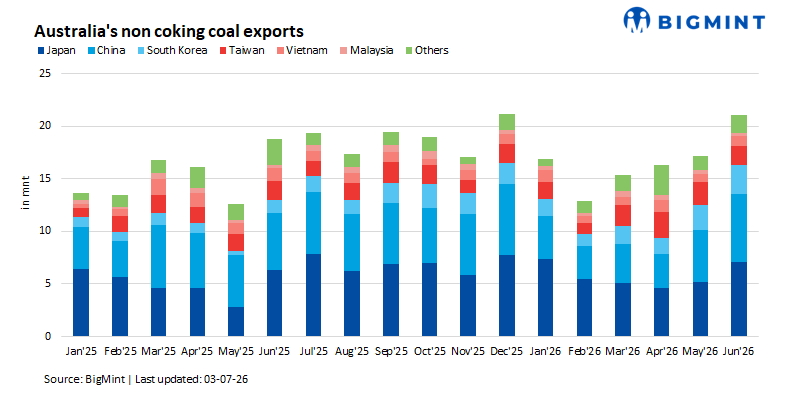
Australia’s non-coking coal exports recovered strongly in June, rising 23% month-on-month (m-o-m) to 21.09 million tonnes (mnt) from 17.13 mnt in May. Compared with June, shipments increased 12.5% year-on-year (y-o-y) from 18.74 mnt, supported by improved vessel loadings across major export terminals and firm demand from key Asian markets.
On a quarterly basis, exports increased to 54.49 mnt in Q2 (April-June) 2026, up 20.7% q-o-q from 45.15 mnt in Q1 2026. During the first half of the year, Australia’s non-coking coal exports reached 99.64 mnt, registering an 8.4% increase from 91.96 mnt in the corresponding period of 2025.
June exports rebound on stronger demand from North Asia
Australia’s non-coking coal exports to key Asian markets strengthened in June 2026, largely supported by higher procurement from major Northeast Asian consumers amid seasonal restocking requirements and competitive Australian supply. Japan retained its position as the largest destination, with shipments rising 35.2% m-o-m to 7.06 mnt, driven by increased utility purchases following relatively lower arrivals in May. Exports to China also climbed 24.0% to 6.50 mnt as steady power-sector demand and favourable import economics encouraged buying.
South Korea recorded another strong month, with volumes increasing 15.8% to 2.78 mnt, reflecting sustained demand from power utilities and industrial consumers.
In contrast, exports to Taiwan declined 17.4% to 1.48 mnt, while shipments to Vietnam and Malaysia eased by 4.2% and 16.2%, respectively, primarily due to sufficient inventories and cautious near-term procurement. Exports to other destinations, however, rebounded sharply by 29.3% m-o-m, indicating improved demand across smaller importing markets.
H1 exports remain higher y-o-y
During January-June, Australia’s non-coking coal exports remained higher than the corresponding period last year, supported by robust demand from Northeast Asia, although buying trends varied across Southeast Asian markets. Japan’s cumulative imports increased 14.2% y-o-y to 34.83 mnt, reaffirming its position as Australia’s largest export destination. Exports to China rose 11% to 25.91 mnt, backed by sustained import requirements despite ample domestic coal availability.
South Korea emerged as the fastest-growing major market, with shipments surging 100% y-o-y to 11.22 mnt, reflecting a significant recovery in import demand. Taiwan also recorded healthy growth of 21.9% to 11.04 mnt.
Conversely, exports to Vietnam and Malaysia declined by 18.8% and 18.6%, respectively, as weaker coal consumption and greater reliance on alternative supply sources limited import requirements. Shipments to other destinations increased 20.4% y-o-y to 9.24 mnt, highlighting broader diversification of Australia’s export markets during the first half of 2026.
Export volumes strengthen across major Australian terminals
Australian coal export terminals reported stronger loading activity in June, reflecting improved vessel scheduling, higher export nominations and stronger demand from key Asian buyers. Newcastle retained its position as the country’s largest export terminal, with shipments rising 22% m-o-m to 15.66 mnt, supported by increased cargo movements and robust loading activity. Gladstone also recorded a healthy 28.1% increase to 1.73 mnt, while exports from Brisbane climbed 41.5% to 0.58 mnt on the back of improved dispatches.
Dalrymple Bay Coal Terminal (DBCT) registered the sharpest monthly increase among major terminals, with shipments surging 51.6% to 0.97 mnt, primarily due to the normalisation of loading schedules following lower volumes in May.
In contrast, Abbot Point reported a marginal 1.6% m-o-m decline to 1.80 mnt, reflecting routine shipment timing and vessel scheduling adjustments rather than any weakness in export demand.
H1 export performance led by Newcastle, Gladstone
During Jan-Jun 2026, Australian coal exports remained above the corresponding period last year across most major terminals, supported by sustained overseas demand and stable port operations. Newcastle continued to dominate export volumes, with cumulative shipments increasing 9.5% y-o-y to 74 mnt. Gladstone recorded the strongest growth among the major ports, with exports rising 20.2% to 8.71 mnt, while Brisbane and Abbot Point also posted increases of 18.9% and 8%, respectively, reflecting steady export throughput during the first half of the year.
However, DBCT remained the only major terminal to register a decline, with cumulative shipments falling 15.5% y-o-y to 4.31 mnt, primarily due to lower loading volumes earlier in the year and intermittent operational constraints that weighed on overall throughput.
Market sentiment
Australia’s non-coking coal exports posted a broad-based recovery during June, with higher monthly shipments translating into stronger quarterly and first-half export performance. Demand from Japan, China and South Korea remained the key driver of export growth, while improved throughput at major ports supported overall shipment volumes.
Looking ahead, export volumes are expected to remain stable, supported by steady mine production and efficient port operations. However, procurement trends across key Asian markets, international coal prices and seasonal electricity demand will continue to influence Australia’s non-coking coal export performance during the second half of 2026.

Leave a Reply