- Rice, cotton planting moves faster than other crops
- Soybean, pulse sowing remain in early phase
The onset and subsequent advancement of the southwest monsoon have accelerated kharif sowing activity across Maharashtra during June, with field operations expanding rapidly during the second half of the month. As of 29 June 2026, total kharif sowing (including sugarcane) stood at 1.12 million hectares, equivalent to 8% of the state’s normal kharif area of 15.75 million hectares, while sowing excluding sugarcane reached 1.09 million hectares, also around 8% of the normal area.
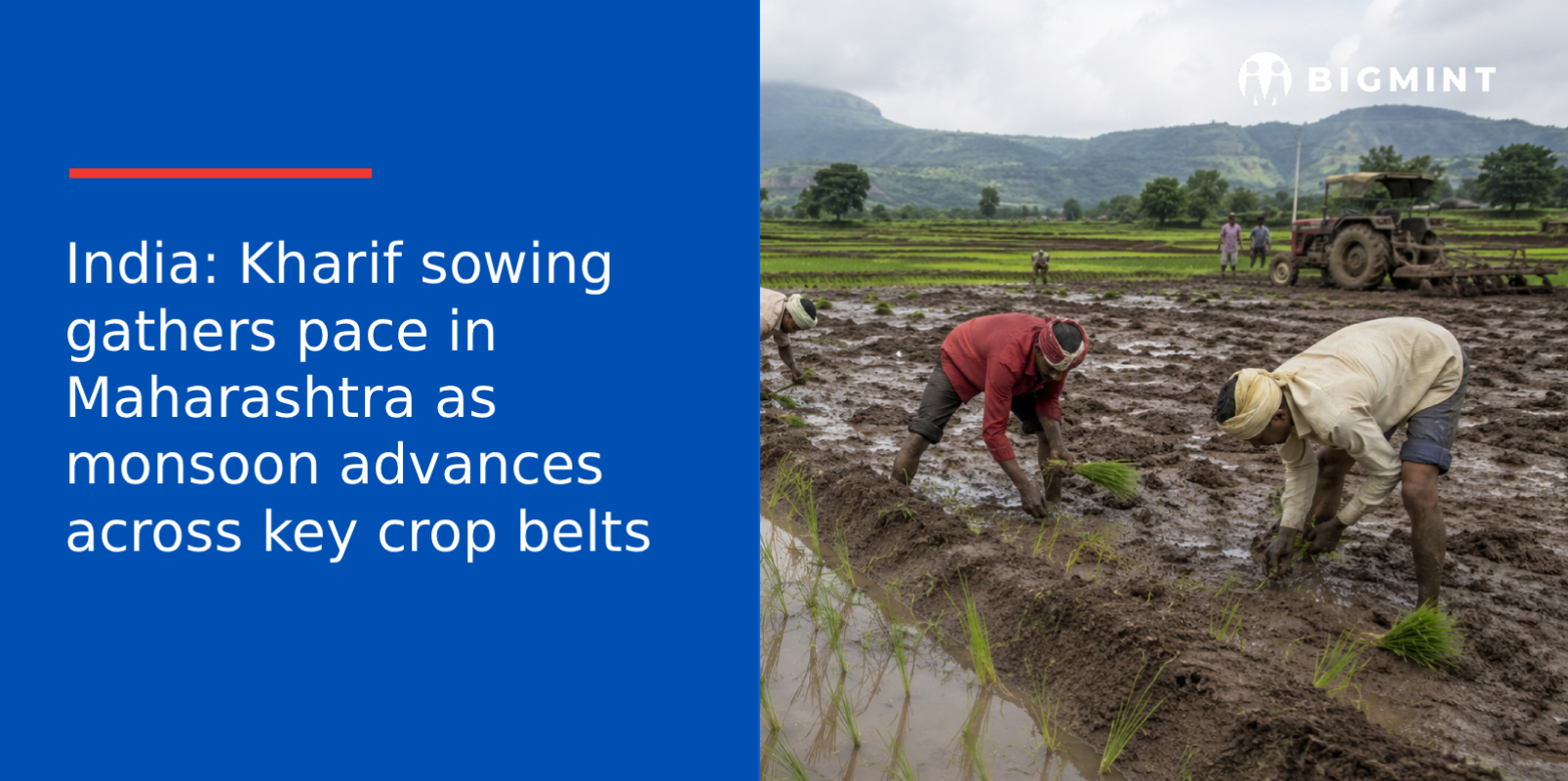
Overall, Vidarbha and north Maharashtra reported relatively stronger progress in cotton and soybean planting, while Konkan districts continued rice transplantation following widespread monsoon showers. Marathwada also witnessed improving field activity, although several districts remained dependent on additional rainfall to accelerate sowing of pulses and oilseeds.
Cereals lead initial sowing campaign
Cereal crops accounted for the largest share of early planting. Total cereal sowing reached 145,497 ha, representing 4% of the normal area of 3.24 million ha. Rice, Maharashtra’s dominant kharif cereal, recorded 46,420 ha under cultivation, while maize covered 86,578 ha. Bajra, jowar and ragi sowing remained limited as farmers in central and western Maharashtra largely awaited more consistent rainfall before expanding acreage.
Pulses, oilseeds await stronger rainfall
Pulse sowing remained at an early stage, with total coverage at 96,082 ha, or 5% of the normal pulse area. Tur (pigeon pea) accounted for 82,894 ha, while moong and urad covered 5,627 ha and 6,516 ha, respectively. Farmers across Marathwada and Vidarbha were gradually beginning pulse planting following improved soil moisture.
Oilseed sowing was similarly in its initial phase. Soybean, the state’s largest kharif oilseed, was planted over 119,008 ha, representing only 3% of its normal acreage of 4.72 million ha, indicating that the peak sowing window is still ahead. Groundnut acreage reached 26,132 ha, while sesame remained negligible at 340 ha. Cotton sowing advanced comparatively faster, reaching 726,804 ha, or 17% of the normal area, supported by timely rainfall across Vidarbha and northern Maharashtra.
Outlook
Market participants expect kharif planting to gather significant momentum during the first half of July as monsoon coverage strengthens across central India. If rainfall remains near normal, Maharashtra is likely to witness a sharp rise in soybean, cotton, tur and coarse cereal acreage over the coming weeks, supporting expectations of a normal kharif production outlook for the 2026-27 season.
Leave a Reply