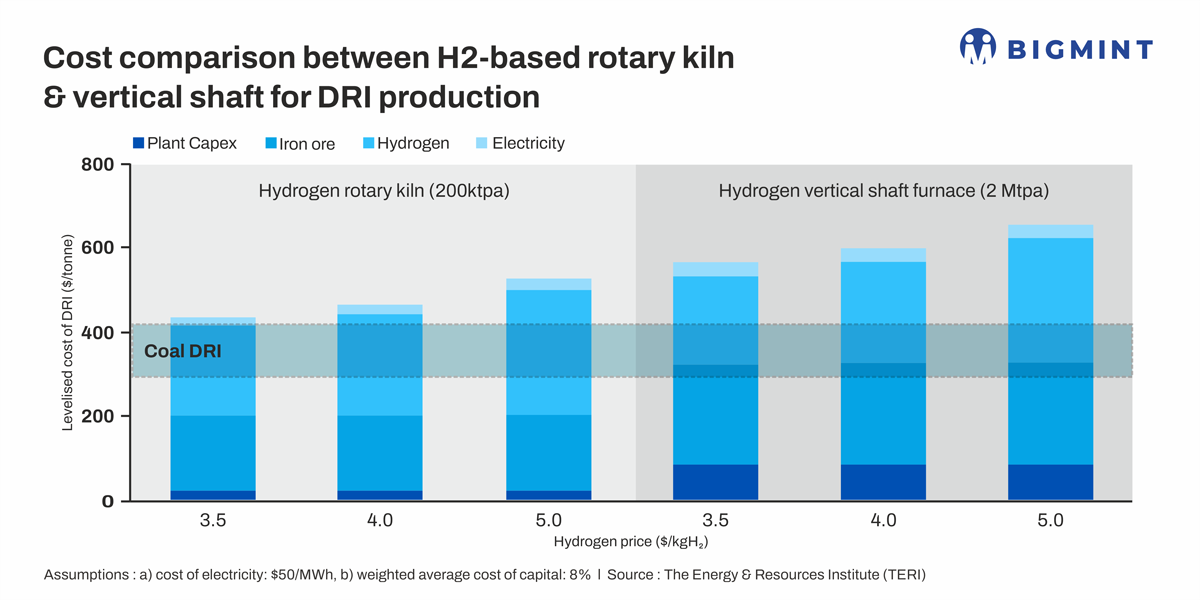
- H2 rotary kiln attractive option due to lower Capex, easier integration
- Relatively easy upgrade from coal-based process will cushion cost shock
- Industrial scale pilot project in Africa paving the way for H2 rotary kiln
Morning Brief: The adoption of greener iron making technologies in India to meet the country’s 2070 net-zero goal will hinge on the availability of a) high-grade raw materials, b) clean energy and fuels, c) carbon capture and storage, etc. The green transition in India’s steel industry will depend, greatly, on the transition in sponge iron production technology.
The rotary kiln process based on coal has achieved a high level of maturity and due to proximity to raw material resources, scope for enhanced cost and energy optimization through waste gas recovery and recycling, and lower Capex and other operational benefits, the coal-based rotary kiln for DRI production has grown phenomenally over the years.
India’s DRI consumption has increased by over 40% from 2021 to 2024, according to BigMint data, and production last fiscal was over 55 million tonnes (mnt). However, typically paired with an electric induction furnace (EIF), this route is the most emission-intensive way of producing steel in India, ranging between 2.7 to 3.1 tCO2 per tonne of crude steel (tcs) versus an all India average of 2.54 tCO2/tcs. This is driven by the use of thermal coal in the heating and reduction process, which is less efficient than alternative production routes, such as the blast furnace.
Technology & opportunity
While it is generally accepted that hydrogen-based DRI is the only way currently visible to decarbonise ironmaking, cost and technical hurdles are a big challenge. Whilst technology providers, such as Midrex and Tenova are already supplying 1 mnt gas-based vertical shafts and larger, these often represent too large a capital investment for small-scale players, at around $345 million or INR 3,000 crore per mnt for the vertical shaft alone.
Moreover, these require direct reduction grade pellets, with an iron content of 67% or higher, necessitating expensive and energy-intensive beneficiation and pelletisation of low-grade Indian iron ores.
A recent project untaken by The Energy & Resources Institute (TERI) demonstrates that the rotary kiln is a more promising option for small-scale players in India to decarbonise manufacturing through integration of renewable-powered hydrogen. The hydrogen rotary kiln is a gastight, horizontal kiln, using hydrogen as the reducing agent, very similar to coal-based kilns used by the industry today.
“(The technology) uses a very similar horizontal rotary kiln that is currently ubiquitous in the industry, with modifications to make it gas-tight as compared to the existing coal-based kilns. Based on initial pilot projects, it is expected that such kilns have relatively low capital costs and can be deployed at a much smaller scale, making it much more suitable to the smaller companies that tend to dominate the sponge iron industry in India,” TERI notes in its latest publication.
Unlike the hydrogen vertical shaft, the rotary kiln is also flexible to a range of iron ore inputs, being able to take lower grade lumps and fines. It also has a greater flexibility in operations, able to cycle between 20% and 100% of its capacity, helping to lower the costs of integration with variable renewable electricity supply.
Global developments
The technology is not yet commercially available but early projects in Namibia, as well as R&D activities in the UK, Germany and the US, indicate that several countries and companies are looking at its potential. HyIron was established through a partnership of Namibian and German companies that work in the field of renewable energies and engineering. At its heart is the HyIron technology, an innovative process to reduce iron ore in a rotary kiln with the help of green hydrogen, thus entirely carbon neutral.
The Oshivela (‘Oshivambo’ for iron) project in Namibia will be the first application of the HyIron technology at an industrial scale. At an initial output of 15,000 t/year, the plant will demonstrate that industrial scale green iron production is economically and technically feasible. Due to a modular construction model, production can easily be scaled up to significantly larger outputs.
TERI scholars have worked out a potentially attractive economics of a hydrogen rotary kiln, highlighting how its lower capex and flexibility can help reduce costs of production as compared to competing technologies. As TERI notes the main reasons that will continue to drive the uptake of smaller hydrogen rotary kilns are similar to the reasons why their coal-based equivalents continue to grow: “lower capex, allowing a broader range of actors to enter the market, who can respond to surging demand for steel, or shortages of scrap, much faster than larger facilities.”
Leave a Reply