- Rebar, billet, pig iron prices gain amid tighter availability
- Scrap remains broadly firm; sponge iron, coal climb higher
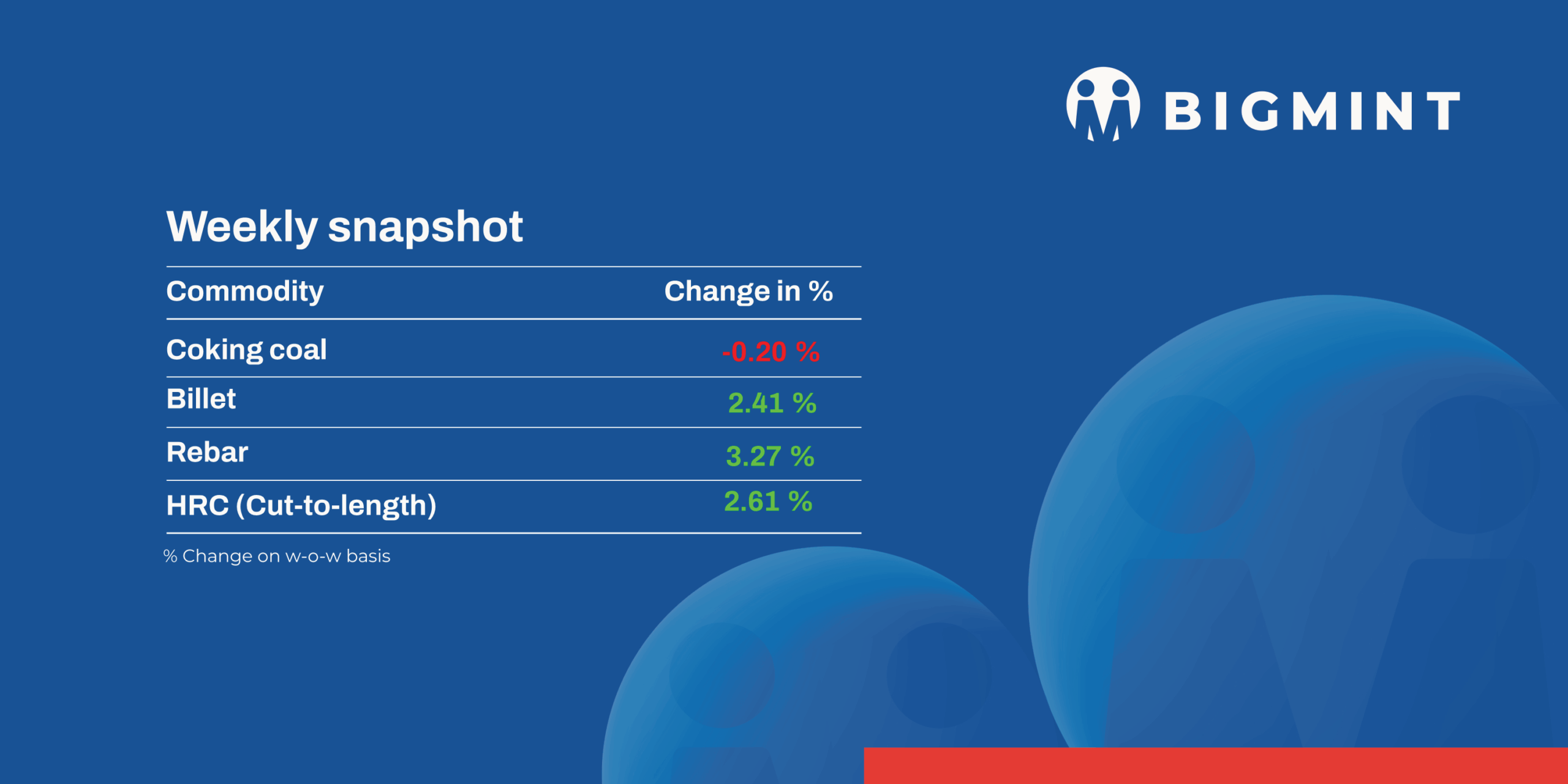
Indian steel markets strengthened in the week ended 19 September 2026, supported by tighter raw material availability, improved post-monsoon demand, and firm mill pricing. Rebar, billet, pig iron, and flat steel prices increased, while export markets remained mixed amid cautious buying.
Iron ore and pellet
- Odisha Mining Corporation (OMC) will auction 1.817 mnt of iron ore on 19 September 2026, comprising 1.21 mnt of fines and 0.61 mnt of lumps. The miner has continued to keep the offered quantity limited this month amid heavy monsoon conditions, which have hampered mining operations. This has led to a surge of INR 750-1,200/t in lump prices across grades. Meanwhile, base prices for fines have been raised by INR 650-750/t across all grades.
- NMDC’s Kumaraswamy auction in Karnataka witnessed strong bidding on 17 September 2026, with around 492,000 t of iron ore booked, comprising 368,000 t of fines (Fe 56.57-62.36%) at INR 2,752-4,883/t ($29-51/t), including premiums of INR 20-860/t ($0.2-9/t) over base prices of INR 2,752-4,023/t, and 124,000 t of 10-40 mm lumps (Fe 60.84-62.24%) at INR 4,311-5,628/t ($45-59/t), with premiums of INR 20-980/t ($0.2-10/t) over base prices of INR 4,281-4,648/t. The aggressive bidding, particularly for higher-grade fines and lumps, indicates firm buying interest amid relatively tight availability.
- India’s low-grade iron ore fines (Fe 57%) export prices fell $4.5/t w-o-w to $54/t FOB east coast in the week ended 17 September, nearing a one-month low amid weak Chinese buying and subdued spot activity. Softer global sentiment prompted sellers to lower offers, while Odisha’s stricter grade checks and monsoon disruptions constrained exportable supply.
- BigMint’s India pellet export index declined by around $5/t w-o-w to $99.5/t FOB East Coast on 16 September 2026, equivalent to approximately $115/t CFR China, primarily due to a $4-5/t correction in the global Fe 61% iron ore fines benchmark from the previous week. Additionally, subdued spot buying interest from Chinese mills exerted further pressure on pellet export sentiment.
Ferrous scrap
- India’s imported ferrous scrap market remained firm, supported by African HMS bookings and stronger post-monsoon demand expectations. African HMS 80:20 was booked at $375/t CFR Mundra, while Costa Rica HMS 60:40 traded at $335/t CFR Chennai. Buying remained selective as some mills continued relying on domestic scrap.
- Towards the end of the week, activity slowed due to the Vishwakarma Puja holiday, while tight shredded availability kept offers elevated. New Zealand shredded scrap was booked at $405-409/t CFR Mundra, and South African HMS 80:20 at $380/t. PSIC-related issues continued to affect African supply, although shipments largely continued. DGFT’s September 16 notice provided a seven-day window for backlog PSICs and revised regular issuance to within two days, improving operational clarity.
- In the last seven days, around 5,000-6,000 t of imported ferrous scrap were booked in India, including 3,000-4,000 t of HMS 80:20, followed by HMS 60:40, turning scrap and shredded scrap.
Coal
- South African thermal coal prices strengthened sharply during the week as domestic coal availability remained tight and import enquiries increased. Ex-Paradip RB2 rose INR 400/t w-o-w to INR 13,600/t, while RB3 increased INR 50/t to INR 11,600/t. Ex-Vizag, RB2 climbed INR 500/t to INR 13,600/t, and RB3 rose INR 50/t to INR 11,600/t. Limited cargo availability, firm overseas demand, and lower Indian port stocks supported prices, although buying remained largely need-based.
- Domestic coal prices continued to rise amid limited availability and reduced auction frequency during the monsoon. Ex-Bilaspur 4,500 GCV coal increased INR 450/t w-o-w to INR 6,400/t, while 5,000 GCV coal rose INR 50/t to INR 8,100/t as of 18 September. Recent MCL and ECL auctions also fetched high premiums for selective grades. Tight supply and higher replacement costs increased import enquiries and kept the domestic market firm.
- Domestic met coke prices strengthened further, supported by tight imported coke availability and firm replacement costs. BF-grade met coke in eastern India rose INR 500/t w-o-w to INR 42,000/t ex-Jajpur, while western India increased INR 200/t to INR 38,200/t ex-Gandhidham. Foundry-grade coke at Rajkot gained INR 500/t to INR 39,500/t. Limited Indonesian met coke availability, with supplies committed through November, supported prices, although softer coking coal costs could ease replacement costs ahead.
Ferro alloys
- OMC’s chrome ore auction base prices fell around 2% m-o-m, offering cost relief despite lower volumes.
- Indian ferro vanadium prices rose INR 11,000/t ($115/t) w-o-w on higher-priced deals, though buying remained cautious.
- Indian silico manganese prices rose on limited supply, higher coke costs and planned maintenance.
- Indian ferro silicon prices rose INR 2,300/t ($243/t) w-o-w, while Bhutan prices climbed INR 3,700/t ($39/t) on fewer offers and higher raw material costs.
Semi finished
- Billet
Indian semi-finished steel prices increased further this week, with billet prices rising across major markets amid balanced demand and availability. Tighter billet availability in several regions and lower production levels supported market sentiment, helping prices remain firm despite a volatile market and downward pressure. As per BigMint’s assessment, domestic billet prices increased by INR 600-1,500/t ($6-15/t) w-o-w. The sharpest increases were recorded in Jalna, Raigarh, Raipur, Rourkela and Hyderabad, where prices rose by INR 1,000-1,500/t ($10-15/t). In contrast, Chennai recorded a marginal decline of around INR 200/t during the week. - Sponge iron
Sponge iron prices increased by INR 50-600/t ($0.5-6/t) w-o-w across various regions. However, the market remained under pressure as softer mill demand and surplus spot availability increased competition among sellers. Higher raw material costs limited sellers’ ability to reduce offers despite subdued demand. Buyers remained cautious, anticipating more favourable price levels, as most have already secured sufficient volumes through earlier bookings. - DRI exports
India’s DRI export market recorded mixed price movements for Nepal and Bangladesh, with buying interest showing some improvement in selected markets. Pellet-based sponge iron offers to Nepal increased by $10/t w-o-w to $330/t CPT Raxaul, while CDRI/mix sponge iron offers rose by $5/t to $353/t CPT Raxaul. In contrast, offers to Bangladesh declined by $12/t w-o-w to $370/t CPT Benapole, indicating divergent demand and price conditions across both export destinations. - Pig iron
SAIL-Rourkela Steel Plant (RSP) conducted a pig iron auction on 18 September, with the entire scheduled quantity of 2,000 t booked at an average price of INR 41,900/t, up INR 3,140/t from the previous auction. In the previous auction held on 26 August, RSP had offered 4,000 t, with the entire quantity booked at an average price of INR 38,760/t, up INR 1,160/t from the 20 August auction. The previous auction had seen 2,500 t booked at INR 37,600/t.
Finished long steel
- IF-rebar: India’s IF-route rebar prices increased during the week, while buyers remained cautious and largely adopted a wait-and-watch approach. Trading activity also remained limited during the week due to Ganesh Chaturthi and Vishwakarma Puja, resulting in lower trading volumes.
- Sellers, meanwhile, continued to quote higher prices amid tight raw material availability, while traders offered some discounts to facilitate sales. As a result, overall buying activity remained low to moderate. Sellers primarily focused on dispatching previously booked material, with limited to no fresh bookings being taken during the period.
- With raw material costs, particularly iron ore and coal, continuing to remain elevated, a significant downward movement in prices is not expected in the near term.
- On a w-o-w basis, rebar prices increased by INR 600-1,600/t across key regions, with Raigarh and Delhi witnessing the steepest rise of INR 1,600/t, according to BigMint’s assessment.
- Trade reference prices of Fe 500-grade rebars manufactured via the IF route (10-25 mm size) were assessed at INR 47,200-47,600/t exw Raipur and INR 51,700-52,300/t exw Jalna.
- Trade reference prices of heavy structural steel for the base size 150 mm channel stood at INR 49,500-50,000/t exw Raipur.
- Trade reference prices of wire rod stood at INR 48,200-49,000/t exw Raipur.
- BF-route rebar: Trade-level blast furnace (BF)-route rebar prices rose INR 2,000/t w-o-w to INR 61,000/t ex-Mumbai, while project prices stood at INR 61,000-63,000/t landed.
- Lean inventories kept supply tight and supported mill pricing, while project enquiries and distributor restocking improved. Raw material sentiment was mixed, with iron ore stable and coking coal softer.
Flat steel
- BigMint’s bi-weekly benchmark assessment for Mumbai HRC (IS2062, Grade E250, 2.5-8 mm/CTL) increased by INR 1,200/t from the previous assessment to INR 63,900/t ex-Mumbai.
- Meanwhile, Mumbai cold-rolled coil (CRC) prices also increased by around INR 1,300/t, with BigMint’s benchmark assessment for Mumbai CRC (IS513, Grade O, 0.9 mm/CTL) rising to INR 73,500/t ex-Mumbai.
- India’s HRC market witnessed improved buying activity during the week, with trade prices rising following recent price hikes by major domestic steel mills. Expectations of further price increases prompted buyers to advance procurement and restock at prevailing levels, although larger-volume purchases remained selective. Meanwhile, controlled mill supplies and limited spot availability provided additional support to trade prices.
- Import volumes: India’s bulk HRC imports stood at 32,474 t as of 11 September. Furthermore, another 59,451 t are expected to arrive by the end of this month.
- Export volumes: India’s bulk HRC exports stood at 233,027 t as of 11 September 2026. Furthermore, another 34,947 t are expected to be shipped by the end of this week.
- Indian HRC export offers showed mixed trends w-o-w across key destinations. Offers to the EU increased w-o-w, supported by stronger domestic realisations, while those to the Middle East and Vietnam remained on hold as mills continued to prioritise domestic sales and most export allocations were already committed. In the EU, selective Q1CY’27 bookings were heard, although higher offers continued to limit additional booking activity.


Leave a Reply