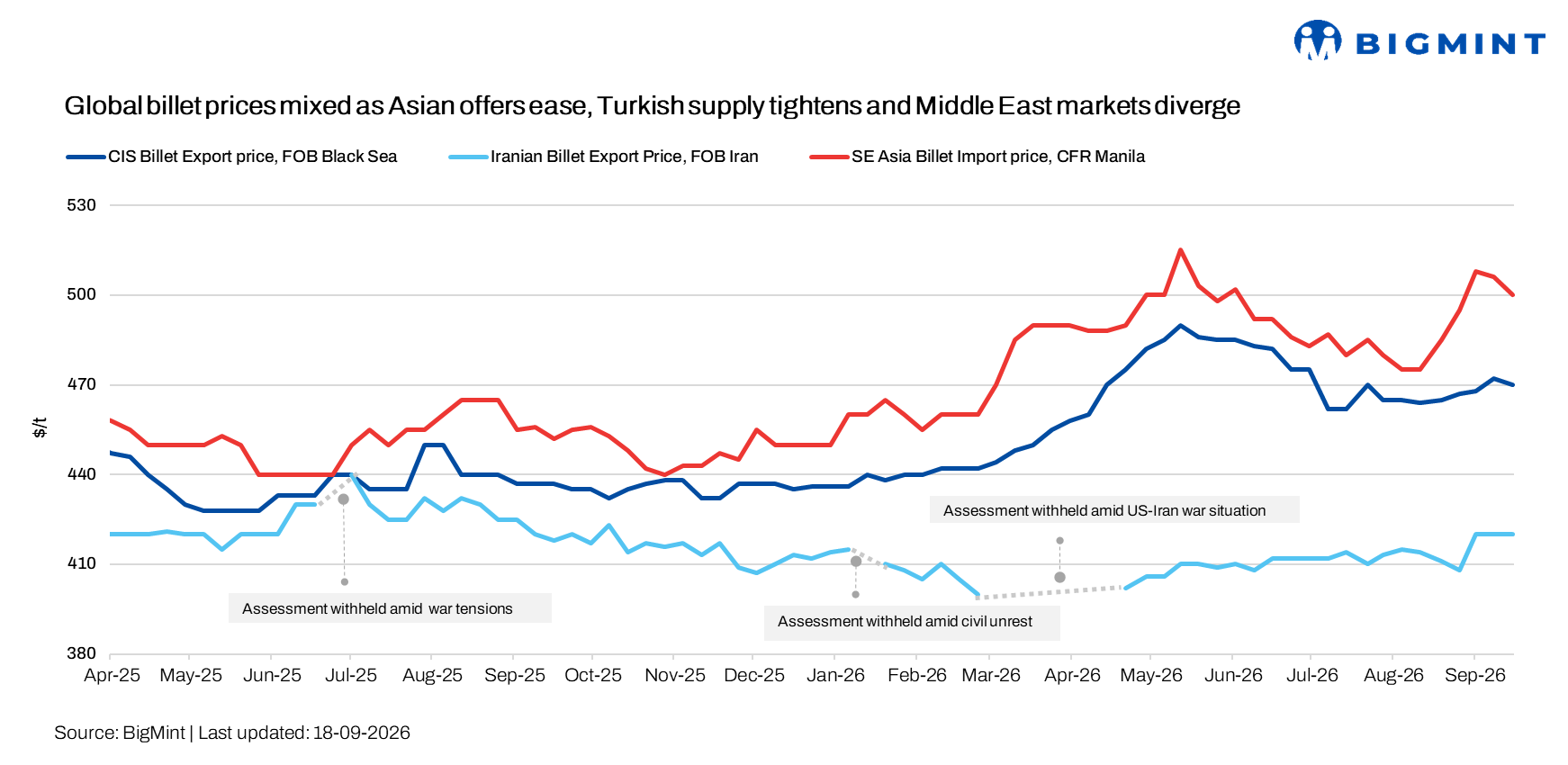
- Iranian billet prices softened on weak regional demand
- Turkish billet prices held firm on supply constraints
Global billet markets were mixed this week, with tight supply and logistical constraints supporting prices, while weak demand and cautious buying limited gains. Asian prices softened on lower raw-material costs, while restricted availability supported markets in the CIS and Turkiye. Middle Eastern markets remained mixed, with import barriers weighing on Egypt and weaker demand pressuring Iran, while tight billet supply supported Saudi Arabia.
Turkiye’s imported scrap market strengthened, with BigMint-assessed US HMS (80:20) rising $9/t w-o-w to $399/t CFR, near a three-month high. Mills covered October-November needs amid limited Black Sea supply, higher freight costs and firm seller expectations.
Firm domestic rebar prices supported higher scrap costs, with Kardemir raising offers by $14/t to $628/t ex-works. Other mills increased offers to $630-650/t, while BigMint’s export rebar assessment rose $12/t w-o-w to $620/t FOB.
Asian billet market
Asian billet and rebar markets remained supported this week, with tight billet availability and selective buying interest offsetting subdued downstream demand and cautious market sentiment. Expectations of production cuts and capacity controls in China provided some support, while weaker raw-material costs limited price gains.
Chinese export billet prices eased from the previous week as lower raw-material costs pressured offers. Mills reduced 3SP billet offers by around $5-7/t to $463-465/t FOB China for November shipment. Standard billet prices at Tangshan Qian’an stood at RMB 3,000/t on 18 September, unchanged from 11 September.
Market participants said buyers remained cautious and were waiting for greater price stability before committing to purchases. Mills are also expected to maintain cautious pricing ahead of the October demand outlook, while higher freight costs and currency movements continued to provide some support to export offers.
In Southeast Asia, open-origin 5SP billet offers were heard at $495-505/t CFR, down around $5-10/t w-o-w. Philippine buyers were bidding around $490-495/t CFR for Chinese 5SP billet, while some buying interest emerged from Vietnam. However, no confirmed deals were reported.
Indonesia’s major mills maintained its base-grade billet offer at $480/t FOB for December shipment. Vietnamese buyers were targeting around $475-485/t CFR for Indonesian material against offers near $495-500/t CFR, leaving a wide bid-offer gap. Chinese 3SP billet was available at $480-490/t CFR Indonesia, but buyers remained cautious amid weak finished steel demand.
Thailand buyers were also largely inactive. Chinese 3SP billet was offered at around $460-465/t FOB, while Indian 5SP billet was heard at $455-460/t FOB, equivalent to around $500/t CFR Southeast Asia. Domestic Thailand billet at around $465-468/t exw remained more competitive.
CIS billet market
Turkish imported billet prices remained firm this week, supported by limited availability and loading constraints among key suppliers. Russian billet offers were heard at around $515-520/t CFR, depending on destination, while Chinese and Malaysian material was offered at approximately $520-525/t CFR. A market participant reported that the latest Russian billet deal was concluded at around $525/t CFR.
Billet imports into Turkiye were assessed at $500-520/t CFR main port, while domestic billet prices stood at $540-565/t exw. Turkish export offers were reported at around $540-575/t FOB.
Malaysian billet was offered at around $510-520/t CFR Turkey, but longer loading times from Asian suppliers reduced its competitiveness. At the same time, loading constraints among Russian and Iranian suppliers have limited alternative supply options, providing continued support to imported billet prices.
Overall, Turkish billet prices remained supported by restricted supply and logistical constraints, despite relatively cautious buying activity.
Middle East billet market
Middle East billet markets showed mixed trends this week, with weak demand and cautious buying weighing on Egypt and Iran, while tight billet availability and higher costs supported Saudi Arabia.
In Egypt, billet imports remained largely unworkable as higher Chinese offers and safeguard duties limited buying interest. Imported billet was assessed at $540-545/t CFR main ports, unchanged w-o-w. The safeguard duty was reduced to 12% from September 14, from 13% previously, and is set to decline to 11% from September 2027.
The Industrial Development Authority received bids for 10 new billet licences, comprising four of 500,000 t/year and six of 200,000 t/year. The additional capacity aims to boost domestic supply and reduce import dependence, but is unlikely to affect the market immediately, with projects expected to take at least three years to come online.
In Iran, billet export prices softened by around $5-10/t to $400-410/t FCA, while port-based offers were reported at $430-440/t FOB. Actual transactions moved closer to $410-415/t FOB as buyers resisted higher prices. A recent assessment for 130×130 mm 3SP billet at Bandar Imam Khomeini was $420/t FOB, unchanged w-o-w. Weak regional demand and geopolitical uncertainty continued to encourage flexible pricing.
In Saudi Arabia, tight billet availability and higher costs supported steel prices despite softer scrap buying prices. Hadeed reduced scrap buying prices by SAR 70-100/t ($19-27/t), bringing high-grade scrap to SAR 2,000-2,100/t ($533-560/t) and shredded scrap to SAR 1,990-1,995/t ($531-532/t). Central and eastern markets remained relatively firm. Hadeed also raised wire rod prices while keeping rebar prices unchanged, while concerns over an east-coast billet shortage continued to influence October expectations.

Leave a Reply