- Raw materials surge on tight supply and higher costs
- Steel prices rise on firmer demand, cautious buying caps upside
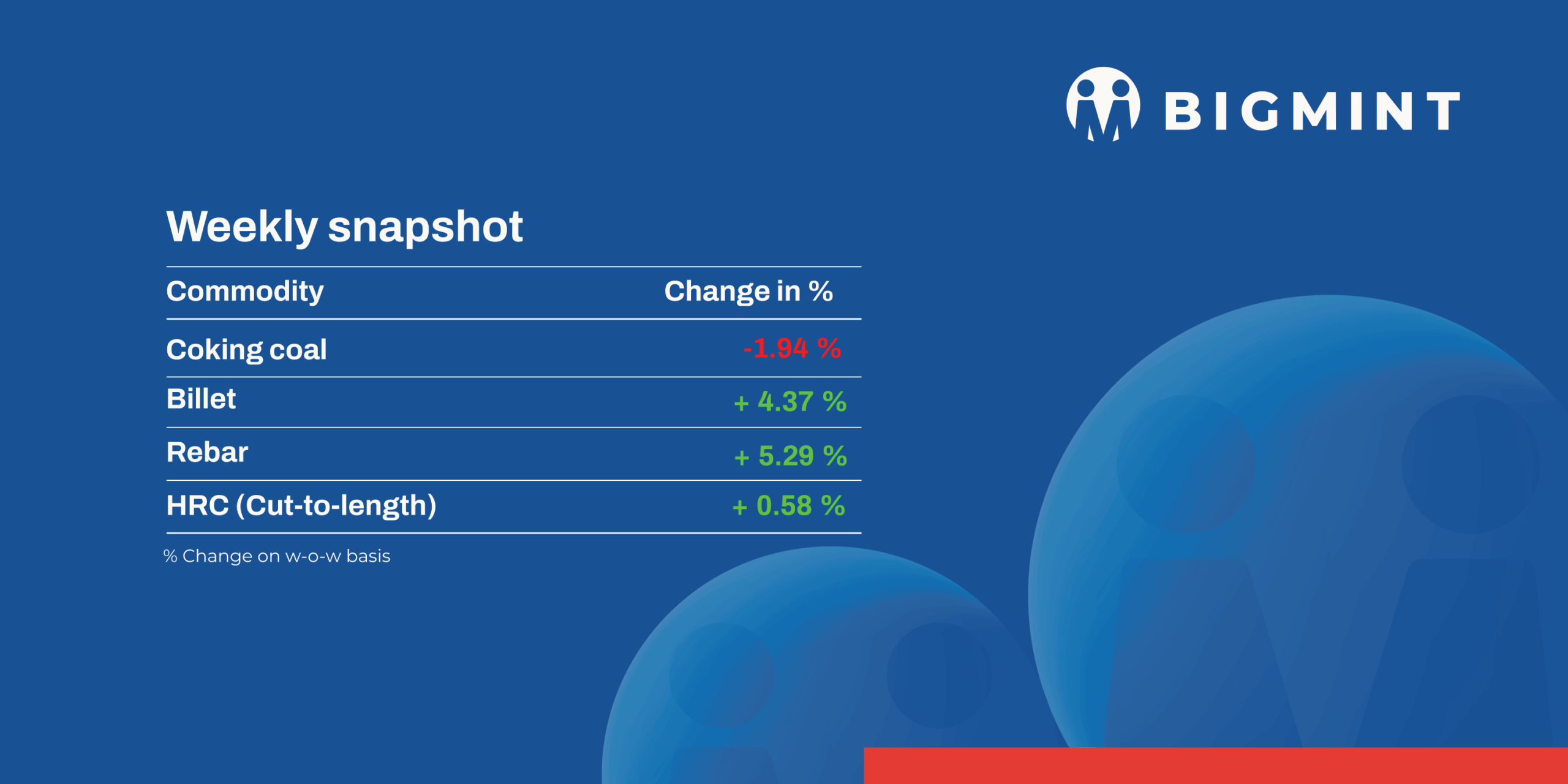
The domestic steel and raw material market strengthened sharply in the week ended 1 October, supported by rising coal and iron ore costs, tight availability and improving finished steel demand. Prices of pellets, coal, sponge iron, billet and finished long steel increased significantly, while ferrous scrap, pig iron and flat steel markets remained comparatively subdued amid cautious buying and selective procurement.
Iron ore, pellet
PELLEX, BigMint’s bi-weekly domestic pellet (Fe 63% ± 0.5%) index for Raipur, rose sharply by INR 600/t w-o-w to INR 11,600/t DAP Raipur on 1 October, supported by active bookings, higher sponge iron prices and tight spot availability. Around 70,000 t was reportedly transacted earlier this week, encouraging sellers to raise offers.
Lloyds Metals raised iron ore fines and pellet offers by INR 150/t and INR 250/t, respectively, effective 1 October, amid tighter ore availability and improved sponge iron and finished steel realisations. Pellet offers increased to INR 11,750/t ex-Chandrapur, while fines FOR Raipur were heard at around INR 7,650/t.
India’s Fe 57% fines export prices declined by $4.5/t w-o-w to $53/t FOB east coast in the week ended 1 October, the lowest since 10 August. Weak Chinese buying interest, subdued steel demand and cautious mill procurement weighed on prices, while Golden Week further limited spot market activity.
Karnataka iron ore prices remained largely firm amid stronger sponge iron and steel sentiments, although grade-wise trends diverged. Fe 57% fines declined INR 50/t w-o-w to INR 2,650/t ex-mines on weak demand, while Fe 62% fines rose INR 150/t to INR 5,400/t due to tight availability and strong demand.
Coal
South African thermal coal prices strengthened sharply during the week. Ex-Paradip RB2 (5,500 NAR) rose INR 600/t w-o-w to INR 14,100/t, while RB3 (4,800 NAR) increased INR 600/t to INR 12,100/t. Ex-Vizag, RB2 gained INR 600/t to INR 14,000/t and RB3 rose INR 500/t to INR 12,000/t. Tight availability, higher replacement costs, limited offers and firm industrial demand supported the market.
Domestic coal prices rose significantly as supply remained constrained and demand strengthened. Ex-Bilaspur 4,500 GCV coal increased INR 500/t w-o-w to INR 7,000/t, while 5,000 GCV coal rose INR 700/t to INR 9,000/t as of 1 October. Lower SECL auction frequency during the monsoon and high premiums for selected grades tightened availability. Expensive imported coal also shifted some consumers towards domestic material, supporting prices.
Washed coal prices strengthened further, with 38–39% FC (5,000 GCV) washed coal FOR Raipur rising INR 850/t w-o-w to INR 10,000/t as of 30 September. Continued ROM shortages restricted washery production and limited market offers. High SECL auction premiums for selected G8, G6 and G9 sources increased raw coal procurement costs, while sellers remained firm. Tight physical availability continued to outweigh cautious buying and limited spot activity.
Domestic met coke prices remained largely stable to weak during the week. BF-grade met coke held at INR 42,000/t ex-Jajpur, while western India declined INR 200/t w-o-w to INR 37,800/t ex-Gandhidham. Foundry-grade coke at Rajkot fell INR 100/t to INR 39,400/t. Softer coking coal costs, with Australian PHCC down $3/t to $272/t FOB, and cautious steel-sector buying limited upside, while supply constraints kept prices elevated.
Ferrous scrap
India: Imported scrap market remained subdued through the week, with mills limiting purchases to need-based requirements amid weak downstream demand. New PSIC requirements and higher Türkiye prices continued to weigh on import activity, while rising freight costs further pressured import economics.
Offers remained high against buyer bids, keeping trading activity thin. UK HMS 80:20 was offered at $365-375/t CFR Mundra, US HMS 80:20 at $370-375/t and African HMS 80:20 at $365-370/t. UK shredded was offered at $445-450/t for 1% impurities, while Brazilian HMS 80:20 was booked at $385/t CFR Mundra.
Near-term buying is expected to remain cautious; however, demand for HMS 80:20 imports is expected to remain relatively firm until Diwali.
Ferro Alloy
Silico Manganese
Silico manganese prices continue to move higher by INR 3,625/t ($38/t) to INR 82,900-83,700/t ($865-874/t) across key regions, while export offers for 65-16 grades rose by $38/t to $990/t FOB Vizag/Haldia. Key smelters had allocated more production to higher-grade silico manganese and export orders, with several producers reportedly committed through November and mid-December. Bulk domestic purchases had further reduced freely available material, leaving limited quantities for spot transactions.
Additionally, State-owned MOIL Ltd has raised manganese ore prices by 5% across all grades for October 2026 deliveries. Prices for ferro-grade ore with manganese content of 44% and above, as well as ferro-grade ore below 44%, chemical grades, silico manganese grade (SMGR) material and fines, have all been revised upward by 5%.
Ferro Manganese
Ferro manganese prices went up by INR 4,700/t ($49/t) w-o-w to INR 89,500/t ($934/t) exw Durgapur, while Raipur prices increased by INR 4,800/t ($50/t) to INR 89,800/t ($938/t). Prices increased amid tighter spot availability, higher manganese ore and coke costs, and improved ferro alloy demand, which strengthened producer offers and reduced sellers’ willingness to discount.
Ferro Silicon
Ferro silicon prices increased by INR 1,100/t ($11/t) w-o-w to INR 94,400/t ($986/t) in Guwahati, while Bhutan prices rose by INR 300/t ($3/t) to INR 94,000/t ($981/t). The upward movement followed Bhutan’s October 2026 price announcements, while limited spot availability and elevated input costs further supported sellers’ offers.
Ferro Chrome
Ferro chrome prices remained mostly steady with slight rise by INR 200/t ($2/t) to INR 118,800/t ($1,240/t). Prices remained largely firm during the week, supported by sellers maintaining their offer levels and regular buying interest from domestic consumers. Consistent deals at prevailing prices provided further support to the market. Meanwhile, export activity remained limited, with relatively fewer overseas enquiries and transactions reported during the week.
Semi-finished
Billet
Indian semi-finished steel prices increased this week, supported by sharp rise in raw material costs, constrained availability and cost-push pressure. Prices moved higher despite modest demand at elevated levels, as increased production costs supported seller offers. As per BigMint’s assessment, domestic billet prices increased by INR 200-3,300/t ($2-34/t) w-o-w. The sharpest gains of INR 3,100-3,300/t ($32-34/t) were recorded in western India, supported by improved demand in the finished steel segment.
Sponge iron
Indian sponge iron prices surged by INR 1,200-2,000/t ($12-20/t) w-o-w across major regions, driven by sharp increases in coal and iron ore costs. However, sponge iron demand remained under pressure as buyers had sufficient material from earlier bookings and showed limited interest at elevated offer levels. This kept fresh buying activity subdued despite the sharp price increase.
Indian sponge iron export offers increases by $3-4/t w-o-w, receiving some support from the domestic price uptrend despite slower buying interest. Pellet-based DRI offers to Nepal increased by $3/t to $323/t CPT Raxaul, while CDRI mix offers rose by $3/t to $349/t. Export offers for Bangladesh increased by $4/t to $364/t CPT Benapole.
Pig iron
SAIL-Rourkela Steel Plant conducted a pig iron auction on 28 September, offering 5,000 t. The entire quantity was booked at an average price of INR 41,400/t, down INR 500/t from the previous auction, reflecting subdued market conditions and buying interest.
NMDC conducted a pig iron auction on 1 October, with 1,300 t of the scheduled 5,000 t booked at a base price of INR 41,500/t ex-works. This was INR 700/t higher than the previous auction on 25 September, when 800 t out of 5,000 t was booked at an average price of INR 40,800/t ex-works.
Finished long steel
IF-rebar: India’s IF-route rebar prices increased by over INR 2,000/t w-o-w in the major markets, primarily supported by rising raw material costs, particularly coal. Steeper hikes were recorded in select markets, including Jaipur and Delhi, partly due to revised gauge parity adjustments. However, buying activity remained moderate, as buyers were reluctant to procure bulk material at elevated price levels. Mill inventories stood at 8–10 days, while order booking visibility remained limited to 3–5 days.
Rebar prices are expected to remain firm in the near term, supported by elevated raw material costs. However, limited buying interest, short order booking visibility and resistance to higher prices may restrict further gains. Market participants are likely to maintain a cautious, wait-and-watch approach, with further price movements depending on raw material trends and a sustained improvement in demand.
Trade reference prices of Fe 500-grade rebars manufactured via the IF route (10–25 mm size) were assessed at INR 48,300–48,700/t exw Raipur and INR 52,000–52,600/t exw Jalna.
Trade reference prices of heavy structural steel for the base size 150 mm channel stood at INR 51,500–52,000/t exw Raipur.
Trade reference prices of wire rod stood at INR 49,500–50,000/t exw Raipur.
BF-rebar: India’s BF-route rebar prices rose by INR 1,000/t w-o-w to INR 63,000/t ex-Mumbai, supported by tight availability, lean inventories and improving project enquiries. Prices increased by around INR 6,500/t m-o-m in September, reflecting a sustained firming trend as supply remained constrained. Project prices were reported at around INR 62,000-64,000/t landed, with booking activity improving as buyers increasingly secured material for near-term requirements amid expectations of further price increases.
Mills raised list prices by INR 500-1,500/t during the week, maintaining a firm pricing stance amid limited prompt availability. Distributor buying also started to recover as monsoon-related disruptions eased and construction activity gradually improved. Market participants noted that distributors were beginning to replenish stocks ahead of the festive season, providing additional support to demand. With inventories remaining lean and mills becoming selective on project bookings, the overall market sentiment remained firm.
Flat steel
Indian HRC and CRC markets showed rising trends during the week, Market demand has improved, with buying activity picking up across regions.
BigMint’s bi-weekly benchmark assessment for Mumbai HRC (2.5-8 mm/CTL, IS 2062, Grade E250 BR) increased by INR 400/t w-o-w to around INR 64,100/t ex-Mumbai as of 01 October 2026.
Meanwhile, Mumbai CRC (0.90 mm/CTL, IS 513, CR1) was assessed at INR 74,100/t ex-Mumbai, up by INR 300/t w-o-w from INR 73,800/t in the previous assessment.
In the western market, demand has improved, with buying activity picking up despite higher price levels. Buyers are continuing to procure material, supported by expectations of further price increases.
In the southern market, overall demand has also improved, with enquiries increasing in the market. However, not all enquiries are being covered, as availability remains relatively tight for some specifications. Inventory levels are estimated at around 80% of normal levels.
In the northern market, demand remains largely need-based, with buyers mainly purchasing for immediate requirements. There is also a slight shortage of thinner-gauge material in the market in both northern and southern market.
Expectations of additional price increases encouraged some buyers to advance purchases, although overall buying remained selective. Inventory levels remained moderate across key markets, with no significant build-up or shortage reported.
Import volumes: India’s bulk HRC imports stood at 109,422 tonnes (t) as of 25 September, with a further 62,854 t expected to arrive by the end of October. A significant portion of these imports is being received under long-term agreements between Indian companies and their parent entities in South Korea and Japan.
Export volumes: India’s bulk HRC exports stood at 277,476 t as of 25 September 2026, with another 37,675 t expected to be shipped by the end of this month. Indian HRC export offers showed mixed trends w-o-w across key destinations during the assessment week ended 29 September 2026. EU-bound offers moved higher amid firmer mill price expectations, although buying interest remained subdued as buyers were reluctant to accept the higher levels. Meanwhile, offers to the Middle East and Vietnam remained on hold, with mills having limited availability for fresh export bookings and continuing to prioritise domestic sales.

Leave a Reply