- Tight supply, high interest rates keep Turkish trading thin
- Construction demand stays weak in South Asia amid rains
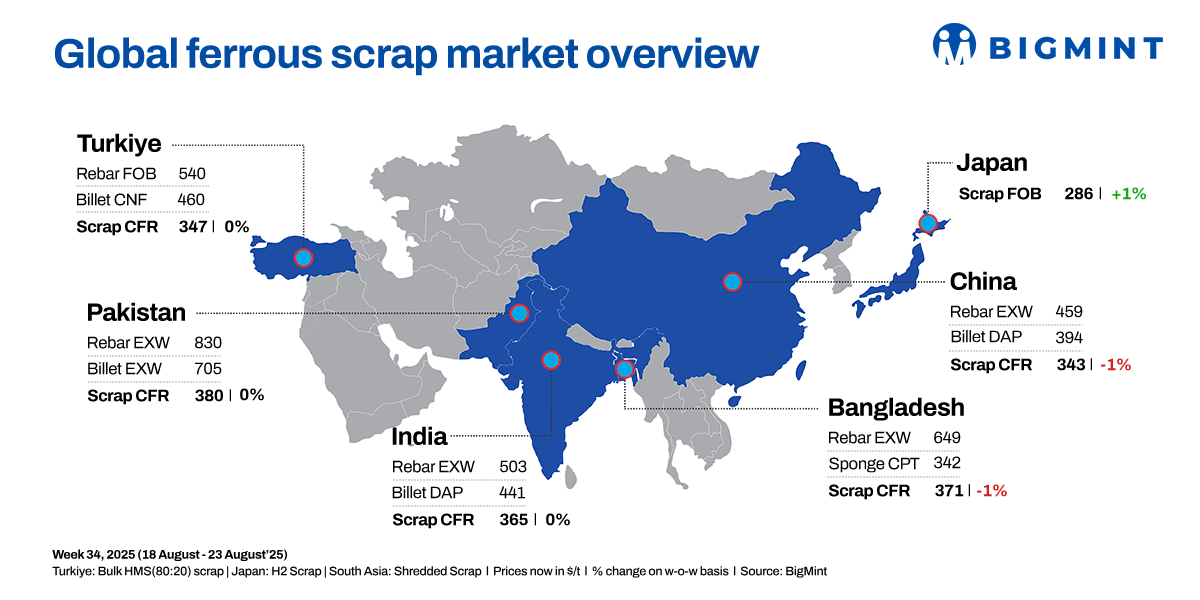
The South Asian imported scrap market remained sluggish, with weak mill demand, heavy rains, and high freight costs limiting activity across India, Pakistan, and Bangladesh, as well as Turkiye in the Middle East. Prices held largely stable, with UK-origin shredded and regional shipments seeing minimal movement.
Turkiye: Turkiye’s deep-sea scrap market stayed stable throughout the week, with HMS 80:20 from US and Baltic origins at $345-348/t CFR and EU cargoes slightly lower at $342-344/t CFR. Weak rebar demand in both local and export markets kept mills from making fresh bookings, while suppliers resisted lower bids amid rising freight and collection costs.
Mills remained cautious, preferring to wait until September before securing cargoes. Market activity was thin, influenced by tight supply, high interest rates, and weak demand for finished steel products across the region.
India: India’s imported scrap market was sluggish throughout the week, with holidays, weak construction demand, and a stronger dollar keeping mills cautious. HMS 80:20 offers near $340/t CFR failed to attract buying interest, and a persistent bid-offer gap of $10-20/t restricted deals. Shredded from UK/Europe held at $370-380/t CFR against lower bids of $350-360/t.
High freight costs pushed Australian shredded cargoes toward Indonesia, while Pakistan’s removal of a duty on HMS diverted material away from India, further limiting supply options.
Pakistan: The imported scrap market remained subdued this week, with UK and EU shredded offers steady at $380/t CFR Qasim. Buyer engagement was weak, and mills resisted prevailing levels amid sluggish steel demand. High freight costs, nearly double those to rival markets, discouraged suppliers, while UAE-based sellers held offers firm without pushing aggressive sales, keeping overall activity muted.
Persistent rains and flooding disrupted construction and reduced end-user demand, keeping mill capacity utilisation at around 35-40%. Buyers waited for price corrections, leaving overall imported scrap trading activity muted.
Bangladesh: Bangladesh’s imported scrap market remained muted through the week as heavy monsoon rains disrupted construction activity and curtailed finished steel demand. Mills stayed cautious, avoiding fresh bookings and keeping overall trading volumes thin. Prices varied across grades, with shredded at $370-374/t CFR and PNS in the range of $372-385/t CFR, though none attracted strong buying interest.
Suppliers held offers steady, but mills refrained from committing to these amid weak downstream demand. Sentiment remained bearish, with participants waiting for construction activity to pick up before taking positions.
Japan: H2 scrap export offers inched up by JPY 300/t ($2/t) w-o-w to JPY 42,000/t ($283/t) FOB Tokyo Bay, supported by improved demand from Southeast Asia. Traders noted stronger buying interest from Indonesia and the Philippines.
Tokyo Steel, meanwhile, cut scrap purchase prices by JPY 500/t ($3/t) across multiple plants on 22 August, with H2 now at JPY 39,500/t ($267/t) for Okayama, Kansai, and Utsunomiya, and JPY 37,500/t ($254/t) at Takamatsu.
China: Shagang Steel cut scrap purchase prices by RMB 30/t ($4/t) on 19 August, marking its first reduction in August. Post-revision, HMS (6-10 mm) stood at RMB 2,460/t ($343/t), inclusive of 13% VAT.
UAE: UAE’s HMS index slipped as mills limited purchases. However, Emirates Steel raised rebar offers for September, setting forth a shift in the market tone. Scrap exports to Pakistan remained slow amid weak demand and heavy rains.
Leave a Reply