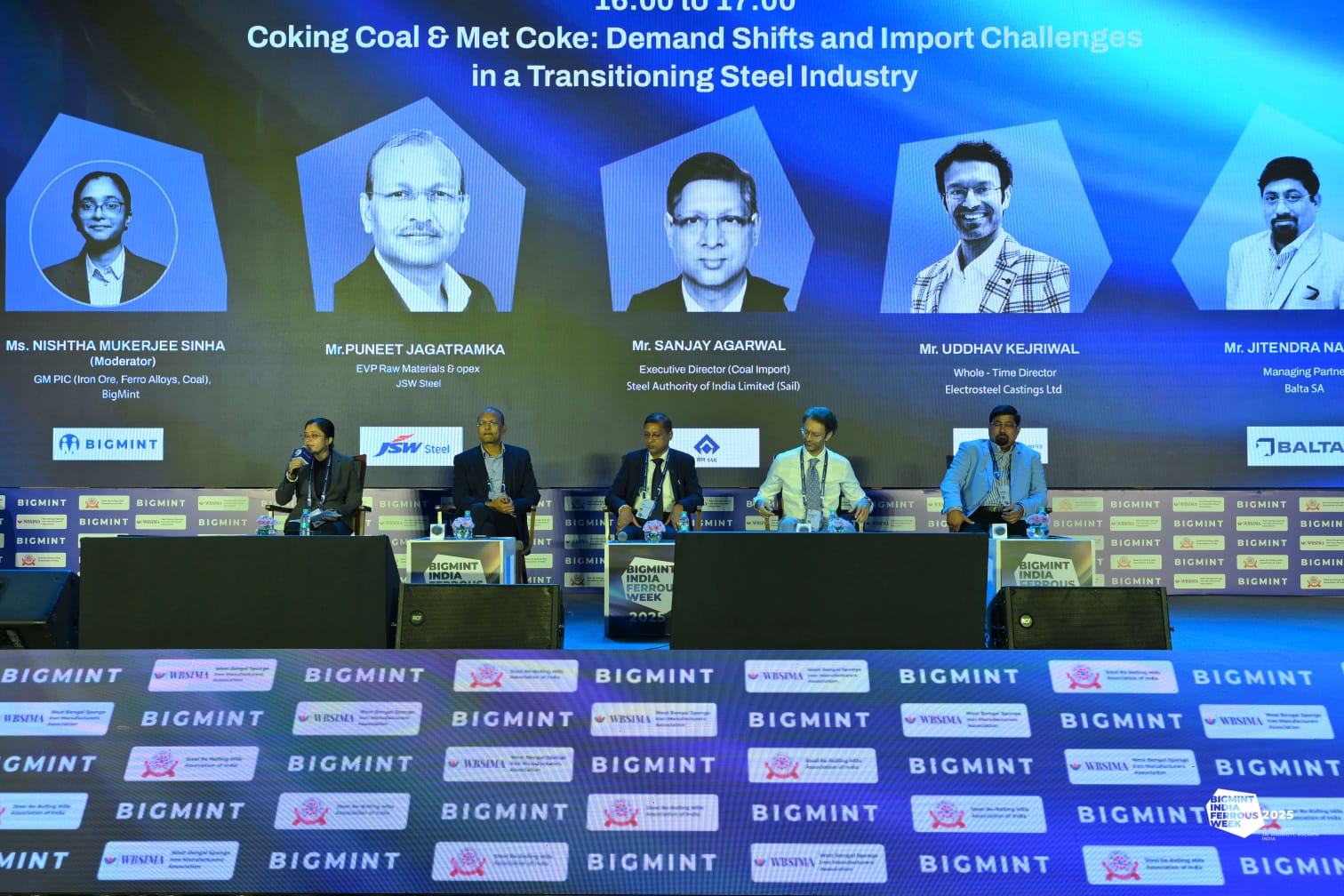
- India diversifying coking coal imports
- Changes in coke-making technology boost blending
The Indian steel sector is at a critical juncture, with coking coal and metallurgical coke (met coke) continuing to shape its cost structure, supply security, and long-term competitiveness.
Given that nearly 90% of India’s coking coal requirements are met through imports, recent trends in sourcing diversification, domestic production initiatives, evolving demand patterns, and regulatory interventions have become central to industry discussions.
Import dependence and geographic diversification
India’s historical dependence on Australian coking coal is gradually declining. Australia’s share, which exceeded 70% of imports four years ago, has now reduced to about 50%, as Indian buyers actively diversify their sourcing portfolio. Mozambique has emerged as a reliable supplier, offering shorter voyage times and consistent deliveries compared with Australia, where adverse weather and logistical constraints frequently disrupt supply.
In addition, the United States, Russia, and Indonesia are strengthening their positions in the Indian market. Indonesian coal, in particular, has shown increasing acceptance given its suitability for blending. Mongolia also remains a prospective supplier, although its landlocked geography continues to present logistical challenges. The diversification strategy is viewed as essential not only for supply security but also for mitigating price-setting power historically commanded by Australian suppliers.
Enhancing domestic coking coal availability
While India’s raw coking coal production has increased to approximately 65-66 million tonnes annually, the volume of washed, usable coking coal remains limited at 7-8 million tonnes. To address this gap, three priority strategies are being pursued:
- Process efficiency: Improving operating parameters in blast furnaces to reduce specific coking coal consumption.
- Technological modernisation: Replacing legacy coke oven batteries with advanced designs capable of handling a wider range of coal grades.
- Captive integration: Expanding coal washing capacity and optimising output from captive mining projects.
Under the government’s Mission Coking Coal initiative, the objective is to raise usable domestic coking coal production. This would substantially reduce reliance on imports while aligning with the National Steel Policy targets.
Demand-side adjustments: Coke, PCI, and blending strategies
Evolving cost dynamics and supply constraints are reshaping demand-side practices in Indian steel plants. Traditionally, high-quality Australian coals dominated blending ratios; however, mills are increasingly incorporating semi-hard and semi-soft coals from alternative origins.
Simultaneously, a structural transition is underway in fuel use. Coke rates, currently around 404 kg/t of hot metal, are projected to decline to ~380 kg/t, while pulverised coal injection (PCI) usage is expected to rise to ~170 kg/t. These adjustments are designed to enhance fuel efficiency, lower costs, and reduce exposure to high-priced coking coal imports. Hot blast optimisation and adoption of stamp-charging coke oven technology further provide flexibility to integrate higher-ash domestic coals without compromising coke quality.
Cost competitiveness through technology and blending
Maintaining cost competitiveness remains a key priority as coking coal markets remain volatile. Indian steelmakers are adopting advanced blending strategies, reducing reliance on premium low-volatile Australian coals and incorporating material from Russia, the US, and Indonesia.
Technological solutions, including AI-based monitoring of coal blends, are being adopted to optimise coke quality and cost efficiency. These enable plants to focus on blend performance rather than being constrained by specifications of individual coal grades. Stamp-charged coke ovens, increasingly deployed in smaller and medium-scale plants, are also proving effective in lowering costs by allowing greater use of semi-soft and domestic coals.
Policy framework: Quantitative restrictions and trade measures
The government has sought to support domestic coke producers through quantitative restrictions (QRs) on imports. However, industry participants argue that anti-dumping duties may be a more balanced and sustainable policy instrument, as they prevent unfairly priced imports while allowing market flexibility.
At the same time, initiatives such as expanded coal washing, greater auction participation, and captive mine development are expected to strengthen domestic availability. Nonetheless, the qualitative limitations of Indian coal remain a concern for large integrated steel producers, making a balanced import-domestic mix inevitable.
Outlook: Towards a resilient and competitive supply chain
The trajectory of India’s steel industry highlights a clear direction: greater import diversification, expansion of domestic washing and mining capacity, adoption of advanced technologies, and optimization of fuel blends. While Australia will remain an indispensable supplier, the increasing role of Mozambique, Indonesia, the US, and Russia signals a more balanced sourcing structure.
With domestic coking coal output expected to scale up and policy measures aimed at supporting merchant coke producers, India is steadily progressing toward reduced import dependence. As the sector targets increased steel production by FY30, building a resilient and cost-competitive coking coal and met coke supply chain will remain fundamental to sustaining growth and ensuring long-term competitiveness in a carbon-conscious global environment.
Leave a Reply