- Turkiye: Ramadan and weak rebar margins cap scrap upside
- Pakistan: UK supply tight; liquidity keeps buying selective
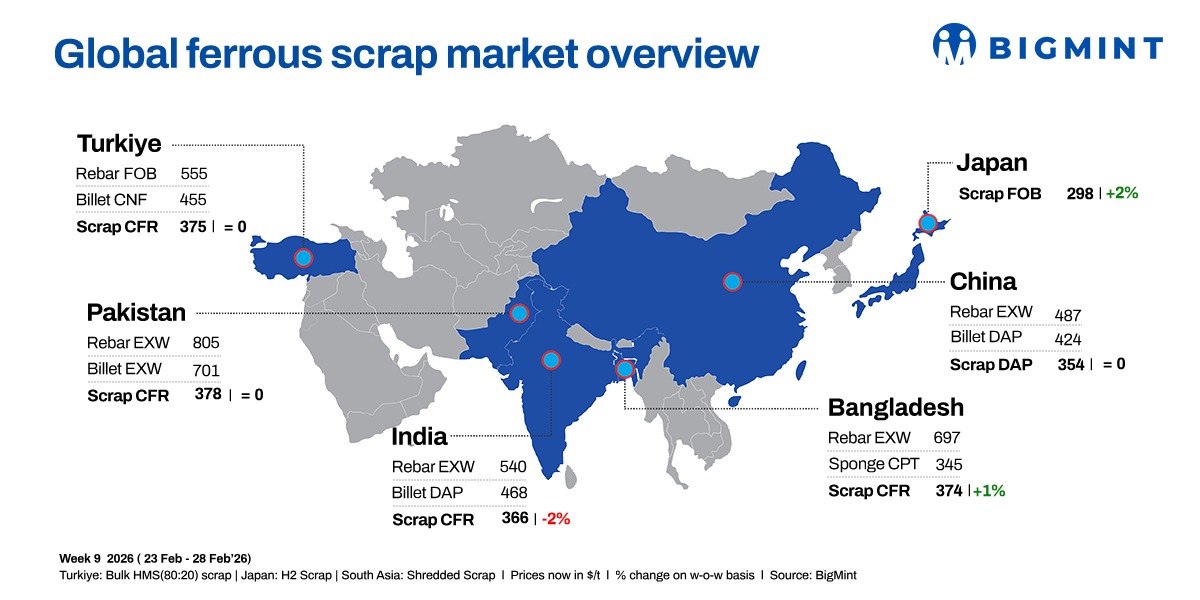
Global ferrous scrap markets remained largely range-bound in the week ended on 28 Feb 2026, with Turkiye and Pakistan steady amid Ramadan-led caution, India witnessing selective need-based buying, and Bangladesh showing mixed sentiment. Japan firmed on higher H2 prices, while UAE and South Korea reflected stable-to-soft trends.
Turkiye: Deep-sea imported scrap prices in Turkiye remained largely stable throughout the week, with US-origin HMS 80:20 hovering at $374-376/t CFR, while EU/Baltic material stood lower at $369-373/t CFR. Limited bookings and tight scrap-to-rebar margins kept mills cautious, with subdued rebar demand capping any significant upside.
Trading remained slow amid Ramadan and US winter-related collection issues, which, along with firm Atlantic freight rates, supported prices. However, buyer resistance near $380/t kept fresh deal activity limited and sentiment mixed.
India: Imported scrap activity in India remained cautious through the week, with buying largely need-based. UK-origin HMS (incinerator scrap) was concluded at $255-260/t CFR, while UK-origin shredded was reported sold at $370/t CFR Chennai, although sellers continued quoting higher at $375-380/t. Demand for shredded remained limited, with HMS 80:20 workable lower at $346-350/t CFR.
Despite firm international cues and a strong dollar, weak domestic TMT demand kept mills price-sensitive. Chennai received relatively higher volumes, but buyers resisted firm Australian offers and instead preferred lower-priced, readily loaded cargoes from Malaysia, Singapore, Hong Kong, and Thailand.
Around 5,000-5,500 t was booked during the week, including nearly 2,000-2,500 t of HMS at $330-346/t CFR, along with shredded, LMS bundles, and incinerator scrap.
Additionaly, KSRTC is setting up South India’s largest registered vehicle scrapping facility at Edappal, Malappuram, in partnership with SIMCO. The INR 30 crore project, laid on 20 Feb’26, will process 100 t/day and generate an estimated INR 300 crore annually.
Pakistan: Imported shredded scrap prices in Pakistan remained largely stable through the week, with UK/EU-origin material heard around $378-380/t CFR Qasim and UAE-origin shredded at $385-390/t, while UAE HMS 80:20 was indicated near $355-360/t. UK-origin shredded was also reported near $377/t. Supply from the UK tightened following Unimetal’s exit, with more volumes moving to bulk buyers, keeping spot availability relatively limited.
Ramadan-led selective trading and liquidity pressures kept buying cautious despite firm supplier offers. Domestic scrap and finished steel prices remained steady, but imported scrap procurement stayed measured, with potential softening if demand fails to improve.
Bangladesh: Imported scrap sentiment in Bangladesh remained mixed through the week. HMS (80:20) was heard at $355-360/t CFR, HMS 1 at $365-370/t, shredded at $372-382/t, and PNS at $378-380/t, while buyer bids generally trailed at $372-375/t, reflecting continued price sensitivity.
Although some restocking was seen in Chattogram, liquidity pressures persisted, particularly among small and mid-sized mills struggling to open LCs. Larger mills continued selective bookings, but overall trading activity remained cautious, keeping broader market momentum under pressure.
Japan: H2 scrap at JPY 46,500/t ($298/t) FOB Tokyo Bay, up by JPY 900/t ($6/t) w-o-w, reflecting cautious upward momentum.
South Korea: South Korea’s pending imported scrap arrivals fell to 41,897 t post-Lunar New Year, though volumes remained supported by earlier Japanese bookings. Fresh contracts were limited, suggesting near-term import inflows may remain steady.
UAE: Domestic scrap index dipped by AED 7/t w-o-w to AED 1,215/t as of 27 February amid subdued Ramadan trading, though tight supply supported heavy melting grades. Export demand from Pakistan remained firm, while EMSteel’s March rebar hike tested market resistance.
Leave a Reply