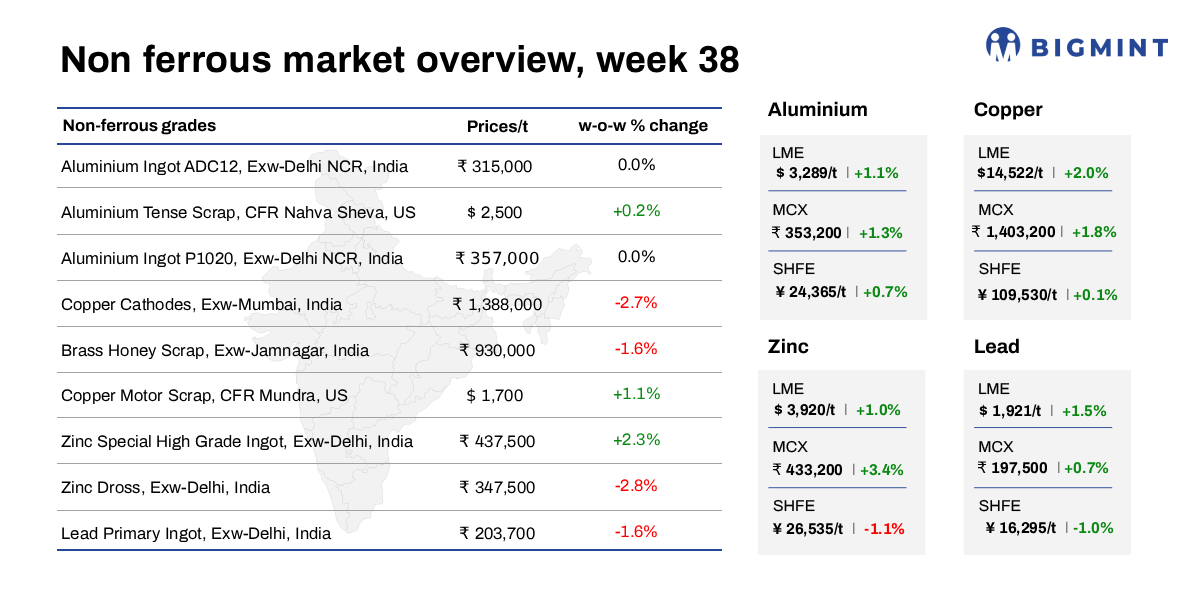
- LME base metals edge up on improving Chinese demand
- Domestic base metals prices show mixed trends amid firm scrap rates
LME base metals extended gains during the week ended 18 September, led by copper, which rose 2.0% to $14,522/t. Lead followed with a 1.5% increase to $1,921/t, while aluminium and zinc advanced 1.1% and 1.0% to $3,289/t and $3,920/t, respectively.
The broad-based gains were supported by improving Chinese physical demand after the recent correction, with buying indicators for copper and aluminium strengthening in September. A weaker near-term impact from the Fed’s expected rate hike and a firmer yuan also supported dollar-denominated metals. Meanwhile, ongoing supply concerns in zinc and lower aluminium and lead inventories provided additional support.
Meanwhile, LME inventories showed a mixed trend during the week. Copper stocks recorded the steepest increase of 9.0% to 255,900 t, while zinc inventories rose 2.6% to 114,250 t. Aluminium stocks declined 0.7% to 242,600 t, while lead inventories fell 1.8% to 375,600 t.
Aluminium
India’s aluminium market remained stable during the week, with both imported scrap and domestic ingot prices unchanged. According to BigMint’s assessment, UK-origin Zorba 95-5 scrap remained at $2,800/t, while P1020 aluminium ingot prices in Delhi NCR stood at INR 357,000/t.
Downstream demand showed some improvement, particularly from the automotive sector, which increased 23% y-o-y during Jan-Aug 2026. Meanwhile, comfortable inventories among some OEMs and greater availability of duty-free FTA material continued to weigh on secondary-market sentiment.
Global trade flows also remained uncertain. The EU dropped its proposed 15% aluminium scrap export duty, providing near-term relief to Indian buyers. However, proposed Waste Shipment Regulation changes could tighten future European scrap availability.
Domestic aluminium prices are expected to remain range-bound in the near term, with market direction likely to depend on international price momentum, domestic replacement costs and the pace of inventory restocking.
Copper
India’s copper scrap market remained firm during the week, supported by tight availability and improved procurement activity.
According to BigMint’s assessment, copper armature scrap, ex-Delhi, increased marginally by INR 2,000/t (0.15%) w-o-w to INR 1,330,000/t.
Scrap availability remained tight as sellers maintained higher expectations, limiting spot transactions into India. Some western-origin material was also diverted to competing destinations offering better netbacks. Meanwhile, domestic recyclers and manufacturers resumed procurement ahead of the October festive season.
Copper cathode prices ex-Mumbai declined by INR 39,000/t (2.73%) w-o-w to INR 1,388,000/t, reflecting weaker domestic physical demand despite firmer LME prices.
Globally, copper prices recovered as Chinese buying improved, while uncertainty over US tariff policy continued to influence trade flows. Rising LME inventories, however, indicated more comfortable near-term availability.
Domestic copper prices are likely to remain mixed, with tight scrap availability supporting secondary prices while cautious downstream buying limits gains.
Zinc & lead
India’s zinc dross and zinc oxide prices declined w-o-w despite firm LME zinc prices, while HZL reduced its benchmark zinc and lead ingot prices.
According to BigMint’s assessment, zinc dross prices ex-Delhi declined by INR 10,000/t (2.8%) w-o-w to INR 347,500/t. Zinc oxide (99% Zn) prices decreased by INR 8,800/t (2.6%) to INR 332,000/t.
Meanwhile, HZL reduced its benchmark SHG zinc ingot price by INR 10,800/t to INR 420,600/t on 17 September, from INR 431,400/t previously. Its benchmark lead ingot price declined by INR 1,700/t to INR 211,400/t from INR 213,100/t.
Zinc prices remained supported by concerns over constrained mine supply, although rising LME inventories and weak downstream demand limited the upside. Lead also benefited from lower exchange stocks, but domestic demand remained subdued.
Zinc and lead prices are expected to remain range-bound in the near term. Import economics and supply concerns may provide support, while weak downstream buying could limit further gains.
Leave a Reply