- Spot treatment charges remain deeply negative across markets
- Mine disruptions continue tightening global concentrate supply
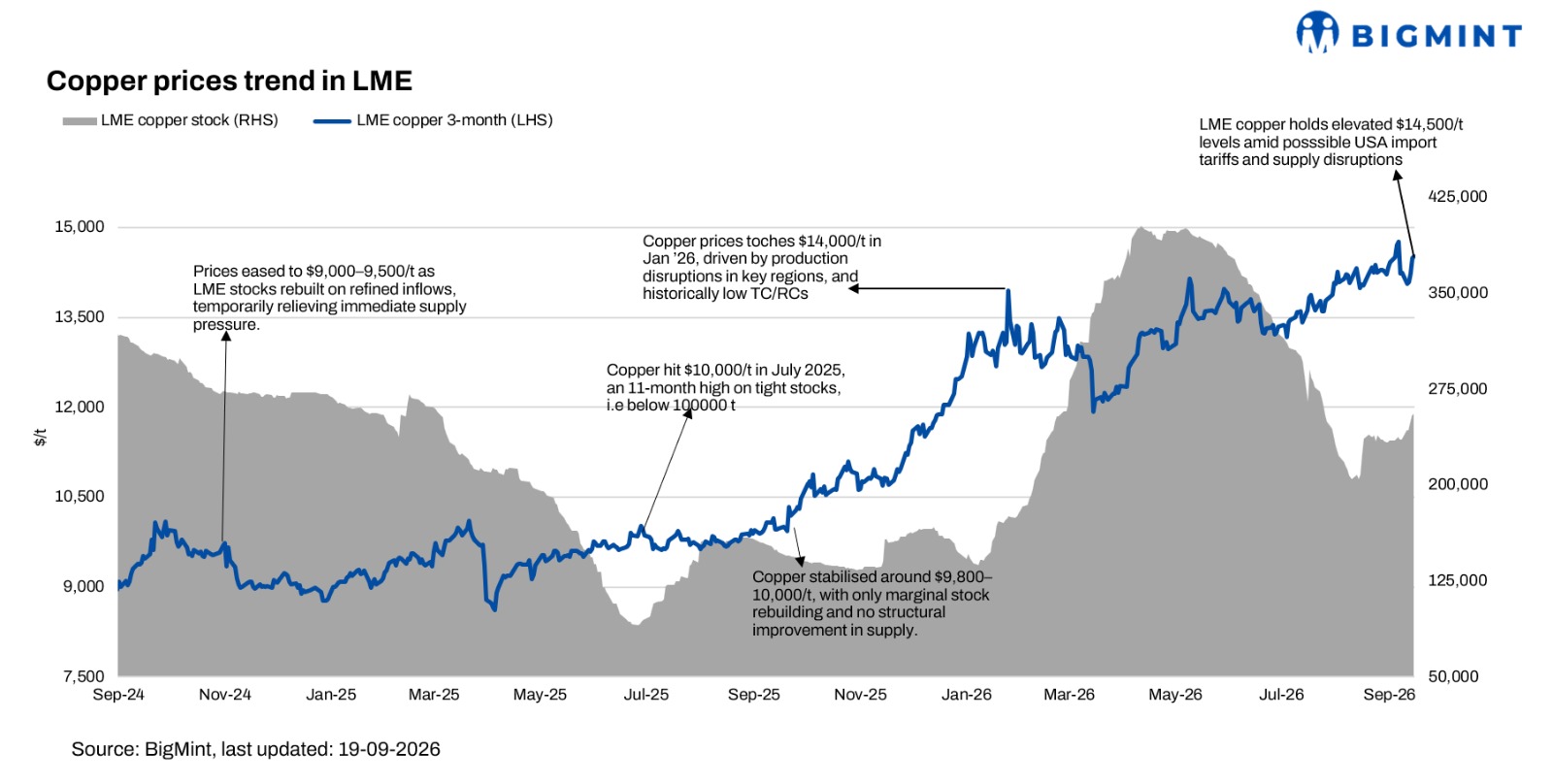
Copper prices have remained elevated despite a sharp correction from record highs earlier this month, as persistent concerns over mine supply and concentrate availability continue to support the market. LME three-month copper futures recently traded around $14,520/t, compared with $14,250/t a week earlier. Prices have risen nearly 49% y-o-y, from around $9,910/t on 9 September 2025 to $14,728/t on 8 September 2026.
The market touched a record $14,875/t last week before retreating as expectations grew that the US could delay or shelve tariffs on refined copper. The uncertainty triggered a sharp reversal, with LME copper recording its first weekly decline after a ten-week winning streak. Prices subsequently recovered as stronger physical demand in China helped offset pressure from US trade-policy uncertainty and higher interest rates.
Mine supply remains key concern
Underlying supply fundamentals continue to support copper prices. Global mine production is expected to decline in 2026, marking the first annual fall since 2017, amid ageing mines, declining ore grades and operational disruptions. Chile, the world’s largest copper producer, has also reported weaker output, adding to concerns over concentrate availability.
The concentrate market remains exceptionally tight, with spot treatment and refining charges deeply negative. This indicates intense competition among smelters for limited concentrate supplies. However, some pressure on refined copper availability has eased following the resumption of operations at Freeport’s two major smelters in Indonesia. PT Smelting, which has around 342,000 t/year of cathode capacity, returned to normal operations following furnace repairs, while the Manyar smelter resumed concentrate feeding. The recovery has also contributed to a sharp easing in LME backwardation.
US tariff uncertainty
The US decision on potential refined copper tariffs remains pending, with the White House weighing concerns that higher copper prices could raise manufacturing costs. Reuters reported on 10 September that no decision had been made, as officials considered the impact of higher copper costs on US manufacturers against the potential benefits of encouraging domestic mining.
The uncertainty has already reshaped global copper trade flows, with large volumes of metal moving into the US ahead of a possible duty. For the scrap market, a prolonged delay could narrow the US price premium and reduce the incentive to divert copper units towards the country, potentially improving availability in other international markets.
China
According to reports, Tongling Nonferrous has completed construction and trial operations of the second phase of its Mirador copper mine in Ecuador. The project is expected to add around 60,000-70,000 t/year of copper output once fully ramped up, strengthening the company’s own concentrate supply at a time when global smelters are facing severe feedstock shortages.
The development comes as Chinese smelters continue to compete aggressively for concentrate amid deeply negative spot treatment charges. While additional mine output could improve Tongling’s feedstock position, the broader concentrate market remains constrained as smelting capacity continues to expand faster than available mine supply.
Japan’s copper scrap imports also continued to increase in the first half of 2026, surpassing 100,000 t during January-June. Including copper alloy scrap such as brass and bronze, total imports reached around 139,000 t, nearly double the volume recorded in the corresponding period of 2021.
The rise in imports may partly reflect Japan’s growing role in regional scrap flows. Market participants increasingly see the country as a potential logistics and trading hub connecting US scrap supply with Asian consumers, including China.
India
India imported 187,331 t of copper scrap during the first half of 2026, up 1% from 185,543 t in the corresponding period last year, according to BigMint data.
The marginal increase came despite disruptions to supplies from several traditional sourcing regions. Higher shipments from the United States and a broader supplier base largely compensated for lower availability from parts of the Gulf and Europe, as global copper scrap trade flows continued to adjust to changing price signals and regional demand.
Leave a Reply