- Suppliers to Turkiye keep offers firm, mills remain cautious
- Bid-offer disparities, Christmas holidays limit trades in India
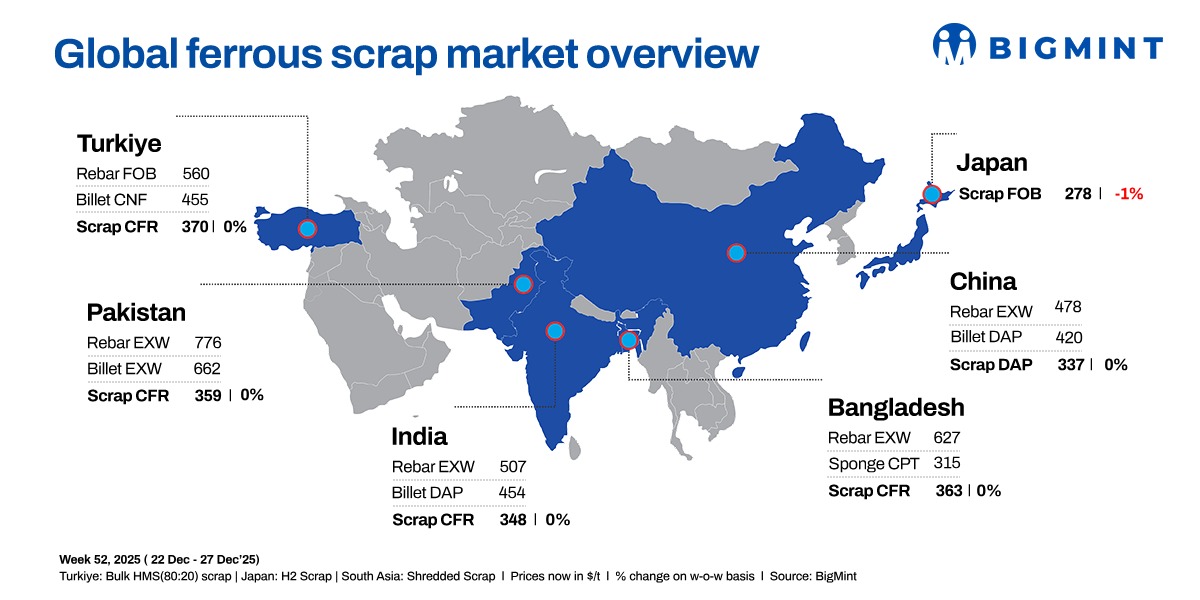
Global ferrous scrap prices remained unchanged w-o-w across major markets, including Turkiye, South Asia, and China, in the week ended 26 December. Prices declined slightly by 1% in Japan. South Asia and Japan recorded cautious demand due to the Christmas holidays, while prices in Turkiye and the US remained firm amid tight supply. Sentiment in the UAE was muted ahead of VAT reforms.
Turkiye: The deep-sea imported scrap market remained stable during the week, supported by firm seller sentiment and tight availability from major exporters. US-origin scrap was near $370/t CFR amid seasonal supply constraints and higher collection costs.
On the buying side, Turkish mills stayed cautious due to weak downstream steel demand, though a few secured cargoes for late January and early February. Holiday slowdowns limited activity, keeping prices broadly unchanged.
India: India’s imported scrap market remained subdued throughout the week. Buying interest was selective. UK-origin shredded scrap was heard around $345-350/t CFR, while HMS 80:20 levels hovered near $318/t CFR Nhava Sheva/Chennai, largely stable.
Supplier activity remained thin due to Christmas and year-end holidays, limiting trade momentum. Although a few spot transactions were concluded, bid-offer gaps persisted, especially for HMS grades, preventing any meaningful pick-up in volumes despite steady price indications.
Approximately 3,000-4,000 t of imported scrap were reported to have arrived in India during the week, including around 1,500-2,000 t of HMS 80:20, while the balance comprised shredded, PNS, HMS bales, LMS bales, and HMS 90:10.
Pakistan: The imported scrap market remained subdued during the week, with weak buying interest amid year-end slowdowns. Imported scrap was assessed at $355-358/t CFR, while shredded offers hovered near $360/t, drawing limited response. Tight US dollar availability further constrained activity, forcing importers to accept unfavourable exchange rates or delay payments, keeping sentiment bearish despite restocking hopes from mid-January.
Additionally, Pakistan’s ferrous scrap imports increased 30% y-o-y to 2.87 mnt in 10MCY’25, aided by duty relief, lower global prices, and cargo diversion, despite weak steel demand and a 17% decline in crude steel output.
Bangladesh: Bangladesh’s imported scrap market remained quiet through the week, with limited trading and largely stable prices. Hong Kong-origin oversized PNS was heard around $363/t CFR, shredded at $353/t, and Australian shredded near $350/t. However, softer domestic melting and ship scrap prices at BDT 45,000-48,000/t ($368-393/t) weighed on sentiment, keeping buying interest cautious and fresh bookings limited.
Japan: H2 scrap prices eased ahead of the year-end holidays, with BigMint assessing H2 at JPY 43,600/t FOB Tokyo Bay, down JPY 250/t w-o-w. Export offers to Vietnam were heard at $325-335/t CFR, with bids below $320/t amid limited activity.
Tokyo Steel revised scrap purchase prices effective 25 December, cutting rates at select plants. Post-revision, H2 prices across its facilities ranged between JPY 39,500-44,500/t, reflecting subdued demand and holiday-related slowdowns.
US: The US scrap market strengthened as dealers pushed for January hikes amid tight supply and restocking demand. FOB prices rose for HMS 80:20 and shredded, while CFR levels firmed for Turkiye and Bangladesh, with Vietnam stable.
The RMDAS ferrous scrap index strengthened in December 2025, with shredded at $394/t, composite scrap at $417/t, and HMS at $353/t, reflecting improved buying interest from US mills and foundries.
UAE: The UAE scrap market softened in late December, with the domestic index down AED 9/t ($2/t) w-o-w amid year-end cautious sentiment and cash-flow pressures. Buying levels stayed stable, while Emirates Steel Arkan rolled over January rebar prices ahead of VAT clarity.
The UAE approved a reverse charge VAT mechanism on ferrous and non-ferrous scrap trading from 14 January 2026, shifting VAT responsibility to buyers. The move aims to curb tax leakages, ease supplier cash flow, and keep near-term market activity stable.
Leave a Reply