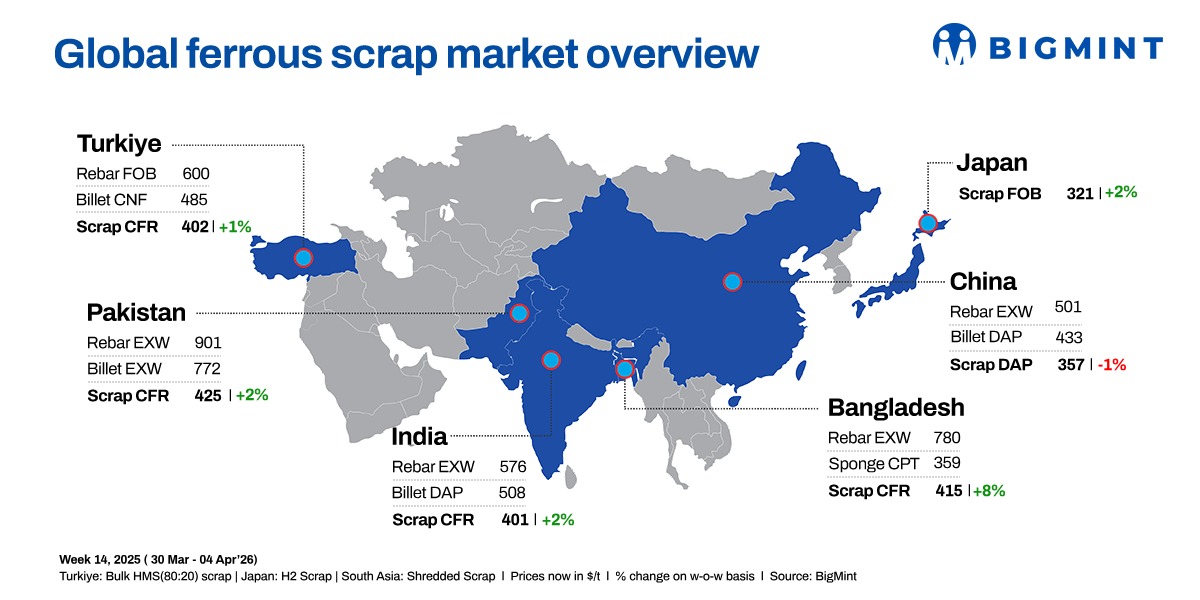
- Turkiye: Prices rise on strong Apr-May bookings, tight supply
- UAE: Prices drop to Oct’23 levels on weak exports, disruptions
The global ferrous scrap market remained mixed in the week ending 4 April. Turkiye showed upward momentum, while Indian scrap prices hit an 18-month high, though trading remained weak. Pakistan and Bangladesh prices were also firm on tight supply, and demand was steady. Japanese prices rose, while UAE remained under pressure amid weak demand and disruptions.
Turkiye: Deep-sea scrap prices strengthened over the week, with US-origin HMS 80:20 rising from around $398/t to $403-405/t CFR, supported by robust bookings earlier and tight supply. Mills actively secured April-May cargoes, while offers remained firm above $400/t, keeping sellers in control.
The uptrend was driven by higher freight and energy costs, along with rising billet prices, while rebar export offers stayed around $600/t FOB and above, allowing mills to pass on some cost pressure.
However, activity slowed later in the week as mills became cautious due to squeezed margins, though prices continued to hold firm.
India: The imported scrap market remained weak, as the rupee depreciation to around INR 95 per US dollar and higher freights pushed up landed costs of HMS to an eighteen-month high, making imports largely unviable. Offers stayed firm, with HMS 80:20 around $380/t CFR and shredded near $390-400/t, but buying interest was limited with a wide bid-offer gap.
Prices were supported by tight vessel availability, global scrap shortages, and rising freights amid geopolitical tensions, though most offers from the UK, Europe, and other origins remained unworkable. The shredded-HMS spread also widened to $25-30/t, reflecting stronger sentiment in higher-grade scrap.
Around 2,500-3,000 t of imported scrap were booked during the week, including Senegal-origin HMS 80:20 at $375/t CFR Mundra, LMS bundles at $320-330/t, and Costa Rica-origin HMS 60:40 at $350-353/t CFR Chennai, indicating subdued buying across grades.
Pakistan: The imported scrap market remained firm through the week, with UK/Europe-origin shredded mostly in the $418-425/t CFR Qasim range, supported by tight supply and limited regional availability as Middle East cargoes dried up. Narrow bid-offer gaps reflected steady but cautious buying interest.
Freight costs surged by about $200 to $1,400-1,500/20 ft, further increasing landed costs and reinforcing firm prices. However, trading activity stayed limited at higher offers, as buyers showed resistance despite supply constraints, keeping overall market sentiment stable but slow.
Bangladesh: The imported scrap market remained stable at elevated levels for most of the week, with UK-origin HMS at $380-385/t CFR and shredded around $405-410/t, supported by firm domestic rebar prices and steady mill demand. Offers from Australia and New Zealand also aligned in a similar range, indicating consistent global pricing despite ongoing economic recovery challenges and external pressures such as Middle East tensions.
Towards the end of the week, prices edged higher as supply tightened and sellers held back material expecting further gains, with shredded reaching up to $412-415/t. However, a widening bid-offer gap of $15-25/t highlighted cautious buyer sentiment, limiting fresh trade activity despite the firm market trend.
Japan: Japan’s FOB H2 export prices increased by JPY 400/t ($3/t) to around JPY 51,200/t ($321/t), amid higher offers, after reaching a 20-month high in the previous week.
Taiwan: Feng Hsin Steel raised rebar and local scrap prices by TWD 200/t ($6/t) for 30 March-2 April, marking a fifth weekly increase, as rising global scrap prices pushed up production costs. Rebar stood at TWD 18,500/t ($578/t) and HMS 80:20 at TWD 9,600/t ($300/t), while US-origin scrap reached $345/t CFR Taiwan.
UAE: Domestic scrap prices declined further in the last week of March, with HMS 80:20 (processed) falling by AED 91/t ($25/t) w-o-w to AED 1,048/t ($285/t), the lowest since October 2023, as weak export demand and cautious mill buying weighed on sentiment. Mills largely stayed on the sidelines amid uncertainty, including disruptions at EGA and logistics issues around the Strait of Hormuz, while rising transport costs supported steel prices.

Leave a Reply