- Wide bid-offer disparities keep buyers on sidelines
- Competitively priced Chinese imports add pressure
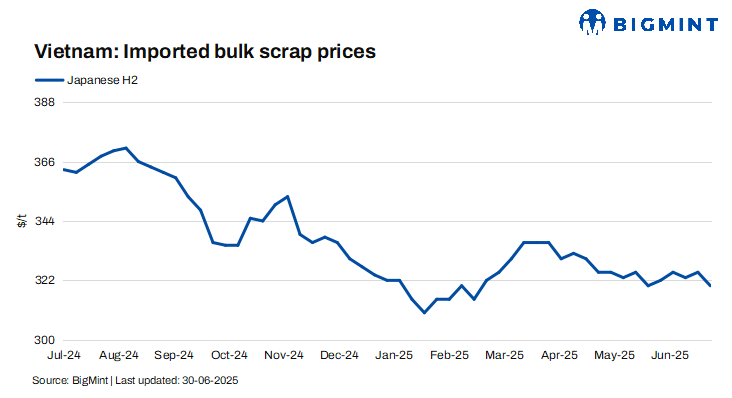
Imported ferrous scrap prices in Vietnam edged lower by up to $5/tonne (t) w-o-w, amid subdued market activity and cautious buying sentiment.
A trader noted, “Demand for imported scrap remains weak, as most buyers are hesitant due to sluggish end-user consumption and the arrival of the rainy season.”
Many buyers opted to stay on the sidelines, discouraged by a significant gap between bids and offers in the spot market.
Weekly assessments
- Japanese H2 was assessed at $320/t CFR, down by $5/t w-o-w.
- US-origin HMS 80:20 bulk was assessed at $338/t CFR Vietnam, down by $2/t w-o-w.
Market commentary
A mill-side participant stated that Vietnamese buyers targeted $315-320/t CFR for Japanese H2, but suppliers held firm, with offers at $325-330/t despite bids softening.
Meanwhile, offers for US-origin HMS 80:20 deep-sea scrap fell w-o-w to $345/t CFR Vietnam, with bids coming in lower at $335/t CFR.
A Vietnam-based trader observed, “Buyers are hesitant to purchase scrap at the moment due to sluggish market conditions.” The rainy season has further dampened downstream demand and rebar consumption, putting additional strain on the scrap market.
A market participant noted, “Bids are typically $10-15/t below current offers, indicating cautious buying sentiment. Moreover, the influx of competitively priced Chinese products and billets is putting additional pressure on markets across Asia, including Vietnam and Korea, fuelling a generally bearish outlook.”
HS scrap offers were heard at $355/t CFR, while bids ranged from $340-346/t CFR, reflecting the ongoing disconnect between buyer expectations and seller pricing.
Outlook
Vietnam’s scrap market is expected to stay subdued in the near term as weak demand and seasonal factors continue to weigh on sentiment. Market participants foresee further potential declines in H2 scrap prices unless steel consumption sees a meaningful rebound. The approaching rainy season is also likely to dampen demand further, keeping product prices under pressure.

Leave a Reply