- Export-linked yarn demand slows despite stable prices
- Spinning millers stay cautious amid weak order visibility
Uncertainty around possible trade and tariff actions by the United States has begun to affect sentiment in India’s cotton yarn market, particularly in north India. Over the past week, yarn exporters reported slower enquiry flow and delayed purchase decisions from overseas buyers. While no fresh tariff has been officially imposed on cotton yarn, the lack of clarity itself has made buyers hesitant to commit to forward contracts, leading to a visible slowdown in fresh export deals.
What is notable is that the current weakness is not being driven by prices or supply constraints. Cotton yarn prices have remained largely stable across key counts. In north India, 30s combed yarn is trading around INR 265-270 per kg, while 40s combed yarn is quoted near INR 29-295 per kg, ex-GST. These levels have seen little week-on-week change, reflecting balanced cost structures at the mill level. Mills indicate that price stability is being supported by steady raw cotton prices and disciplined production schedules.
Raw cotton availability remains comfortable across markets. Kapas arrivals are ongoing in major producing states, and additional supply is entering the system through imports under the duty-free window. Trade participants indicate that spot lint prices are broadly range-bound and aligned with recent CCI auction benchmarks, helping spinning millers maintain margins despite slower yarn offtake. There has been no sign of supply tightness or panic buying at this stage.
At the ginning level, offtake remains regular but lacks urgency. Ginners report that spinning millers are buying only for immediate requirements, with no aggressive forward coverage. Cottonseed prices are also steady, offering limited additional support to ginner realisations. Overall, the value chain is functioning smoothly, but without the confidence needed for higher risk-taking or inventory build-up.
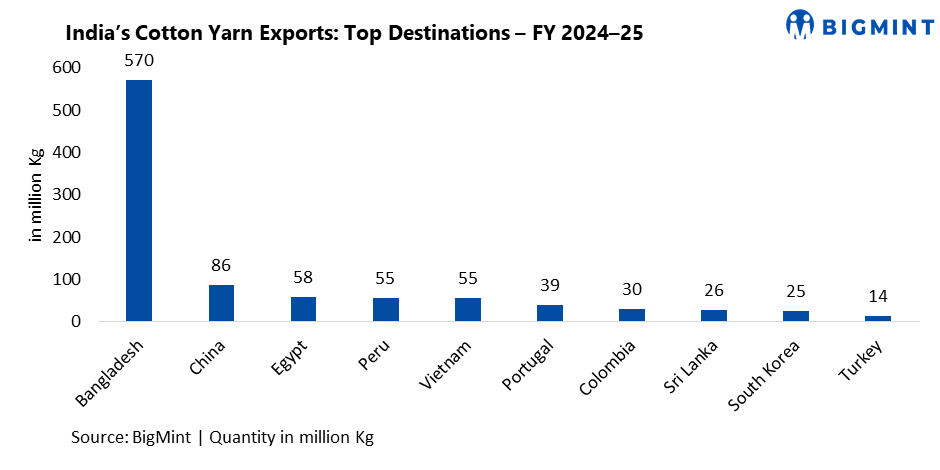
The slowdown in yarn demand is largely sentiment-driven. Although the US accounts for a small direct share of India’s cotton yarn exports, any uncertainty in US trade policy tends to affect global apparel sourcing decisions. A slowdown or delay in garment orders eventually feeds back into yarn demand, often with a short lag. Exporters are therefore cautious, especially those exposed to US-linked supply chains, even if their direct yarn shipments to the US are limited.
Looking ahead, clarity on US trade policy will be critical for restoring confidence. If tariff concerns ease or remain unchanged, deferred yarn enquiries could gradually return, especially from buyers in Asia supplying the US apparel market. Until then, spinning millers are likely to continue operating on confirmed orders, ginners may see steady but cautious buying, and cotton prices are expected to remain range-bound rather than move sharply higher. Brokers should expect sentiment-led volatility rather than fundamentals-driven price action in the near term.
Leave a Reply