- NAPP coal inventories dip as retail prices remain elevated
- Petcoke approaches $180/t, cement buyers turn cautious
Global high-CV fuel markets remained firm in late September, with US Northern Appalachian (NAPP) coal and high-sulphur petroleum coke confronting Indian consumers with sharply higher replacement costs.
The two markets, however, face different dynamics. Petcoke is being driven by rising US Gulf Coast (USGC) prices and expensive freight, while India’s NAPP coal market is emerging from an exceptional inventory squeeze. A sizeable arrival programme could eventually ease NAPP coal availability, although immediate supply remains tight.
For Indian consumers, the issue is increasingly fuel economics rather than outright demand.
Petcoke: USGC rally pushes Indian costs higher
USGC petcoke has strengthened sharply during September, feeding directly into higher replacement costs for India’s cement industry.
US-India petcoke prices – 6.5% sulphur

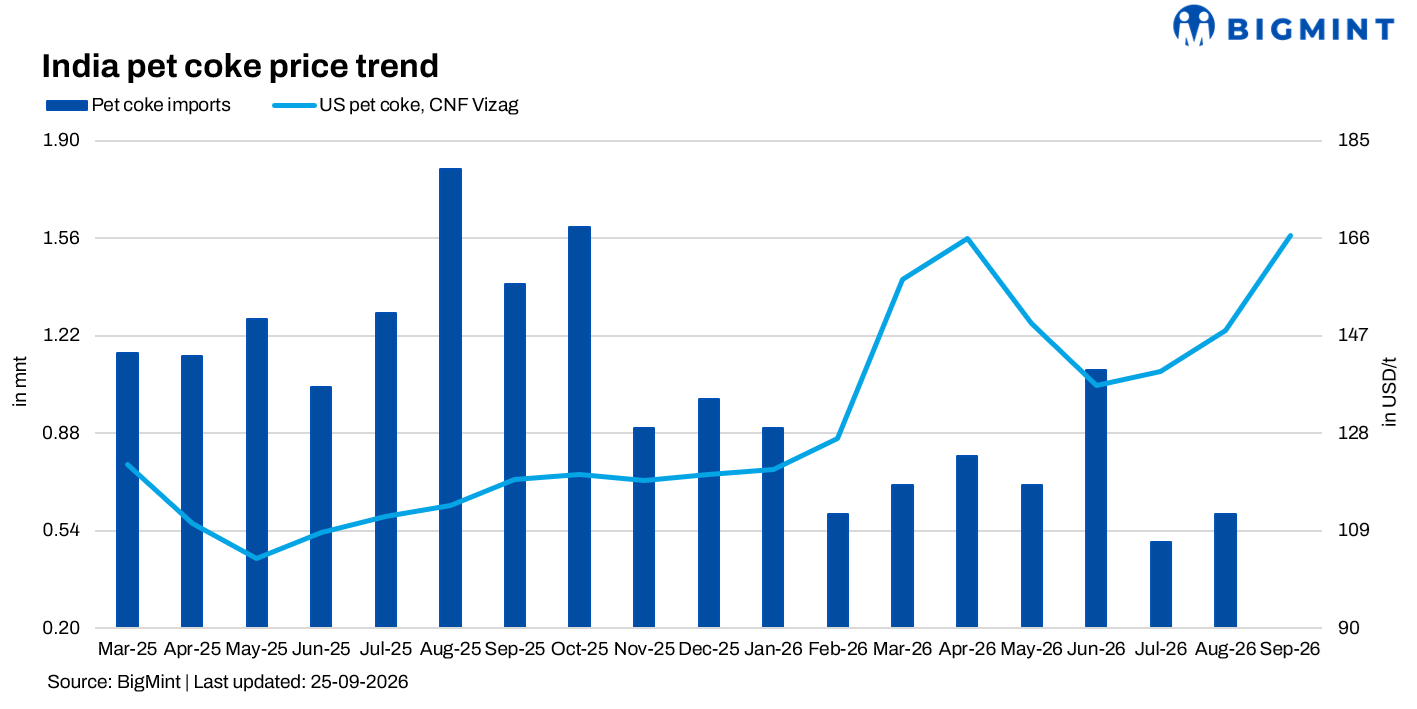
USGC 6.5% sulphur petcoke reached $98/t FOB on 23 September, up $5/t w-o-w and $15/t above its August index. CFR India rose to $170/t, up $7/t w-o-w and more than $26/t above August.
Physical indications are already above the $170/t assessment. A recent high-sulphur USGC cargo was heard concluded around $174-175/t CFR west coast India. Following the transaction, replacement indications moved towards $180/t CFR, while October-November cargo economics could approach $185/t CIF WCI if current USGC and freight levels persist.
Market feedback indicates imported petcoke at around $175-180/t CNF. Buyers are increasingly cautious, with some considering waiting for domestic refinery pricing rather than chasing imported cargoes at current levels.
Cement expansion supports fuel demand
Higher prices come as India’s cement industry prepares for stronger post-monsoon activity.
Cement demand has been running at high-single-digit y-o-y growth quarter-to-date, with improvement expected during H2FY27. However, elevated fuel costs remain a pressure on producer margins.
Capacity continues to expand. UltraTech Cement has commissioned another 4.6 mnt, taking domestic grey cement capacity to around 205 mnt. Capacity is targeted at approximately 217 mnt by end-FY27 and 237 mnt by end-FY28.
This provides structural support to India’s requirement for high-CV kiln fuels. However, as petcoke approaches $180/t CFR, cement producers have greater incentive to compare petcoke against domestic and imported coal on a delivered-energy basis.
NAPP: depleted stocks keep prices elevated
Indian NAPP retail prices have also risen sharply.
Latest indications are predominantly around INR 18,000-18,500/t ex-warehouse, with some offers reaching INR 19,000/t. Spot transactions have been heard around INR 18,000-18,200/t, while CFR indications are around $175/t.
The strength becomes easier to understand when viewed against inventories.
Retail ground stocks of NAPP and ILB fell from 365,902 t in January to only 72,824 t in August, an 80% decline. August stocks were also 89% below the 669,737 t held a year earlier.
Weekly inventories subsequently fell further, from 215,173 t in week 31 to just 40,661 t by week 37, against 625,670 t in the corresponding week of 2025.
Demand remains, but buying turns need-based
Low stocks do not indicate disappearing consumption.
Retail NAPP and ILB lifting reached 187,452 t in August, up 22% m-o-m and 61% y-o-y. January-August lifting totalled 2.81 mnt.
However, weekly lifting subsequently slowed from 56,656 t in week 34 to 20,375 t by week 37.
Market feedback similarly points towards limited day-to-day lifting and increasingly need-based purchases. Buyers still require coal, but resistance has strengthened around INR 18,000-19,000/t.
This suggests price resistance rather than demand destruction.
Incoming cargoes could ease NAPP squeeze
The strongest counterweight to current NAPP prices is the incoming vessel programme.
Around 1.6 Mnt of NAPP is scheduled to reach India between late September and early November, based on the current vessel line-up. Cargoes are destined for industrial consumers and the retail market, particularly through Tuna, Kandla and Gangavaram.
This suggests the market is experiencing a timing squeeze rather than an absence of future supply.
Near-term availability could remain tight because inventories have been drawn exceptionally low. But if scheduled cargoes arrive broadly on time, replenishment through October and early November should become substantial.
The key risk is logistics. Delays in cargo feeding and vessel loading at Baltimore have already affected schedules, and further slippage could prolong India’s supply tightness.
BigMint assessment
NAPP and petcoke are entering the post-monsoon demand season from very different supply positions.
NAPP appears closer to peak physical tightness. Indian inventories have been depleted to exceptional levels, explaining current INR 18,000-19,000/t retail prices. However, the large cargo pipeline provides a visible route towards replenishment. If October-November arrivals remain broadly on schedule, retail availability should improve and upward price pressure could ease. Delays at Baltimore remain the principal upside risk.
Petcoke looks structurally firmer in the near term. USGC 6.5% sulphur prices have risen sharply, freight remains expensive and Indian replacement indications have moved towards $180/t CFR, with forward economics potentially approaching $185/t.
India’s expanding cement capacity supports underlying fuel demand, but buyers are becoming increasingly price-sensitive. At current levels, cement producers are likely to intensify comparisons between petcoke, imported coal and domestic alternatives.
The key distinction is therefore supply visibility: NAPP has significant replacement tonnage approaching India, while petcoke currently has less visible relief from elevated replacement costs.
Unless freight or USGC prices retreat, petcoke could remain the firmer of the two fuels, while NAPP’s Indian premium becomes increasingly vulnerable to the arrival of October-November cargoes.
Leave a Reply