- Weak downstream demand limits upside across UAE steel markets
- UAE mills remain cautious despite firmer raw material availability
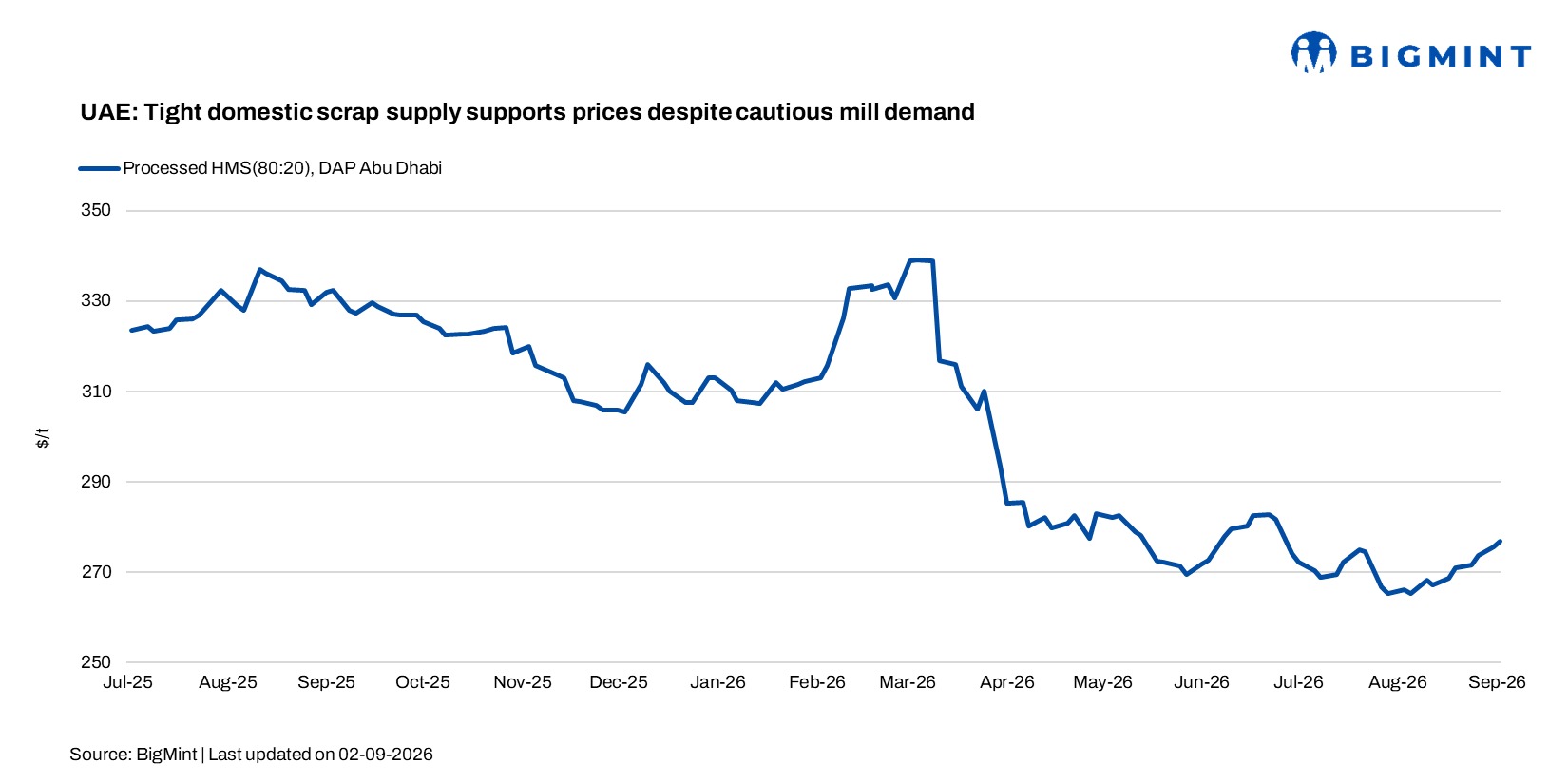
UAE local scrap prices remained largely stable this week, with limited movement across most grades. Processed HMS 80:20 was an exception, rising by AED 11/t ($3/t) w-o-w. However, the increase has not been enough to change the overall market tone, with mills continuing to resist higher buying levels.
On a DAP Abu Dhabi basis, excluding 5% VAT, HMS 80:20 was heard at AED 870-880/t ($235-238/t), while HMS Super was around AED 920-950/t ($248-257/t). Shredded scrap was higher at AED 1,080-1,100/t ($292-297/t).
Other grades were also largely unchanged, with LMS (pure) at AED 780-800/t ($211-216/t), PNS unprocessed at AED 960-970/t ($259-262/t), processed PNS at AED 1,060-1,070/t ($286-289/t) and fabrication scrap at AED 1,000-1,050/t ($270-284/t).
Market scenario
A major Dubai-based scrap yard representative said material availability is relatively tight, but buyers are not showing enough urgency to push prices higher. “Material is short, market is stable,” the source said, adding that slower container movement has also made sellers hesitant to raise offers.
The yard was indicating 80:20 sheared at around AED 1,025/t ($277/t), shredded at AED 1,125/t ($304/t) and processed HMS at AED 990-1,010/t ($267-273/t).
The same cautious tone is visible in regional trade activity. A UAE-based trader reported Middle East-origin fabrication scrap offered at $424/t CFR Qasim, while sheared HMS was offered at around $410/t for 1,000 t. Compressor scrap was around $420/t CFR Karachi/Qasim. Separately, 500-1,000 t of sheared HMS was reported sold at $410/t CFR Qasim, while shredded scrap was offered at around $430/t CFR Qasim.
For now, tight availability is providing a floor to UAE scrap prices, but weak buying momentum is limiting any meaningful upside. Sellers appear unwilling to cut aggressively, while mills are also showing little appetite to chase higher prices.
UAE steel market faces demand and logistics pressure
The cautious tone in the scrap market is also visible in the wider UAE steel market, although the factors driving the two markets are somewhat different.
HRC imports continue to be largely FOB-driven as vessel availability remains tight. Indian HRC transactions were reported at around $520-525/t FOB, while Chinese offers were heard at $490-510/t FOB. Despite competitive steel prices, buyers that have secured cargoes are still facing difficulties arranging vessels.
In rebar, the UAE market came under renewed pressure as September trading began. The leading producer maintained its September price at AED 2,921/t ($795/t) exw and reportedly sold its full allocation of around 170,000-180,000 t. Other suppliers have started reducing offers, with Omani rebar heard at around AED 2,870/t ($781/t) DAP.
Demand remains a concern, particularly in construction. Monthly UAE rebar consumption is estimated at around 425,000 t, down from 475,000-500,000 t several months ago. Traders are therefore continuing to buy cautiously and are looking for further price concessions.
Meanwhile, billet availability has tightened across the GCC, creating another supply-side challenge for UAE re-rollers. Locally available billet was assessed at around $650/t delivered, while Indian billet was available at around $505-510/t CFR for September-October shipment. Import options remain limited amid ongoing logistics constraints.
Outlook
The UAE scrap market is likely to remain quiet through early September, with tight availability offering some support but cautious mill buying limiting any meaningful price rise. Steel prices could continue to face pressure as construction demand remains weak and mills compete for orders, while vessel shortages and tight billet supply may provide some support. A clearer recovery in downstream buying will be needed for prices to move higher.
Leave a Reply