- H1 scrap imports increase to 1.67 mnt
- Steel production falls 26% amid weak margins
- Imported shredded prices average $403/t CFR
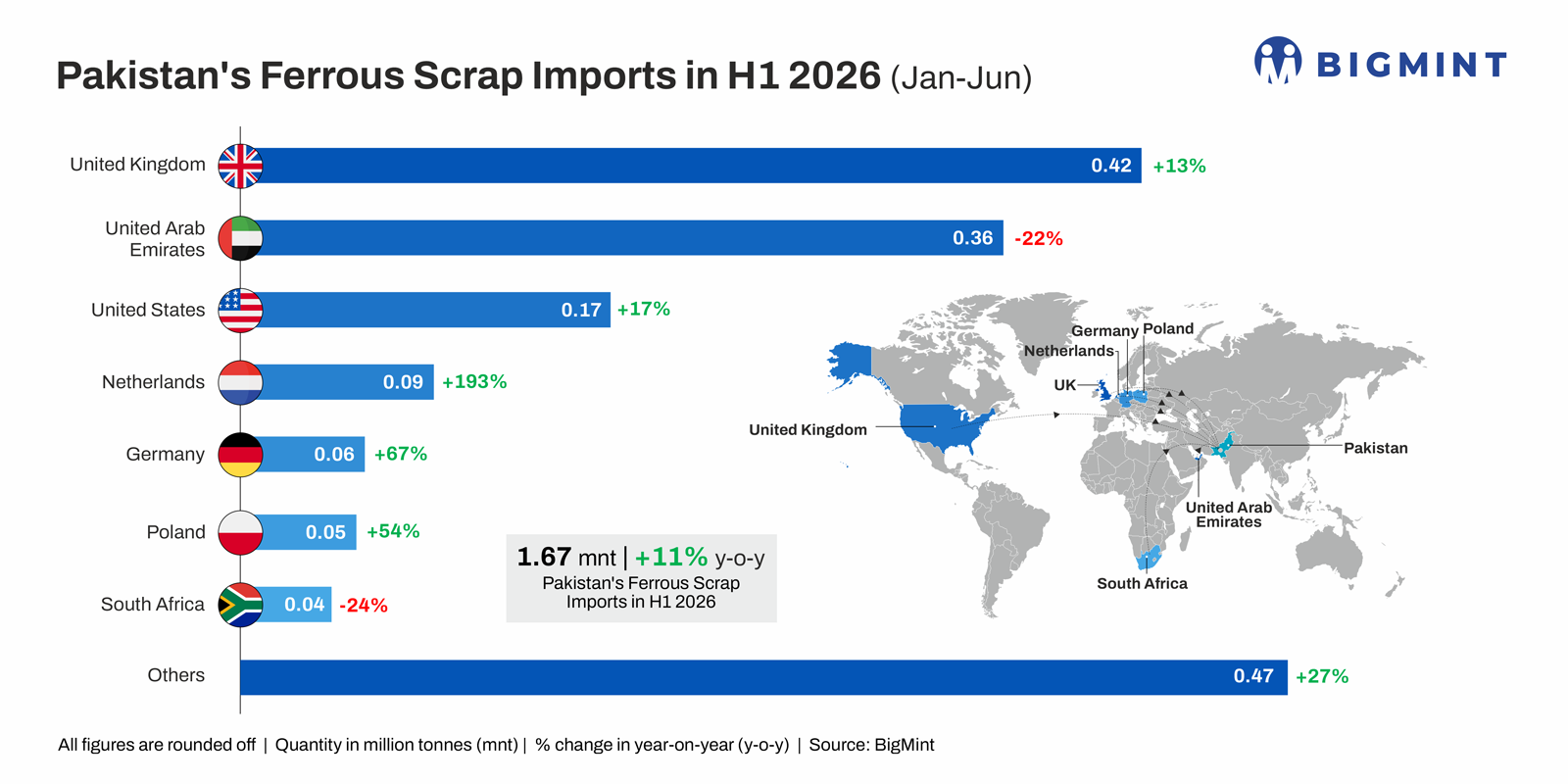
Morning Brief: Pakistan’s ferrous scrap imports increased in January-June 2026 (H1CY’26) despite persistent weakness in the domestic steel sector, as higher imports in January and a strong recovery in June offset softer volumes during March-April.
According to the BigMint data, Pakistan imported 1.67 million tonnes (mnt) of scrap in H1, up 11% y-o-y from 1.51 mnt in H1CY’25.
However, the rise in scrap procurement was accompanied by a sharp contraction in crude steel production, highlighting the challenging operating environment for Pakistani steelmakers.
Crude steel output fell to 1.39 mnt in H1CY’26, down 26% from 1.87 mnt in the same period last year.
Scrap imports strengthen in June
Scrap imports remained volatile during H1CY’26, falling from 0.39 mnt in January to 0.21 mnt in March before recovering gradually. Imports rose to 0.24 mnt in May and accelerated to 0.32 mnt in June, up 33% m-o-m and 68% y-o-y, with June volumes significantly above 0.19 mnt recorded in June 2025.
The latest monthly rebound suggests that some mills returned to the import market after reducing procurement earlier in the year. However, the recovery remains uneven, with buyers continuing to assess finished steel demand, working capital availability and replacement costs before committing to fresh cargoes.
The UAE, one of Pakistan’s major scrap suppliers, recorded a 22% decline in scrap exports to Pakistan during H1CY26. The decline was partly linked to disruptions and logistical challenges arising from the Middle East conflict, which affected regional trade flows and reduced export availability.
Steel output remains under pressure
Despite higher scrap inflows, Pakistan’s crude steel production continued to contract. Monthly output declined from 0.27 mnt in January to 0.25 mnt in February and 260,000 t in March, before falling further to 200,000 t in April. Production remained subdued at around 210,000 t in May and 200,000 t in June.
Total H1 production of 1.39 mnt was 26% lower y-o-y. The decline reflects persistent margin pressure across the steel industry, with weak downstream demand, elevated energy costs and financing expenses restricting mill operating rates.
Pakistan has installed steelmaking capacity approaching 9 mnt/year, but actual annual output remains far below potential at around 3.8 mnt. Several mills have reportedly shut down, while operating facilities are running at only around 30-50% utilization.

Scrap prices remain elevated
Imported shredded scrap prices stayed considerably higher than last year despite weak steel production. The average price for UK-origin shredded scrap reached $403/t CFR Qasim in H1CY’26, up 8% from $374/t in H1CY’25.
Prices started the year at $371/t in January before rising to $381/t in February and jumping to $407/t in March. Offers then climbed to $424/t in April and May, before easing to $414/t in June and $401/t in July.
The sharp increase during March-May was supported by tighter overseas availability, higher freight costs and geopolitical disruptions affecting shipping routes. The average H1 price remained well above last year even as Pakistani buyers faced weak domestic steel demand.
For comparison, UK-origin shredded scrap prices in India averaged $383/t in H1CY’26, up 5% y-o-y. Pakistan therefore maintained a premium of around $20/t over the Indian market on the same origin during the period.

Higher steel imports offer limited support
Pakistan’s finished steel imports increased during H1, but the rise has not translated into a meaningful recovery in domestic steel production. Total steel imports reached o.42 mnt, up 31% y-o-y from 0.32 mnt.
Finished flat steel accounted for most of the increase, rising 32% to 0.41 mnt, while semi-finished imports remained unchanged at around 0.01 mnt.
The increase in imported finished steel indicates continued competition for domestic producers, particularly in flat products, while weak construction and industrial activity continue to constrain local demand.

Gadani revival to strengthen domestic scrap supply
Pakistan’s ship recycling volumes declined 15% y-o-y to nearly 51,000 LDT in H1CY’26, reflecting limited vessel availability, liquidity constraints and cautious buying by local recyclers. However, unlike Bangladesh, the country’s long-term outlook continued to improve as the government accelerated structural reforms aimed at modernising the Gadani Ship Breaking Yard. The revival programme includes infrastructure upgrades and HKC-compliance measures, with nine of 16 recycling plots already upgraded.
Freight, taxes and financing weigh on buying
Market participants continue to cite high energy costs, heavy tax burdens, elevated freight rates, exchange-rate movements and expensive financing as major constraints on scrap purchasing.
Shipping disruptions linked to geopolitical tensions also increased logistics costs during the first half. Route diversions and vessel shortages raised freight costs on UK and European routes, increasing the landed cost of imported scrap and making mills more cautious about accepting higher supplier offers.
Pakistan’s currency remained relatively stable, with the average PKR/USD rate at around 279 in H1 2026, compared with 281 in H1 2025. The marginally stronger rupee provided some relief on import costs, although this was insufficient to offset higher scrap, freight and financing expenses.
Outlook
Scrap market is expected to remain cautious in the upcoming days. June’s strong rebound in imports indicates renewed procurement interest, but the sharp decline in crude steel production highlights the underlying weakness of mill economics.
The reported four-month UAE ban on ferrous scrap exports could further tighten Pakistan’s supply options. In June, the UAE reportedly moved to restrict ferrous scrap exports for four months, with market participants citing increasing difficulties in securing export approvals. The measure could further reduce UAE-origin scrap availability to Pakistan, particularly as the UAE is an important regional supplier.
The reported restriction is part of broader UAE efforts to retain recyclable materials for domestic steelmakers and recycling companies. If implemented, reduced UAE export availability could push Pakistani buyers to seek alternative origins, potentially increasing competition for scrap from other suppliers and adding pressure to landed costs.
Buyers are likely to remain highly price-sensitive, with purchasing decisions dependent on finished steel sales, scrap replacement costs, freight availability and financing conditions. If shipping costs moderate and international scrap availability improves, shredded scrap prices could stabilize around $385-400/t CFR Qasim.
However, sustained weak downstream demand, high electricity costs and limited mill utilization could restrict further growth in scrap consumption. Unless domestic steel margins improve, the increase in H1 scrap imports is unlikely to signal a broad-based recovery in Pakistan’s steel sector.
Leave a Reply