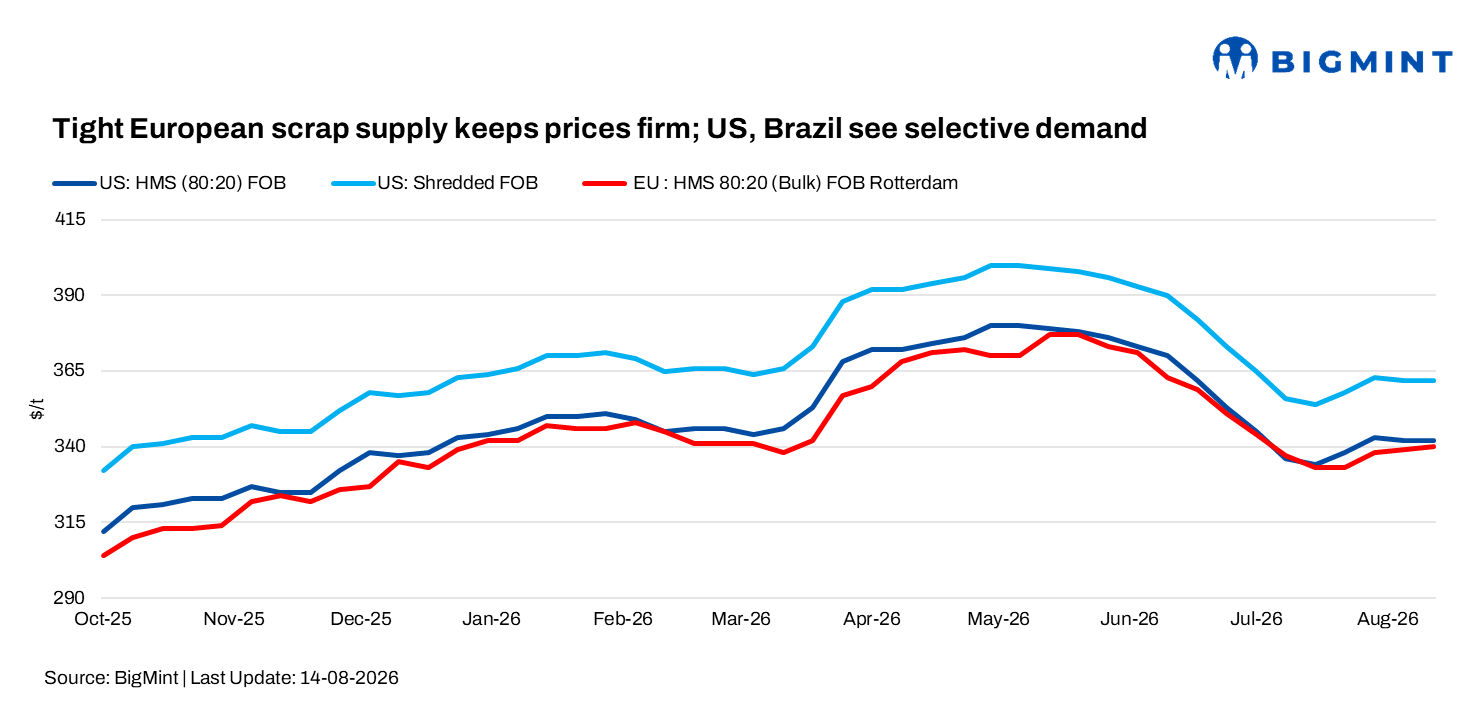
- Limited Baltic vessel availability keeps export scrap offers firm
- US shredded scrap faces downside amid weak export demand
Ferrous scrap export markets remained mixed during the week ended 14 August. Firm freight rates, tighter summer scrap availability, and slower collection supported European export prices, while cautious buying interest and weak finished steel demand limited upside across key import markets.
Meanwhile, the US and Brazil markets came under pressure on select grades amid subdued buying activity and softer export demand.
For Turkiye, EU-origin scrap offers have narrowed the gap with the latest US-origin bookings. However, the ongoing disruptions in the Black Sea have created fresh uncertainty, with slab, pig iron, and billet shipments delayed due to limited vessel availability. As alternative metallic feedstock becomes increasingly constrained, Turkish mills may be compelled to rely more on imported scrap, providing underlying support to scrap prices despite weak rebar demand and compressed steelmaking margins
US
US East Coast FOB bulk HMS 80:20 and shredded scrap prices fell by $1/t w-o-w to $342/t and $362/t, respectively, amid cautious overseas buying.
In the domestic market, busheling prices remained unchanged, while shredded scrap declined by $11/t, widening the Chicago spread to $33/t at $496/t for busheling and $463/t for shredded. The August settlement marked the seventh consecutive month of stable busheling prices.
Despite stronger finished steel values, mills continued pushing for lower secondary-grade scrap prices. September expectations remained mixed, with some sellers anticipating stability while others expected further downside for shredded amid high inventories and weak exports.

Europe
European ferrous scrap prices remained firm during the week ended 14 August, supported by elevated freight costs, slower summer scrap collection and limited availability. However, export demand remained subdued as Turkish mills continued to face weak rebar demand and squeezed margins, restricting fresh bookings.
FOB Rotterdam HMS 80:20 bulk prices increased by $5/t w-o-w to $340/t, while Benelux dockside prices remained stable at Euro 265-270/t ($305-311/t) DAP.
Exporters resisted lowering offers amid tight supply, higher logistics costs, and critically low Rhine water levels. Spot activity was further curtailed as many European mills remained shut for the August summer holiday period.
Recent Italian offers were reported at Euro 335-338/t ($386-390/t) for E2, Euro 340-350/t ($392-404/t) for E8, and Euro 310-330/t ($358-381/t) for E3.
European deep-sea scrap exports to Turkiye remained resilient, with around 170,000 t expected to arrive during the first half of August, according to BigMint’s Vessel Line-up Dashboard. Northwest Europe accounted for nearly 95% of scheduled shipments, led by Dordrecht (87,000 t), Liverpool (40,000 t), and Klaipeda (33,000 t), reaffirming its position as Turkiye’s key scrap supply hub. Supramax vessels accounted for over 75% of expected cargoes. Steady export line-ups into key Turkish ports, particularly Iskenderun and Nemrut, indicate that European suppliers continue to serve Turkiye despite seasonal collection constraints.
Meanwhile, disruptions to Black Sea slab, billet, and pig iron shipments are expected to increase Turkish mills’ dependence on imported scrap, helping European exporters maintain firm offer levels in the near term.
Brazil
Brazil’s ferrous scrap market remained under pressure, with price cuts of up to BRL 50/t ($10/t) reported for selected grades, although the declines were not widespread. HMS 80:20 at BRL 800/t ($154/t) FOT, turnings at BRL 700/t ($135/t) FOT and clean steel scrap at BRL 900/t ($174/t) FOT.
Some buyers and sellers reported August price reductions, mainly for specific materials or outdated contracts. However, foundries largely maintained prices to secure high-quality scrap amid improved automotive sales.
Exporters said domestic scrap prices had likely reached a floor, although export availability could face additional pressure from September as the new grain crop increases competition for vessel space and freight rates rise.

Leave a Reply