- Renewables reducing coal’s share, but coal remains critical for reliability
- Stronger supply buffers emerging ahead of summer demand
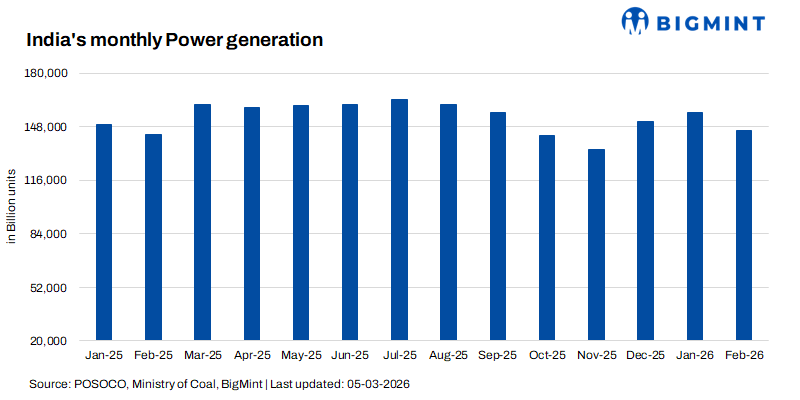
India’s electricity data for February 2026 shows a power system that is growing, diversifying, and quietly preparing for summer. While coal remains the backbone of the grid, renewables are expanding quickly. At the same time, late-February trends suggest that thermal power will still play a critical reliability role when demand rises.
Feb’26 vs Feb’25: Changing generation mix
Since both February 2025 and February 2026 had 28 days, we can compare them directly.

To make this clearer, we use Average Daily Generation (ADG). India’s average daily generation rose 1.8% y-o-y to 5,192 MU/day in February, indicating steady demand growth. However, coal generation fell 2.5% to 3,779 MU/day, suggesting that incremental demand was increasingly met by non-coal sources such as renewables, hydro, and nuclear.
Coal’s share fell from 76.0% in February 2025 to 72.8% in February 2026. The main reason is renewable growth. Renewable generation rose 21% y-o-y. Its share increased from 12.9% to 15.3%. Hydro and nuclear also increased strongly.
The message is simple: India’s total demand is growing, but renewables are capturing most of the incremental growth.
Jan to Feb 2026: Is momentum building?
Since January has 31 days and February has 28, we compare daily averages. India’s average daily power generation increased from 5,039 MU/day in January 2026 to 5,192 MU/day in February 2026, marking a 3.0% m-o-m rise as demand strengthened ahead of summer. Coal generation grew by 2% to 3,779 MU/day, indicating higher thermal dispatch to support rising consumption. Hydropower recorded the strongest growth at 8.3%, while renewable energy sources (RES) increased by 5.7%, highlighting the expanding contribution of non-fossil sources to the overall generation mix.
Despite February being shorter, daily generation increased by 3%. This shows demand momentum is strengthening as India moves toward summer. Coal also increased sequentially by 2% on a daily basis, meaning thermal plants are being dispatched more frequently.
Peak demand is rising
Peak demand in February 2026 remained elevated.
- February 2025 peak range: 228-238 GW
- February 2026 peak range: 235-244 GW
- Highest February 2026 peak: 244 GW
Even after the mid-month high, demand in the last week remained around 238-240 GW. India is operating at higher structural peak levels than last year.
IEX market
The Indian Energy Exchange (IEX) provides important confirmation of system conditions. Despite higher peak demand, average spot prices fell 20%.

This is because sell-side the liquidity exploded. Renewable supply has created a strong cushion in the market. Even when demand rises, prices do not spike as easily. The market is deeper and more efficient than last year.
Late Feb: A preview of summer strategy
The most important insight comes from the last week of February (22-28 February).

During this period:
- Total daily generation consistently exceeded 5,250 MU.
- Coal reached its highest weekly average of the month.
- Several days saw coal generation near 4,000 MU.
- Peak demand hovered around 240 GW.
At the same time, renewable output dipped slightly. This is critical.
When renewable availability eased, coal stepped up. The grid dispatched thermal plants to maintain reliability. Hydro also increased as snowmelt and seasonal flows improved.
This pattern shows that India is preparing for summer by testing its ability to coordinate coal, hydro, and renewables together.
What this means for summer 2026
The February data shows four clear trends:
- Demand momentum is strong: Average daily generation rose 3% from January to February.
- Coal’s share is falling, but not its importance: Coal share dropped to 72.8%, but in late February coal ramped up sharply when needed. Coal is evolving from “always-on baseload” to a reliability anchor.
- Renewables are reshaping price dynamics: Massive sell-side bids on IEX are keeping prices stable even at high demand levels.
- The grid is stress-testing itself: Late-February coal ramp-ups and sustained peak demand around 240 GW suggest that operators are preparing for hotter months ahead.
February 2026 shows a grid that is stronger than last year, more diversified, and better supplied. Yet it also confirms that coal remains the system’s reliability backbone. The real test will come in April, May, and June, when summer heat pushes demand beyond 240 GW. The late-February data suggests India is already preparing for that challenge.
Leave a Reply