- Scrap consumption declines 4% y-o-y in Jan-Aug’26 on lower steel output
- Including EAF-based steelmaking in China’s carbon market key to boost sector
Data Deep Dive: China produced around 651 mnt of crude steel in 8MCY26, of which around 582 mnt came through the BF route and 69 mnt through electric furnace (EF) production. This translates to a BF share of around 89% and EF share of around 11%, highlighting the continued dominance of the BF-BOF route in China’s steelmaking mix.
Monthly BF production declined from 77.81 mnt in March to 66.70 mnt in August, while EF production remained relatively stable at 7.91-9.23 mnt/month. The limited contribution from EAFs has restricted the potential for higher scrap consumption through electric steelmaking, despite China remaining the world’s largest steel scrap consumer.
Historical production trend shows gradual decline
China’s crude steel production has declined from 1,065 mnt in CY20 to 961 mnt in CY25. Output fell to 1,035 mnt in CY21 and 1,018 mnt in CY22 before recovering marginally to 1,029 mnt in CY23. Production then declined to 1,005 mnt in CY24 and further to 961 mnt in CY25.
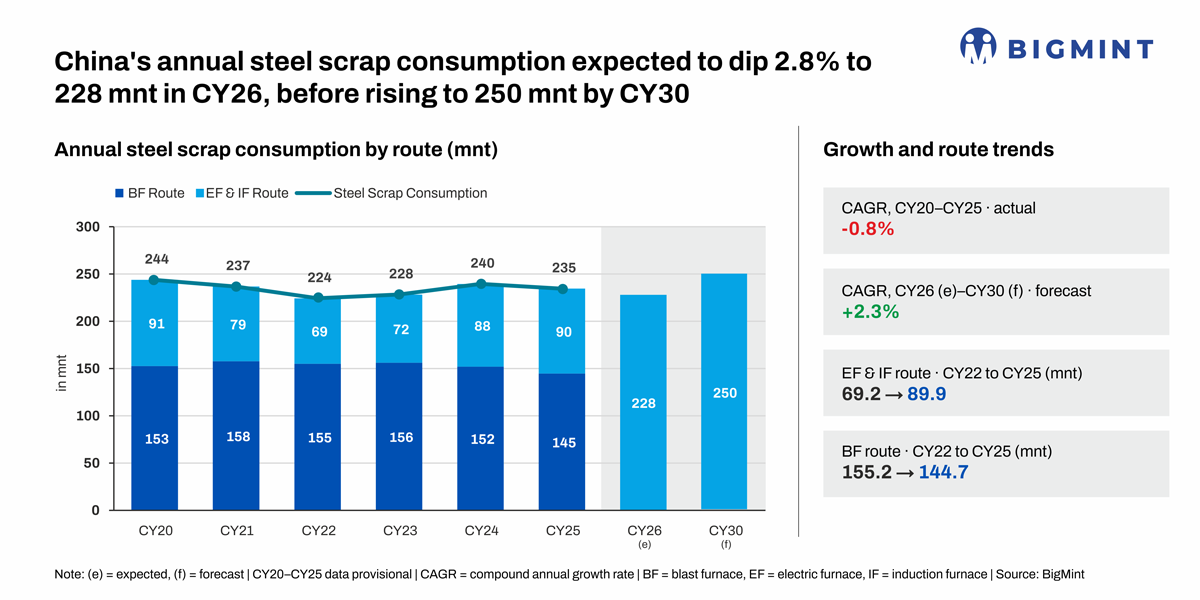
The production decline has also influenced scrap consumption, although the reduction has been less pronounced. Scrap consumption fell from 244 mnt in CY20 to 224 mnt in CY22 before recovering to 240 mnt in CY24 and easing to 235 mnt in CY25.
Scrap consumption declines alongside lower steel output
China’s ferrous scrap consumption declined 4% y-o-y to 164 mnt in 8MCY26, compared with 172 mnt in the corresponding period of 2025. The decline broadly followed weaker crude steel production, which fell 4% y-o-y to 651 mnt from 676 mnt.
China’s scrap consumption declined 6.9% y-o-y to 113.59 mnt in January-July 2026. Scrap consumption per tonne of crude steel fell 4.1% y-o-y to 196.8 kg/t, while converter scrap consumption declined 4.6% to 157.2 kg/t. EAF scrap consumption also fell 2.4% to 564.4 kg/t.
The overall scrap ratio declined to 19.68% from the previous year, while the EAF share of steel production remained broadly stable at 9.73%.

EAF economics remains challenging
China’s low EAF share is closely linked to production economics, particularly electricity costs, scrap availability and finished steel margins. Unlike BF-BOF production, EAF steelmaking is highly dependent on electricity and scrap, making operating economics more sensitive to changes in power and raw material costs.
According to a McKinsey study, China’s DRI-EAF production costs are around 25% higher than those in Oman in its benchmark, while BF-BOF remains substantially more competitive in China. The analysis estimates levelised DRI-EAF steel production costs at around $610/t in China, compared with around $480/t for BF-BOF. Energy costs are a major contributor to the cost difference.
This cost disadvantage has limited EAF utilisation and expansion despite its lower emissions intensity. China’s EAF share remains around 10%, below the government’s earlier target of 15%.
Low EAF utilisation limits additional scrap demand
EAF capacity utilisation in China has remained below that of BF-BOF producers, reflecting weaker economics and volatile steel margins. High electricity consumption, scrap availability and affordability remain key constraints for EAF producers.
The relatively low EAF share also limits the increase in scrap consumption that could otherwise result from a shift away from BF-BOF. However, China’s scrap demand is not dependent solely on EAF production, as converters also consume significant quantities of scrap.
The current production mix therefore remains important for the scrap market. Any sustained increase in EAF production could result in higher scrap requirements per tonne of crude steel, while continued reliance on BF-BOF would keep scrap consumption more closely linked to converter utilisation and overall steel output.
Converter route remains largest scrap consumer
Despite the low EAF share, the converter route remains the largest consumer of scrap in China. Converter/BF-route scrap consumption stood at 145 mnt in CY25, compared with 90 mnt through EF route.
Converter-related scrap consumption therefore accounted for around 62% of total scrap consumption in CY25, while EAF accounted for around 38%.
However, the available data does not indicate an increase in absolute converter scrap consumption. Converter route consumption declined from 152 mnt in CY24 to 145 mnt in CY25, while data show converter scrap intensity falling 4.6% y-o-y in January-July 2026.
This indicates that the key opportunity for higher scrap demand lies in improving scrap utilisation across existing converter operations as well as increasing the share of EAF-based steelmaking.
Capacity replacement, carbon policy to support EAF growth
China’s capacity replacement policy is expected to play an increasingly important role in reshaping the country’s steelmaking mix. The latest policy direction supports capacity optimisation and encourages electric furnaces and other lower-carbon production technologies.
China had previously targeted increasing EAF’s share of crude steel production to 15% by 2025. However, the share remained around 10%, indicating that the target has not yet been achieved.
The expansion of China’s national carbon market could provide an additional policy mechanism for supporting EAF adoption. China officially extended its national carbon emissions trading scheme to the steel sector in 2025, although EAF steelmaking remains outside the allowance allocation framework. This limits the ability of the carbon market to reward the lower-carbon characteristics of EAF production.
A recent analysis by Transition Asia noted that incorporating EAF production into China’s carbon-market framework could provide stronger incentives for the shift towards lower-carbon steelmaking. However, the report also highlights that China’s policy approach would need to account for domestic differences in electricity costs, scrap availability and market conditions.
The combination of capacity replacement, carbon market development and decarbonisation targets could therefore gradually increase EAF penetration, although economic competitiveness will remain the key determinant of actual utilisation.
Outlook
China’s ferrous scrap consumption is expected to remain subdued in CY26, with consumption estimated at around 228 mnt, down from 235 mnt in CY25 and 240 mnt in CY24. This follows a 4% y-o-y decline in 8MCY26 consumption to 164 mnt from 172 mnt. The decline broadly coincided with lower crude steel production, while monthly scrap consumption fell from a peak of 24 mnt in March to 16 mnt in August.
Over the longer term, BF-BOF is likely to remain dominant, but capacity replacement and decarbonisation policies could gradually increase EAF penetration. A higher EAF share would support scrap demand due to the route’s significantly higher scrap intensity, while greater scrap utilisation in converters could provide additional support.
China’s ferrous scrap consumption is forecast to recover gradually to around 250 mnt by CY30, implying a 2.3% CAGR during CY26-CY30. This would take consumption above CY24 and CY25 levels, although growth is expected to remain moderate. The pace of recovery will depend on steel output, EAF economics, electricity costs, scrap availability and the implementation of capacity replacement policies.
Leave a Reply