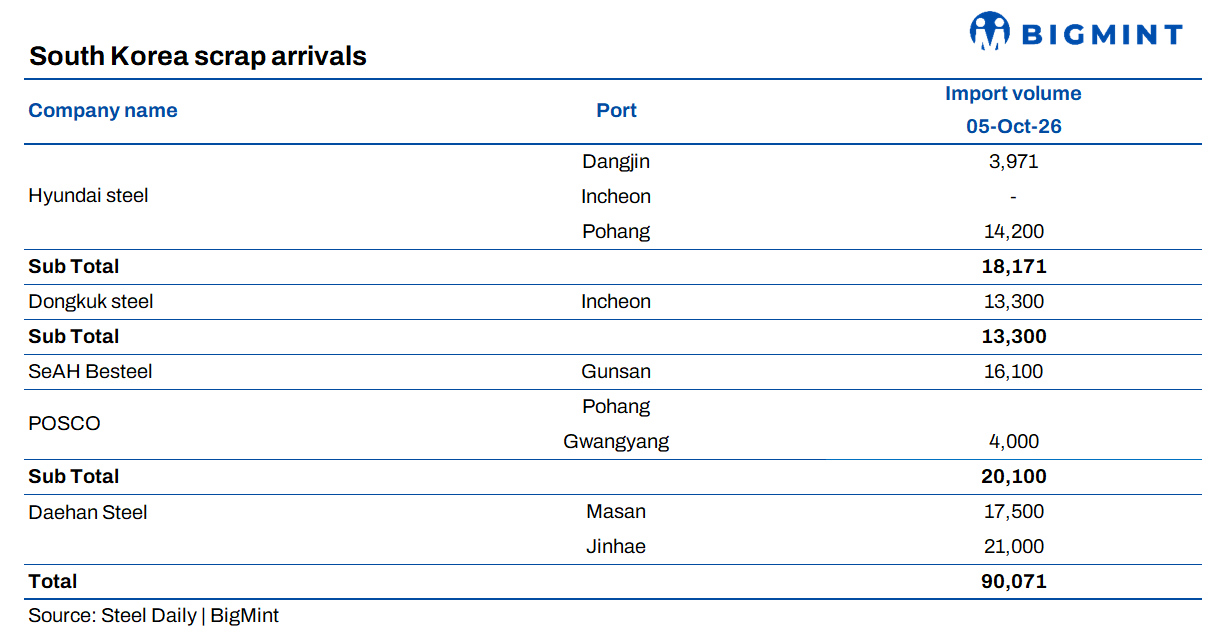
- Southern ports account for 63% of scheduled arrivals
- SeAH Besteel leads company-wise scrap arrivals in October
South Korea’s scheduled ferrous scrap arrivals at major domestic ports reached 90,071 t as of 1 October, the highest level this year and the strongest since early February 2025. The increase comes after a rise in arrivals from September, with the latest four figures averaging 72,643 t, up 28% from the July-August average of 56,758 t. Southern ports accounted for 56,700 t, or 63% of total scheduled arrivals.
Import arrivals by ports
- Jinhae recorded the highest scheduled arrivals at 21,000 t across nine vessels.
- Masan followed with 17,500 t across eight vessels.
- Gunsan recorded 16,100 t across seven vessels.
- Pohang received 14,200 t across six vessels.
- Incheon recorded 13,300 t across five vessels.
- Gwangyang and Dangjin recorded 4,000 t and 3,971 t, respectively.
Meanwhile, activity at South Korean ports extended beyond scrap imports. Masan Port is scheduled to receive around 10,000 t of billets on 5 October, with the cargo believed to be linked to Korea Special Steel. The combined volume at Incheon, Dangjin and Gunsan stood at 33,371 t, accounting for 37% of total scheduled arrivals.
Market updates
The increase in arrivals was largely concentrated in the southern region, with cargo volumes at Masan, Jinhae and Pohang rising sharply since September. Average cargo volume per trip at the three ports increased to around 37,000 t from approximately 11,000 t during July-August. Jinhae’s average rose to 18,125 t from 8,537 t, while Pohang increased to 10,675 t from 1,487 t. Masan, which had remained around the 1,000-t level during July-August, reached 17,500 t in the latest schedule.
By company, SeAH Besteel accounted for the largest volume, with 16,100 t scheduled at Gunsan, while Dongkuk Steel is expected to receive 13,300 t at Incheon. Hyundai Steel’s arrivals totalled 10,171 t, comprising 3,971 t at Dangjin and 6,200 t at Pohang. POSCO’s arrivals stood at 9,000 t, combining 4,000 t at Gwangyang and 5,000 t at Pohang. POSCO’s lower imports compared with June-July are understood to reflect adjustments ahead of the planned overhaul of Gwangyang Blast Furnace No. 2 in November.
Although import arrivals have increased sharply, the higher availability is expected to add downward pressure on the domestic scrap market as southern steelmakers lower their purchasing prices. At the same time, a significant portion of the volumes at Masan and Jinhae have no confirmed destinations and are presumed to be linked to electric-furnace steelmakers in the southern region.
Note: This article has been written in accordance with a content exchange agreement between SteelDaily and BigMint.
Leave a Reply