- Plate steelmakers drive higher scrap procurement across ports
- Mills’ restocking demand strong ahead of peak season from Sep’26
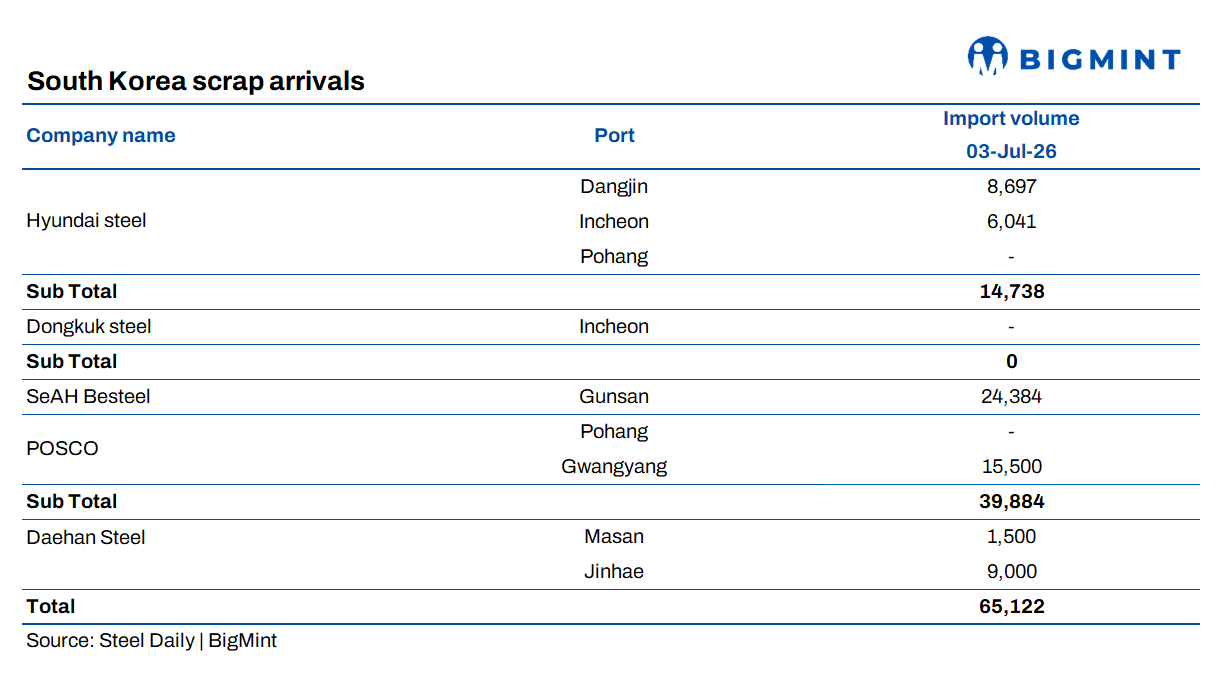
SteelDaily: South Korea’s ferrous scrap import activity strengthened in the first week of July, with declared arrivals at major ports reaching 65,122 t, the highest level since February 2025. This marks a recovery from the relatively low arrivals of the past few weeks, which had led to scrap supply shortages.
Import declarations by companies
- POSCO declared around 15,500 t of imported scrap at Gwangyang Port.
- SeAH Besteel and POSCO together imported 39,884 t, accounting for 57% of total declared imports.
- Hyundai Steel declared 6,041 t for its Dangjin works, representing 9% of total imports.
- Dongkuk Steel completed unloading declarations for 13,200 t across four cargoes at Incheon North Port, including 8,700 t of imported scrap and 4,500 t of domestic material.
- Gunsan Port recorded the highest declared arrivals at 24,384 t.
- Jinhae Wharf handled around 9,000 t, while Masan Port recorded 1,500 t.
Meanwhile, activity at South Korean ports extended beyond imports. A 15,000 t scrap cargo departed from Dangjin’s Godae Wharf for Thailand via Hong Kong on 2 July, while around 15,000 t of imported billets for Daehan Steel’s Pyeongtaek plant are expected to arrive around mid-July.
Market updates
The increase in imports was largely driven by plate and speciality steel producers, while procurement by long steel producers remained relatively modest. Despite higher inventories, Hyundai Steel maintained limited import activity during the week.
Although the recent supply crunch has eased, with inventories at top steelmakers rising sharply, stockpiling demand remains strong. This is because a significant number of steelmakers maintain that they need to build up further stock to ensure a stable supply of scrap during the peak season from September onwards. Additionally, while mills have reduced scrap purchasing prices amid increased inventories and ample incoming supplies, stock levels are not yet so excessive; consequently, demand for scrap is expected to continue despite the price cuts.
Moreover, POSCO’s steel scrap purchases are set to return to normal in the second half of the year. Purchase volumes, which had fallen sharply in the first half due to plant maintenance, are expected to recover to between 160,000 and 190,000 t per month.
POSCO attributes the decline in scrap steel consumption in the first half to a reduction in molten steel production at the Pohang Steelworks due to maintenance work. The Pohang Steelworks purchased an average of approximately 30,000 t of steel scrap per month. In the second half of the year, as production returns to normal, this figure is expected to rise to 60,000-70,000 t per month, returning to its usual level.
Note: This article has been written in accordance with a content exchange agreement between SteelDaily and BigMint.
Leave a Reply